 Verbamor
Two lapses means struggling, 80 days means mastered
A word list records that you once met a word. It says nothing about whether you can still produce it. Verbamor's Library instead tracks each word as a dated retrieval attempt in two directions, recognition and recall, and marks a word mastered only after roughly 80 days of stability, or struggling once it's beaten you twice.
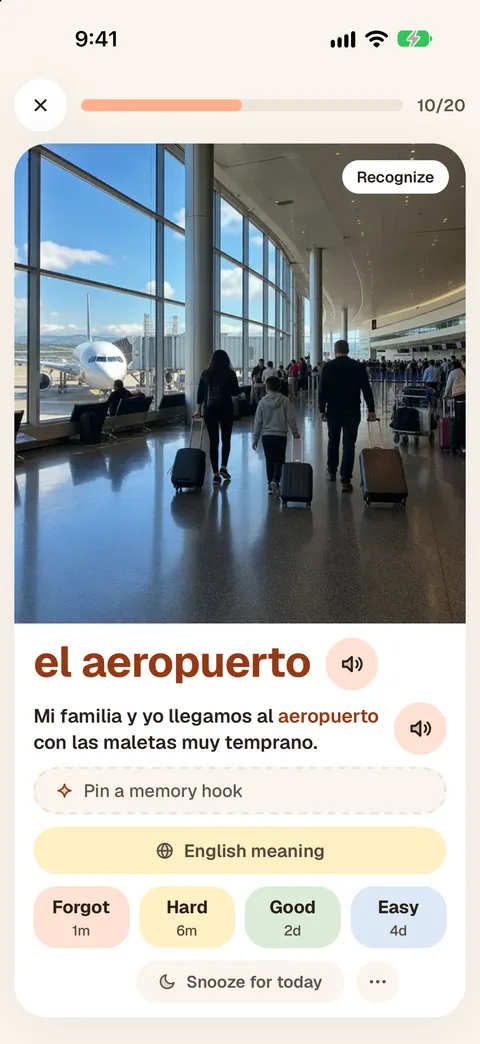
Verbamor turns the words from your own lessons and recordings into flashcards, and brings each one back before you’d forget it.

Open the notes app on your phone and search for the last Spanish word you wrote down. Mine was madrugada, the small hours before dawn, typed during a tutor lesson in March. I found it in a note with 84 other words.
I couldn't tell you which of the 84 I can still say out loud, and which are gone. The note recorded that I once met the word. It recorded nothing about whether I kept it.
A list of words you've written down grows every week and tells you less every week. What you want to know is narrower and harder: for each word, can I produce it right now, cold, without the answer in front of me?
A word list measures exposure, and exposure predicts little
A list measures exposure. You met the word, you wrote it down, the count went up by one. Exposure is easy to record, and it's a weak predictor of whether the word is available to you in conversation.
Karpicke and Roediger showed how weak, in a 2008 paper in Science. College students learned 40 Swahili-English word pairs. Each time a pair was recalled correctly, it was dropped either from further study or from further testing.
Dropping a pair from further study cost nothing. Dropping it from further testing cut final recall by more than half.
A week later, the students who kept being tested on every pair recalled about 80% of them. The students who kept studying every pair, but stopped being tested on one once they'd recalled it, got 36%. Extra exposure bought almost nothing once the words had been seen.
Recalling a word once and then writing it down is the 36% condition. Rereading the list later doesn't move you out of it.
The students couldn't feel the difference, either. Every group predicted it would recall about half the pairs, and those predictions were uncorrelated with how they actually did.
A list holds no record of a retrieval attempt, so it can't tell you which of those words you kept. Neither can your own sense of it.
A useful record needs a different unit: "on this date I tried to produce this word cold, and here is what happened."
The unit that works: one retrieval, dated
Verbamor's Library is built on that unit. Every word you save becomes a card, and every card carries the history of your attempts to produce it.
Which direction you can do. Each word is tracked in two directions independently. Recognition: you see the Spanish, you produce the English. Recall: you see the English and a gapped sentence, you produce the Spanish.
These are different abilities and they decay at different rates. Most learners are far stronger on recognition, which is exactly why a list feels reassuring and a conversation doesn't.
The Library shows the weaker of the two directions rather than the average, so a word you can read but can't say never reads as finished.
How durable it is, and when it comes back. Each direction carries a stability value from FSRS, the scheduler that predicts when you're about to forget. Stability is measured in days: it's the time required for your chance of recalling the word to fall from 100% to 90%.
Verbamor turns that into one durability number per word, and the thresholds are fixed. Past roughly 80 days of stability a word is marked mastered. Below that it's learning.
The same number sets the next due date, which a last-seen date can't give you. Last-seen tells you when the word was in front of your eyes. Due tells you the day the scheduler expects it to start slipping.
Whether it's fighting you. A word counts as struggling when you're currently relearning it, or when you've forgotten it twice after learning it and haven't yet recovered. Two lapses is the line.
This is deliberately different from "new and shaky": a word you started last week and keep getting right is learning. Struggling means the word has beaten you more than once.
After four weeks, the struggling filter tells you the most
Say you record two tutor lessons a week and save around 15 words and phrases from each. After four weeks that is roughly 120 cards. Open Library and the strip at the top of the screen shows three numbers: total, due today, and mastered.
At week four the mastered number is still zero or close to it, and that's the correct reading. Mastered needs about 80 days of stability, and no word you met three weeks ago has had time to earn it.
Expect the bulk of your collection sitting in learning, some in struggling, and whatever you saved but haven't started sitting in new.
The filter chips are where the record starts paying. Six of them: all, due today, new, learning, struggling, mastered.
Tap struggling and you get the list of words that have beaten you at least twice. Those are the ones worth taking to your next lesson. You now have their names, instead of a vague feeling that some words aren't sticking.
Here's what a card that has been through four weeks of this looks like. The trace below is composed from a real study log with the dates shifted, so treat it as the shape of the record rather than a specific learner.
You saved acogedor, cosy, on 3 March from a lesson recording. Recognition: started 4 March, seven attempts, one lapse, next due in 19 days. Recall: started 4 March, seven attempts, three lapses, currently relearning, due tomorrow.
The Library shows the recall direction, because it's the weaker one, so the word reads as struggling.
A word list would show you acogedor, cosy. The record shows you that you can read it and can't say it, and that this has now been true three times.
Search ignores accents and matches both sides of the card, so typing "casse" finds cassé and typing "cafe" finds café. You can search the English gloss too.
That matters more than it sounds. The moment you actually want a word back is the moment you're trying to say something in English and reaching for the Spanish.
You can also scope the whole view to one deck, and the three numbers at the top recalculate for that deck alone. That is how you check whether one specific tutor's vocabulary is holding up.
Do this today, in about ten minutes
You don't need a month of data for the record to be worth having. Run this now.
- Find the last piece of audio from a real lesson or conversation. A voice memo works. Import it in Record.
- Let it transcribe and mine the words and phrases you met. Multi-word phrases get mined too, so me da igual stays together instead of breaking into three words that mean nothing apart.
- Select 10 to 15 to keep. Fewer than you want to. Keep the words you tried to say in the lesson and couldn't, and skip the ones that only looked interesting on the page. The words you keep get an example sentence, an image, and two recordings of that sentence: one with the answer replaced by a tone, one complete.
- Open Library, switch to list view, and read the 15 statuses. They'll all say new, because you haven't tried to produce any of them yet.
- Study them once. Now read the statuses again.
Step 5 is the point. Ten minutes in, the record contains something a note never contains: which of the 15 words came out of your head, and which didn't.
Three cases where you don't need this
Three honest limits.
If you're learning from a fixed course that already tracks its own vocabulary, you have a record. It records the course's words rather than yours, which is a real difference if you have a tutor. But a second tracker on top of a working one is busywork.
If you already run Anki and are happy in it, Anki tracks all of this and more. It ships SM-2 (an older scheduling formula) by default, with FSRS available under the deck options. Once you enable FSRS you're running the same algorithm family.
The cost is that Anki ships no language content of its own. The example sentence, the image and the two recordings are yours to make, per card, forever.
Gabriel Wyner, who wrote the standard guide to doing this well, timed himself at 110 Russian cards in an hour and a half. He puts the ongoing cost at "2-3 hours a week for card creation to maintain a 25 new cards/day habit". At his rate the 120-card collection above costs you about 100 minutes at the keyboard before a single review.
In Verbamor the equivalent work is step 3 above: you tap the words you want in the mined list, and the sentence, image and two recordings are generated for them. Your authoring work is the tapping. That's the trade, and for some people making the cards is the study.
And if you're learning a language Verbamor doesn't teach, it can't help you. For English speakers it teaches Spanish, French, Italian, Portuguese, Russian and German, and nothing else.
The 17 self-study hours go uncounted
The Foreign Service Institute, the US State Department's language school, publishes what full-time instruction costs for languages close to English. Category I, which includes Spanish, French, Italian and Portuguese, runs 24 to 30 weeks and 552 to 690 class hours. Spanish and French sit at 30 weeks.
The same page gives the shape of a typical week: 23 hours in class and 17 hours of self-study.
Those 17 hours are where a record earns its place. Class time is scheduled and someone else counts it.
The self-study goes uncounted, and at the FSI rate it's 68 hours across the four weeks described above.
Put the four-week reader against that number. Two lessons a week and 15 cards each is 120 cards, tracked in two directions. That's 240 separate things the scheduler is asking you about, each one carrying its own dated attempts and its own lapse count.
The acogedor trace shows what that buys per direction: seven dated attempts, and a lapse count that says which direction failed. FSI's learner has 68 self-study hours in the same four weeks and no such number for any of it.
So use the struggling count as the check, and read it against the two-lapse line that defines it.
A struggling list of zero after four weeks means you haven't been retrieving cold. Two lapses is a low bar, and honest recall practice will push some words over it.
A list that keeps growing week over week means you're saving faster than you can study, and step 3 is where you fix it. Open Library tomorrow morning and read that one number.
Sources
Testing beats re-exposure a week later
- Karpicke, J. D., & Roediger, H. L. (2008). The critical importance of retrieval for learning. Science, 319(5865), 966–968.
What making your own cards costs
- Wyner, G. How long does making cards take? Fluent Forever blog.
FSI weeks, class hours and self-study
- US Department of State. Foreign Language Training. Foreign Service Institute.
Know which words you've actually kept.
Verbamor logs every retrieval attempt by date and direction, so instead of a list of words you once wrote down, you get a record of what you can still say.
Start 7 days freeThe 7-day free trial is on the yearly plan.