 Verbamor
47 minutes of Spanish, 22 candidates, 14 cards
A 47-minute Spanish lesson produced 22 candidate words, and only 14 were worth keeping as flashcards. The keepers came mostly from three tags: struggled, corrected and gap, ranked by how hard you'd fought for the word rather than by whether the tutor happened to say it. A word you reached for and never produced, like cambiar dinero, still earned a card, because the reach itself was the evidence.
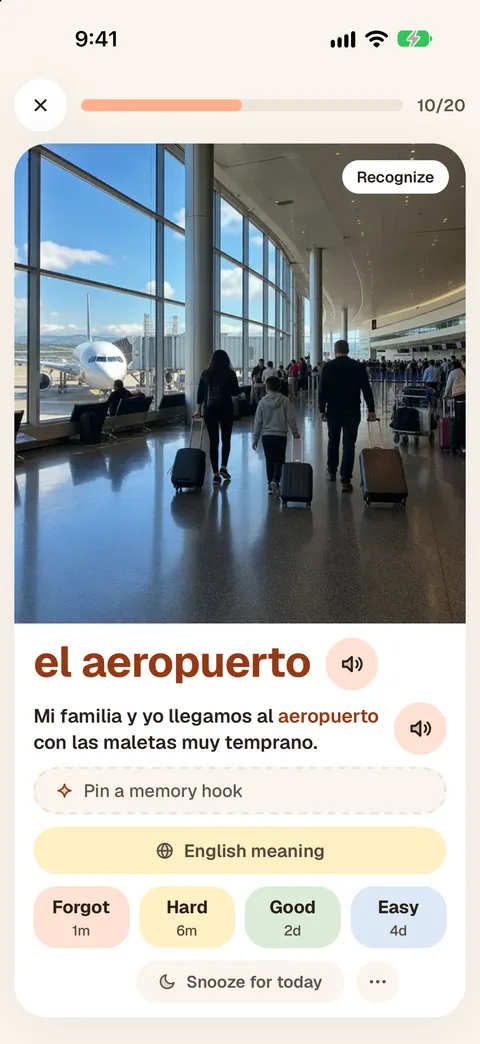
Verbamor turns the words from your own lessons and recordings into flashcards, and brings each one back before you’d forget it.

A 47-minute Spanish lesson transcribes to about 38,000 characters. Somewhere in there are maybe fourteen words worth keeping. The rest is greetings, your tutor saying "muy bien," and the same six words repeated eleven times each.
The hard part of making flashcards from a lesson is deciding which fourteen. Typing them takes a few minutes. Choosing them is the whole job.
Here's one lesson run all the way through, with the decisions shown.
A 47-minute lesson becomes a transcript read in about 10 parts
The recording is a conversation lesson about a trip. You talk, the tutor corrects, you talk again. Verbamor lets a single recording run to 90 minutes, so a 47-minute lesson fits with room left over.
The audio is transcribed with speaker labels, so the transcript knows which lines are yours and which are the tutor's. That distinction does real work later.
Then the transcript is cut into parts of about 4,000 characters. It's split only on speaker turns, so no part begins mid-sentence.
This lesson makes about 10 parts, and a 90-minute recording can take up to 28. Each part is read separately and the results are merged.
Seven tags rank each word, and your fumbles rank highest
Every candidate word comes back tagged with why it was chosen. There are exactly seven tags, ordered from most earned to least:
- struggled: you reached for the word and it came out badly, with a hesitation, a self-correction, or a mangled form.
- corrected: the tutor supplied it or fixed it after you got it wrong.
- gap: you needed it and never produced it at all. You said it in English, talked around it, or trailed off. The word you were reaching for is inferred.
- taught: the tutor introduced, explained or drilled it at you.
- used: you produced it correctly, and it's still worth reinforcing.
- related: topic vocabulary you didn't say, only offered when you named a theme instead of recording a lesson.
- personal: tied to your own work, your people, your routine, your city.
This ordering is the whole method. A word you fumbled outranks a word your tutor happened to say.
The transcript keeps speaker labels precisely so the difference between "you couldn't say it" and "the tutor said it" survives into the tagging.
The gap tag is the one that pays for the transcript. In this lesson you said "I want to, uh, the thing where you change money." Every word of that is English, so a search of the transcript for Spanish vocabulary turns up nothing here.
The reach is still visible. cambiar dinero comes back tagged gap, with a note saying what you were trying to say.
You can't get that card by highlighting words in a textbook, because the word never appeared.
The 47 minutes produced 22 candidates, and 14 were worth keeping
The lesson returned 22 candidates: 17 single words and 5 phrases. Verbamor caps a whole recording at 60 words and 30 phrases after deduplication (removing repeats), so these ceilings were never near binding.
Deduplication matters more than the cap. Your tutor said aduana (customs) six times across three chunks. The first chunk to surface a word owns it, so it appears once, attached to where it was actually taught.
Here is the full 22, tag by tag, with the eight discards marked:
- 2 struggled, both kept: el equipaje (luggage), which you said as "el equipajo" twice, and fuera, the past subjunctive of ir, which you built wrong.
- 3 corrected, all kept: hacer cola (to queue), after you said "estar en línea"; el vuelo (the flight), after you said "el vuelvo"; facturar (to check in luggage), after you tried "checkear."
- 4 gap, all kept: cambiar dinero (to change money), el mostrador (the counter), retrasado (delayed), la tarjeta de embarque (boarding pass).
- 6 taught, 3 kept: aduana (customs), la puerta de embarque (the gate) and el pasillo (the aisle) stayed. el aeropuerto, la maleta and el billete were dropped, because you had already used all three correctly earlier in the same lesson.
- 5 used, 1 kept: caber (to fit), kept because you produced it once and hesitated first. viajar, la ventana, esperar and llegar were dropped as words you have had for a year.
- 2 personal, 1 kept: you are a nurse, so el turno de noche (the night shift) and la enfermera (the nurse) both came back. el turno de noche stayed. la enfermera was dropped, because you say your own job title in every lesson already.
That fuera entry deserves a note. A conjugation card only gets minted when you actually got a specific form wrong, and it lives separately from its own infinitive.
So fuera and ir are two different cards, on purpose. You know the verb already, and the specific form is the thing that beat you.
Fourteen of the 22 got kept. The eight drops are the three taught words you'd already said correctly, the four easy used words, and one personal word you never forget.
A picker that shows you why each word is there makes throwing eight away a two-second decision. You don't have to argue with yourself.
Each card blanks the word out of a sentence you hear
Take el mostrador. The card that gets built has:
- The headword with its correct definite article, because the article is part of the word.
- A short example sentence with the answer left blank.
- The exact inflected form, with the right ending, that fills that blank.
- The English translation of the whole sentence.
- IPA, the phonetic spelling, for the headword.
- An image showing the same scene the sentence describes, with no text in it.
- Two recordings of the sentence: one where the answer is replaced by a tone, one read complete.
The front of the card plays the clip with the tone, so you hear the sentence with a hole in it and produce the word into the hole. The back plays the full read.
A single recording can't do both jobs, because a recording that says the answer can't test the answer.
The cloze blank, the gap in the sentence, is doing the same work. Roediger and Karpicke ran two experiments on this in Psychological Science in 2006.
Students read prose passages, then either took free-recall tests on the material or reread it the same number of times. A final test came 5 minutes, 2 days or a week later.
At 5 minutes the rereading group did better. At 2 days and a week the tested group did substantially better. The rereading group was also more confident it would remember the material.
A card that lets you feel you knew it is trading a week of retention for a pleasant five minutes.
The image needs one honest caveat. Carpenter and Olson (2012) found Swahili words were not learned better from pictures than from English translations. Learners were more overconfident recalling from a picture.
Pictures only won once that overconfidence was corrected by retrieval practice or an explicit warning.
The image on a Verbamor card sits next to a blank you have to fill. That's the retrieval-practice condition from that paper, not the picture-alone one. Take the image as a route to the meaning, and don't read it as evidence you know the word.
Four weeks later, the gap cards still need the most work
The 14 cards enter a queue scheduled by FSRS, an algorithm that fits a memory model to each card from your own grades and targets 90% recall by default.
At four weeks, the shape is predictable, if unimpressive. The three taught airport nouns are mostly done, sitting at intervals of two to four weeks, because they were never hard.
El equipaje has been failed twice and keeps coming back in days. That's correct: you had it wrong twice in the lesson too.
Fuera is the slowest card in the set and will still be around at month three.
The four gap cards are the interesting ones. They're the words you couldn't say, so they arrive with no prior memory to build on, and they need more reviews than anything else in the batch.
They're also the only four cards in the deck that fix a thing you demonstrably couldn't do.
Failing them is fine, and it's worth more than a clean pass on an easy card. Kornell, Hays and Bjork (2009) ran six experiments with materials designed so retrieval would fail.
Unsuccessful attempts still enhanced later learning, compared to being shown the answer straight. Their materials were general-knowledge questions and word pairs, not foreign vocabulary, so don't stretch the finding further than it goes.
Here's who should ignore all of this. If you're three lessons into your first language, the fourteen words from any given hour aren't the constraint on you. Grammar is. Card the handful you actually fumbled and spend the rest of the time talking.
This method earns its keep once you're having real conversations and losing real words out of them. That's roughly where "I understood the whole lesson and remember none of it" starts happening every week.
Record your next lesson, then look only at the items tagged struggled, corrected and gap. If there are fewer than four, keep them all and go do something else.
The word you couldn't say still gets a card.
Verbamor tags every candidate by how you actually met it, struggled, corrected, gap, so the words worth reviewing are the ones your own lesson proved you needed.
Start 7 days freeThe 7-day free trial is on the yearly plan.