 Verbamor
How much of a paid lesson hour you actually keep
Count the new words from your last tutor lesson, then try to say them out loud right now. The count tends to be humbling. The tutor was good and the hour was good; what's missing is the roughly 45 minutes of solo review FSI's own ratio says should follow every hour of class, spent testing yourself rather than rereading notes.
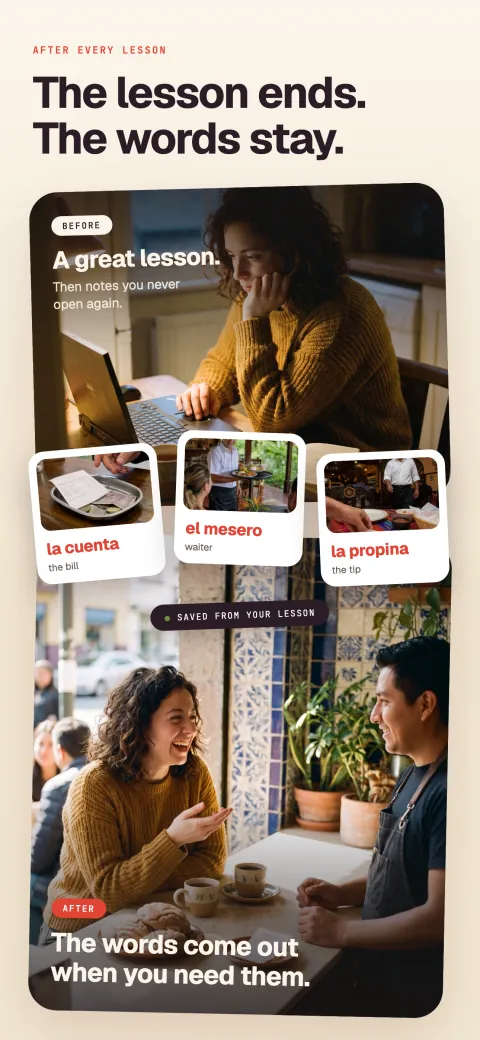
Verbamor records your lesson and turns what your tutor taught into cards that come back on schedule.

Count the new words from your last lesson. Not the ones you already knew: the words your tutor gave you, corrected you on, wrote in the chat box. For most people it's somewhere between 8 and 20.
Now say them out loud, right now, without looking at your notes.
Count how many arrive. Whatever that number is, it's the real answer to "am I wasting money on tutors".
The hour was good. The tutor was good. Six days later you're carrying a fraction of it into the next lesson, and you pay for the next lesson at full price anyway.
The hour is fine. The six days after it are the problem
A tutored hour is one of the better ways to spend an hour on a language. You speak. You get corrected in real time.
You hear a real person choose real words. Nothing here argues against booking one.
The money question sits somewhere else. You buy an hour of input, and then your memory spends the next week deleting most of it. Whatever survives to the next lesson is what you actually bought.
Jaap Murre and Joeri Dros ran a careful replication of Ebbinghaus's original forgetting experiment and published it in PLOS ONE in 2015. One subject spent 70 hours learning lists and relearning them after gaps of 20 minutes, 1 hour, 9 hours, 1 day, 2 days, 6 days and 31 days. Savings, meaning how much easier the relearning was, dropped fastest in the first hours and kept falling across the month. The authors call it a successful replication of Ebbinghaus's 1885 curve.
Two cautions before you take that curve to your own lesson. The material was nonsense syllables, which are harder to hold than meaningful words in a sentence you understood. And it's one subject.
So don't read it as a percentage of your lesson. Read the shape: the steep loss happens in the first day, and by the time your weekly lesson comes around, the curve has already done most of its work.
That shape is why the lesson feels productive and the month feels flat. Each hour lands. Each hour then drains, and the next hour starts partly from scratch.
FSI budgets 17 hours of self-study for every 23 in class
The US Foreign Service Institute (FSI), the State Department's language school, publishes its own language timelines. For Category I languages, the ones closest to English, it lists 24 to 30 weeks and 552 to 690 class hours.
Spanish and French are both 30 weeks. Italian and Portuguese are both 24.
The same page carries a line nobody quotes. "A typical week is 23 hours per week in class and 17 hours of self-study."
FSI plans 17 hours of solo work for every 23 hours with a teacher. That is a ratio of about 0.74 hours alone for every hour taught. These are full-time diplomats in an intensive program, and the institution that does this for a living still budgets almost as much time outside class as in it.
Now scale that ratio to a normal life. One hour with a tutor per week implies about 45 minutes of solo work over the following days.
Forty-five minutes, split across a week, is under 7 minutes a day.
Most learners who feel like they're wasting money are running the class hours at close to full intensity and the self-study hours at close to zero. The part that broke is the self-study.
Lesson content leaks in three ways, and each needs its own fix
Watch what actually happens to a word after your tutor says it. There are three separate failures, and they need different fixes.
The word never got written down. Your tutor says something useful at minute 41. You nod. It goes nowhere.
At the end of the hour you can't reconstruct it. You never had it in any form outside your working memory, and working memory is gone by dinner.
The word got written down and never got looked at again. This is the most common one. Notebooks, the chat panel in italki's classroom, a notes app.
The record exists. Nothing ever triggers you to open it. A note you don't reopen is a record of a lesson and nothing more.
The word got looked at but never got recalled. You reread the list. It all looks familiar.
Familiar is what rereading produces, and familiarity is a poor predictor of whether the word will arrive when you need it in a sentence.
That third failure has the best evidence behind it. Karpicke and Roediger tested this in Science in 2008 with 40 Swahili-English word pairs.
Students who kept testing themselves on the pairs recalled about 80% a week later. Students who kept restudying pairs that had been dropped from testing recalled 36%.
Students in every condition predicted they would get about 50%, and the paper reports those predictions were uncorrelated with actual performance.
That last detail is the one that costs money. Rereading your lesson notes feels like the work is done. The feeling and the outcome come apart, so you go into the next lesson confident and empty.
A 20-minute weekly routine for your next lesson hour
This is small on purpose. It has to survive a normal week.
During the lesson, keep one running list. Keep it in one place. Every new word or phrase your tutor gives you goes on it, plus the correction they made to something you said wrong.
Get it all down and worry about neatness later. The corrections matter more than the new words, because a correction is proof of a gap you didn't know you had.
Within a few hours, cut the list to 10. You'll have more than 10. Keep the ones you'll plausibly say this month, and delete the rest without guilt.
A tutor once gave me the word for a type of roof tile. It was interesting. It's gone, and that was the right outcome.
That same evening, write each one into a sentence you'd actually say. Use your own sentence, about your job or your weekend, instead of the tutor's example.
Slamecka and Graf described the generation effect in 1978: material you produce yourself is remembered better than the same material you read. Writing your own sentence is the cheapest version of that.
On day 2 and day 4, test yourself cold. Cover the target language side. Say each one out loud from the English before you look.
Say it out loud rather than thinking it, so you can't quietly revise a near-miss into a pass. Ten items takes about 3 minutes.
Before the next lesson, run the list once more and mark the misses. Those are your first three minutes of the next lesson. Now the hour you paid for starts by repairing known holes.
Total cost: roughly 20 minutes across the week. Against FSI's implied 45, it is a light version, and it is close to what a normal person will actually do.
On spacing the touches, the honest position is a range. Cepeda and colleagues reviewed 317 experiments on distributed practice in 2006. They found that the gap producing the best retention grows as the delay before your test grows.
For a one-week cycle, a couple of touches spread across the week fits that pattern. Treat day 2 and day 4 as a rough shape rather than tuned numbers. The point is that a touch lands before day 7.
True beginners and people with a poor tutor need a different fix
Some people genuinely are wasting money on tutors, and a study routine won't fix it.
If you're a true beginner in week one, an hour of one-to-one conversation is an expensive way to learn how the alphabet sounds. Get a few weeks of basic vocabulary and sound patterns from anything cheaper first, then hire someone.
If your tutor spends the hour talking about the tutor, or reading a textbook at you that you could read alone, you have a tutor problem. On italki you can book a trial with someone else this week.
On Preply, note that a subscription is tied to one tutor and runs in 28-day cycles. Unscheduled lessons expire at renewal and don't carry over, so switching has a different cost there.
And maybe you book a lesson mainly because it puts one hour of speaking in your week, and you're honest that you're buying practice rather than progress. That's a fair purchase. Just don't expect the vocabulary to accumulate.
The rest of us are in a narrower position: good tutor, good hour, and a leak in the six days after it.
Do this with the lesson you already had
Start with the lesson you already had. Open those notes right now, before you book the next one.
Write down the 10 items worth keeping. Put each in a sentence about your own life. Then tomorrow, before you look at any of it, say all 10 out loud from the English.
Count how many arrive. That number is what you kept from the hour you already paid for, and it is the only figure here measured on you.
Keep more of the hour you paid for.
Verbamor records or imports the lesson, pulls out what your tutor actually corrected you on, and schedules it for retrieval practice, so the words don't leak out before your next session.
Start 7 days freeThe 7-day free trial is on the yearly plan.