 Verbamor
Share the source, keep the review queue separate
Two people start learning Spanish together, and by week three one is ahead on vocabulary while the other is ahead on listening. The scheduler is why a shared study session breaks down: FSRS fits its 21 parameters to one person's forgetting curve, and a merged deck blends two curves into a description of neither. The fix is sharing the source material and keeping each person's review queue separate.
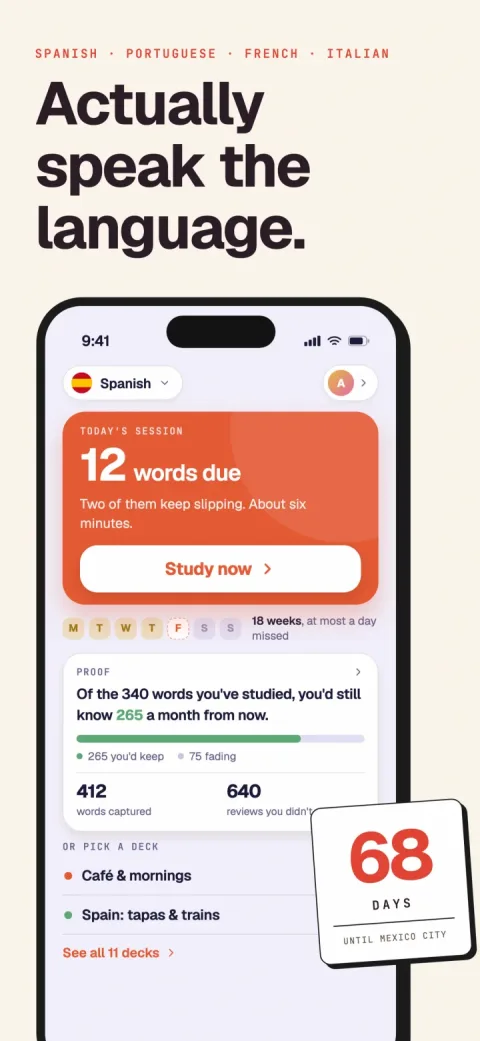
Verbamor opens on one short session a day: the words that are due, and about how long they’ll take.

Two people decide to learn Spanish together. Week one, they do everything side by side.
Week three, one of them is ahead on vocabulary and behind on listening, and the other is the reverse. The shared study session has turned into one person waiting.
Two learners can share material, sources and a schedule. They can't share a memory.
Share the source, and keep separate review queues
The part worth sharing is the input: the podcast episode, the lesson recording, the article, the song. Both of you meet the same words in the same context, so you have something to talk about later. "The word from the taxi bit" means something to both of you.
The part to keep separate is the review queue. FSRS-6, the open-source algorithm that predicts when you're about to forget each card, carries 21 numeric parameters. Its optimizer computes them from your own review log.
Anki's manual says the FSRS optimizer "uses machine learning to learn your memory patterns and find parameters that best fit your review history." Those 21 numbers describe your forgetting alone.
Press Again on a review card in Anki and that card lapses: it goes through relearning steps. The same manual says a card with blank relearning steps "will be assigned a new interval of 1 day by default." The Minimum Interval after relearning also defaults to one day.
So a card you had earned up to a 60-day gap comes back tomorrow because your partner forgot it. That lapse is now a row in your review history, the only thing the optimizer reads.
Run a shared deck for a few months and those 21 parameters get fitted to a blend of two forgetting curves, which describes neither of you.
Check which scheduler your partner has before you conclude one of you is broken. Anki ships the older SM-2 scheduler, and FSRS is opt-in: the manual has you switch it on at the bottom of the deck options page.
Agree on what you both listen to this week. Never agree on what you both review today.
The routine takes twenty minutes each, plus one short call
It takes about twenty minutes each, separately, plus one short conversation.
- Pick one source a week, together. One podcast episode, one video, one article, one recorded lesson. Twenty minutes of audio is plenty, and a short piece you both finish beats a long one one of you abandons.
- Each of you mines it alone. Import the audio or paste the text into your own app, and pick your own words.
- Study your own queue on your own days. No coordination. If you review daily and your partner reviews four times a week, nothing breaks.
- Talk for ten minutes at a fixed time. Same slot every week. Use the source as the agenda, so neither of you has to invent something to say.
- In week two, check that step 2 is happening. The signal is specific. Your partner turns up having listened to the episode but with no words pulled from it, and the three-words-each block collapses into you talking. Say so that week, before month two. Ask them to bring three words next time. If week three looks the same, drop the call to once a month and keep picking sources for yourself.
Two accounts, no family plan. Pricing is at the end.
One 20-minute episode holds roughly 130 to 200 words past rank 1,000
I took five episodes of the Duolingo Spanish Podcast from the same "Costumbres" season. They were 103 (siestas in Spain, published 3 March 2022), 104 (monigotes in Ecuador), 105 (asadoras in Argentina), 106 (piñatas in Mexico) and 107 (quinceañeras in the U.S.).
From each I pulled only the storyteller's Spanish, skipping Martina the English host: 137 passages and 4,738 running words. Each episode runs about 20 minutes with her narration, and the Spanish comes to roughly 950 words of it.
I counted surface forms (each spelling as written) and didn't lemmatise, so quedar and quedarse are two entries. I ranked every form against the OpenSubtitles Spanish frequency list in the FrequencyWords project, the 50,000-line es_50k.txt file.
Run it on your own episode. The transcript sits on the episode page under an <h2> heading that says Transcript, each speaker's name in bold at the start of their paragraph. Copy the passages from your storyteller only, one paragraph per line, speaker label included, as 103.txt. Then get the frequency file:
curl -sO https://raw.githubusercontent.com/hermitdave/FrequencyWords/master/content/2018/es/es_50k.txtSave this as rank.py next to it:
import re, sys
rank = {}
for i, line in enumerate(open("es_50k.txt", encoding="utf-8"), 1):
    rank.setdefault(line.split(" ")[0], i)
def words(path):
    text = re.sub(r"(?m)^\s*\w+:", " ", open(path, encoding="utf-8").read())
    return set(re.findall(r"[a-záéíóúüñ]+", text.lower()))
cut = int(sys.argv[2])
seen = set()
if "--seen" in sys.argv:
    for p in sys.argv[sys.argv.index("--seen") + 1:]:
        seen |= words(p)
for w in sorted(words(sys.argv[1]) - seen, key=lambda w: rank.get(w, 10**9)):
    if rank.get(w, 10**9) > cut:
        print(rank.get(w, "unlisted"), w)
Run python3 rank.py 103.txt 1000 and it prints every word past rank 1,000, commonest first, in well under a second. That regex line strips the speaker labels, which is why joan doesn't show up as a Spanish word.
The --seen argument subtracts the vocabulary of episodes you've already worked through: python3 rank.py 103.txt 1000 --seen 104.txt 105.txt 106.txt 107.txt. Here's what the five episodes print at two cutoffs.
| Episode | Past rank 1,000 | Past rank 2,000 | Between the two | Share (%) |
|---|---|---|---|---|
| 103 | 156 | 110 | 46 | 29.5 |
| 104 | 126 | 93 | 33 | 26.2 |
| 105 | 199 | 160 | 39 | 19.6 |
| 106 | 194 | 147 | 47 | 24.2 |
| 107 | 175 | 129 | 46 | 26.3 |
The share between the two cutoffs runs from 19.6 to 29.5 percent, median 26.2. One episode carries roughly 130 to 200 words past rank 1,000, a quarter of them in the band between the two cutoffs.
Two selection rules pull different words from the same episode
I can't show you two people, so here's the weaker thing I can show: the same episode mined under two rules.
Rule one keeps only the words past rank 1,000 that are new after the other four Costumbres episodes, which models a learner with prior exposure to the series. Rule two works down the same list from the commonest word, which models a learner starting cold. Both rules read all 156 words past rank 1,000 in episode 103.
State the obvious objection first, because it sank my earlier version of this test.
If you cap two lists at the same length and they share most of their words, the leftovers must split evenly. That symmetry comes from arithmetic and proves nothing. So here are three caps.
Uncapped, rule one keeps 128 words and rule two keeps all 156. The overlap is 128 and the exclusives are 0 and 28. Rule one produces a strict subset of rule two, and the divergence is entirely one-directional.
Cap both at 131 and the overlap falls to 103, with 25 and 28 exclusive. Cap both at 90 and the overlap is 66, with 24 exclusive each, which is the forced symmetry the objection predicts.
So the divergence survives the cap change in size, at roughly a fifth to a quarter of each list, but its shape doesn't. Only the appetite-limited caps make the two rules diverge in both directions. That's a real finding about the rules and a weak proxy for two people.
The words themselves are ordinary. Rule two keeps mayoría (rank 1,002), agradable (1,031), tema (1,086) and caliente (1,098), each of which the other rule drops because it appears in one of the other four episodes. Rule one keeps bando (8,318), encendida (7,933) and respeta (8,605), which a learner working up from the common end reaches late or never.
The rarest words land on both lists, because neither rule has met them. Six of the 156 words in episode 103 are absent from the 50,000-word list entirely, including magisterio, desempleadas and jubilé.
Shared sources produce a shared hard core and a private middle. The hard core is what you talk about. The private middle is what you each schedule alone, and it's why a merged queue is wrong for both of you.
Use the ten minutes to retell the source and trade words
Two people sit down, say "so, Spanish," and then translate sentences at each other until it feels like homework. Copy this script as is.
Minute 1 to 3. Retell the source. One of you summarises the episode in the target language, badly.
Short sentences are fine. Wrong genders are fine. The other person doesn't correct anything yet.
Minute 3 to 5. Swap. The second person adds what the first one missed, also in the target language.
Minute 5 to 8. Three words each. Each person brings three words or phrases they kept from the source and says them out loud. Use each in a sentence about your own week, not a sentence from the episode.
Say the word before you look at anything. A card whose front plays the example sentence with the answer replaced by a tone forces that, because there's nothing to read off the screen.
Minute 8 to 10. The stuck list. Each person names one thing they couldn't say this week. Make it a whole thing, bigger than a word: "I could not say that the shop was already closed when I got there."
Write it in one shared note, one line per entry, name first. One to three entries per person per week is what actually gets written down; more than that and nobody processes it.
On Monday the stuck list goes through step 2, the same step you use for the episode. Translate each stuck sentence, then keep the two or three words in it you didn't have.
Two stuck sentences yield four to six cards against roughly a dozen from the episode. So the week lands near fifteen new cards, about a third of them from the stuck list.
No correcting during the first five minutes. Correct during the last five if you both want it. Interrupted speech stops being speech, and the person corrected mid-sentence learns to say less.
Hand over the routine, and skip it if your levels are far apart
Skip all of this if one of you can hold a conversation and the other is in week two. The gap turns the ten-minute call into a lesson, the ahead person gets no practice, and the behind person gets discouraged on schedule. A beginner is better off with a tutor and a patient friend than with a fluent partner who has run out of patience.
Most recommendations fail because they arrive as a name with no instructions. "You should try Verbamor" gives the other person a homework assignment. Give them the routine, and the app becomes a detail they can take or leave.
I want to do the Spanish thing properly and it works better with two people. Here is the deal: every Sunday one of us picks a podcast episode, twenty minutes or less. We both listen and pull our own words out of it, separately, whatever we each need, because you share what goes in and you keep separate what comes back. Then Wednesday at 8 we talk for ten minutes about the episode, in Spanish, badly. No correcting for the first five minutes. Want in?
Four things to do now, in this order:
- Open the Duolingo Spanish Podcast archive at podcast.duolingo.com/spanish and take any episode from the most recent page. Note the link.
- Run
rank.pyon that episode's transcript at cutoff 1,000, so you know which words are yours before the first call. Expect roughly 130 to 200 words from a 20-minute episode. A count under 50 means you copied the English host's paragraphs too, or missed most of the transcript. - Put the ten-minute call in both calendars, on a day that is not the day you pick the source.
- Send the paragraph above with the episode link already in it.
Verbamor has no shared decks and no family plan. Two people means two accounts: US$19.99 a month each, or US$129.99 a year each (about $10.83 a month). The 7-day trial is on the annual plan only, and there's no free tier.
Share the episode. Keep the deck yours.
Verbamor builds each person's cards from what they personally struggled to say, so two people studying the same lesson still get flashcards scheduled to their own memory.
Start 7 days freeThe 7-day free trial is on the yearly plan.