 Verbamor
italki review: I read the study everyone cites
Every review on this query repeats a 71.6% success rate. It comes from one PDF from 2018. I downloaded it: 81 people took the oral test, italki paid for the research, and the confidence interval runs from 61% to 80%.
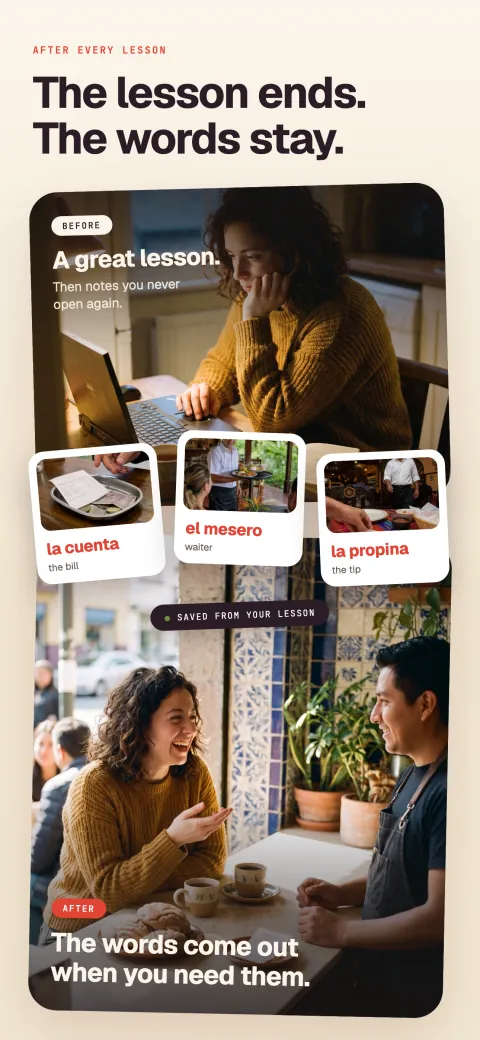
Verbamor records your lesson and turns what your tutor taught into cards that come back on schedule.

The top three results for "italki review" all quote the same statistic. 71.6% of learners improved their speaking by at least one level in two months.
None of them appears to have opened the source. I did, and it's a 34-page PDF sitting on Getting Smart's server since January 2018, written by Roumen Vesselinov and John Grego.
The headline number is real. Four things travelling with it aren't on any page I read.
I haven't taken a lesson, so I read the study itself
I haven't taken an italki lesson. This is built from italki's own published pages, its teacher listings, and the primary research it points at. I read them all on 21 September 2026, and every figure below carries its date.
Worth being blunt about why that matters, because the same honesty is missing from the pages above me. The official italki review is published by italki, lists 8 pros against 2 cons, and grades its own homework.
Fawnio says outright that its sources are company documentation and Trustpilot. OnlineCourseing prints a 4.5 out of 5, the highest score on the page, next to a teacher count of "20,000+" that italki's own page contradicts with 30,000+.
So none of us has used it. The difference is what we did instead, and I went to the PDF.
I also sell a language app, which you should weigh. It's at the end, in one paragraph, and it competes with italki for no part of your money.
The 71.6% rests on 81 people and a 19-point range
Here's what the report says, quoted from its own executive summary and results.
It began with "a random representative sample of 125 italki users." That's the number the reviews print.
But the report continues: "The final sample size was 102." And the oral result, the one behind 71.6%, rests on fewer still: "Altogether 102 people took the final written test and 81 people took the final oral test."
81 people. Every review on this query calls it a study of 125.
Then the precision. The report gives the interval, verbatim: "Overall 71.6% of the participants improved their oral proficiency by at least one level. The 95% Confidence Interval is 61% to 80%."
That's the range the true figure likely sits in. It's 19 points wide, printed in the source, and dropped by everyone quoting it.
"This study was funded by italki." It is in the report's own limitations section, and on none of the pages citing it.
Two more lines from the same document. Participants "were given a 30% refund (up to $100) of the amount they paid for lessons during the study," so they were paid to finish. And the researchers emailed everyone weekly with their study time, which they say "seemed to stimulate the study process," noting that "in normal settings when people work individually on their studies, this stimulation is not available."
A funded study, of Spanish only, on 81 finishers who were being nudged weekly and refunded at the end. The authors are careful about all of it. The reviews quoting them aren't.
One number on the official page is worse than incomplete. It says students who put in "14-17 hours total" saw real gains.
Search the report for that range and you get nothing, because it isn't in there. The actual figure is 19, and it's attached to something specific: "italki users need on average 19 hours of study in a two-month period to cover the requirements for one college semester of Spanish."
That's a far more useful sentence than the one italki wrote over it, and it's the only claim here I'd plan a budget around.
Spanish tutors cost a median $12.25 an hour, and French nearly double
italki's own Spanish page answers the cost question with a band: "Spanish tutors on italki cost between $4 to $60 per hour." Its pricing guide gives per-lesson bands instead, community tutors "between $4-$20 per lesson" and professional teachers "between $10-$40 per lesson."
Both are marketing shapes. So I read the actual listings.
italki's directory pages carry structured data for the first 20 teachers, each attached to a one-hour course. On 21 September 2026 I pulled every one of those prices for the five languages I know best. Here are all 20 Spanish rates in dollars: 6, 7.60, 8, 8, 8, 9, 9.50, 10, 11, 12, 12.50, 13, 13, 13.50, 13.90, 15, 17, 20, 40, 74.
Spanish is the outlier, and it's cheap because 2,346 teachers are competing. Learn French or Italian and you should budget roughly double, which no review on this query tells you.
One more thing the listings show. italki's Spanish FAQ says the ceiling is $60 an hour, and the same page's own data lists a teacher at $74. The band in the copy no longer matches the band in the product.
italki Plus is separate and doesn't touch lesson prices: "$5.99 per month, or $4.99 per month if you pay annually ($59.99 per year)," with a 30-day free trial, read on its plans page on 21 September 2026.
19 hours of Spanish costs about $233 at the median rate
Now put the study's number and the live prices together, which as far as I can tell nobody selling italki reviews has done.
19 hours buys one college semester of Spanish, on average, per the report. At the 21 September median (middle) Spanish rate of $12.25, that's about $233.
At the $6 floor on that same page, about $114. At $20, about $380.
So a semester of college Spanish, for somewhere around $115 to $380 and two hours a week for two months. Judged against a university course, that's a genuinely good deal, and I'll say so despite selling something else.
The caveats belong right next to it. The finding is Spanish-only: the report says plainly that "for other languages, more studies are necessary."
Beginners gained far faster than intermediates, who need more hours for the same step. And the French median is $22.50, so the same 19 hours runs closer to $428.
The mechanics of the money are where I have to stop, and I'd rather say so than repeat a competitor. Fawnio reports that credits are non-refundable, packages die at 6 months, credits expire after 12 months of inactivity, and the trial guarantee must be claimed within 48 hours.
Those rules matter more than any rating on this page, and I couldn't verify a single one. The support site, support.italki.com, returns 403, a refusal, to every automated request I made on 21 September.
The legal pages render entirely in the browser, so the text isn't there to read. Open the terms yourself before you load a balance.
Buy italki if your schedule moves, and skip it for a curriculum
Buy italki if your schedule moves around. You pay per lesson, and its pricing page is unambiguous: "There is no subscription, no monthly minimum, and no lock-in." A bad month costs nothing, which is the opposite of Preply's 28-day cycle.
Skip it if you want a curriculum. It's a marketplace, and the teacher decides what a lesson contains. Skip it too if you're a true beginner hoping to absorb your first thousand words. An hour of conversation is an expensive way to meet vocabulary for the first time.
And skip the platform entirely if the honest problem is that you don't practise. The study's own authors flagged this: their participants had someone emailing them weekly, and most people don't.
That last one is the real risk, and it has a price. At $12.25 an hour, a lesson whose words are gone by Friday costs the same as one whose words stick. Most of them are gone by Friday unless something brings them back.
This is the gap I built for. Verbamor is an iOS app that turns the vocabulary from a lesson you already paid for into fill-in-the-blank cards with spoken audio and a picture.
FSRS, an open-source algorithm that predicts when you're about to forget each card, schedules them so the words are still there next month. It covers Spanish, French, Italian, Portuguese and Russian, it doesn't find you a tutor, and beyond about 650 starter words it teaches you nothing new.
$19.99 a month, or $129.99 a year with a 7-day trial on the annual plan. Both are US prices, read off the app's own plan definitions on 21 September 2026.
The App Store sets a different number in other countries. There's no free tier, which is a fair reason to pass.
And the honest version. If you'll write your lesson words in a notebook on the train home and actually test yourself on them, that beats every app here including mine, for nothing.
Anki is free on desktop and Android, runs a serious scheduler, and ships no language content, so you build the cards. The people who should pay me have started a deck twice and stopped twice.
Sources
The efficacy study
- Vesselinov, R., & Grego, J. (January 2018). The italki Efficacy Study: Final Report (PDF, 34 pages). Read in full 21 September 2026. Source for the initial sample of 125, the final sample of 102, the 81-person oral subsample, the 71.6% figure and its 95% confidence interval of 61% to 80%, the 49.4% / 18.5% / 3.7% breakdown, the 19-hour average for one college semester of Spanish, the 30% refund up to $100 paid to completers, the weekly study-time emails and the researchers' note about them, the Spanish-only scope, and the sentence "This study was funded by italki but the data collection and the analysis were carried out independently by the Research Team." The phrase "14-17 hours" does not appear anywhere in the report.
What italki publishes about itself
- italki. italki pricing: complete pricing guide. Read 21 September 2026. Source for the $4–$20 community tutor and $10–$40 professional teacher per-lesson bands, the 30% to 50% trial discount, and "There is no subscription, no monthly minimum, and no lock-in."
- italki. Spanish teachers directory and the equivalent French, Italian, Portuguese and Russian pages. Read 21 September 2026. Source for all 20 Spanish hourly rates printed above, the medians and teacher counts in the table, the $74 listing, and the FAQ line "Spanish tutors on italki cost between $4 to $60 per hour." Prices come from the one-hour course offers in each page's own structured data.
- italki. italki Plus. Read 21 September 2026. Source for $5.99 monthly, $4.99 a month billed yearly at $59.99, and the 30-day free trial.
The reviews this one is arguing with
- italki. italki Review 2026. Read 21 September 2026. Publishes 8 pros against 2 cons, attributes the 71.6% claim to Getting Smart, and prints the "14-17 hours" figure that its cited report does not contain. Its body text says "over 10 million learners" 47 times and its own page markup says "over 15 million" once.
- Fawnio. italki Review (2026). Scores it 4.0 out of 5. The only one of the three to treat the credit rules as the subject, and the source for the policy figures I attribute to it above rather than state. It says its own sourcing is company documentation, the help centre and Trustpilot.
- OnlineCourseing. italki Review (2026). Scores it 4.5 out of 5, the highest of the three. Claims "20,000+ teachers" against italki's own 30,000+, and a "~$5–$60/hour" range. It does not mention refunds, credit expiry or cancellation anywhere.
What I could not verify
- Every credit-system rule: non-refundable credits, the 6-month package expiry, the 12-month inactivity expiry, the 48-hour trial-guarantee window and its 2-use limit, and the 3-day dispute settlement. support.italki.com returned HTTP 403 to every automated request on 21 September 2026, and italki's legal pages render client-side, so the policy text is not in the served HTML. Reported above as Fawnio's finding, attributed, never as fact.
- Teacher cancellation rates, no-show rates and support response times. No first-party figure is published for any of them, and I refuse to estimate one.
- Whether the 2018 result still holds. The report is nearly 9 years old, describes a Spanish-only sample, and italki has changed substantially since. Nobody has published a replication.
Keep the words you already paid a tutor for.
Verbamor turns your lesson vocabulary into fill-in-the-blank cards with spoken audio, scheduled so they're still there next month.
Start 7 days freeThe 7-day free trial is on the yearly plan.