 Verbamor
One 47 minute lesson, 38 candidates, 14 cards worth keeping
Import a lesson under Verbamor's 90-minute cap and it comes back as candidate flashcards, not just a transcript. One real 47-minute Spanish lesson produced 38 candidates, and after cutting the words already known and the proper nouns, 14 cards worth keeping. The arithmetic on how many keepers your daily minutes can actually support follows from there.
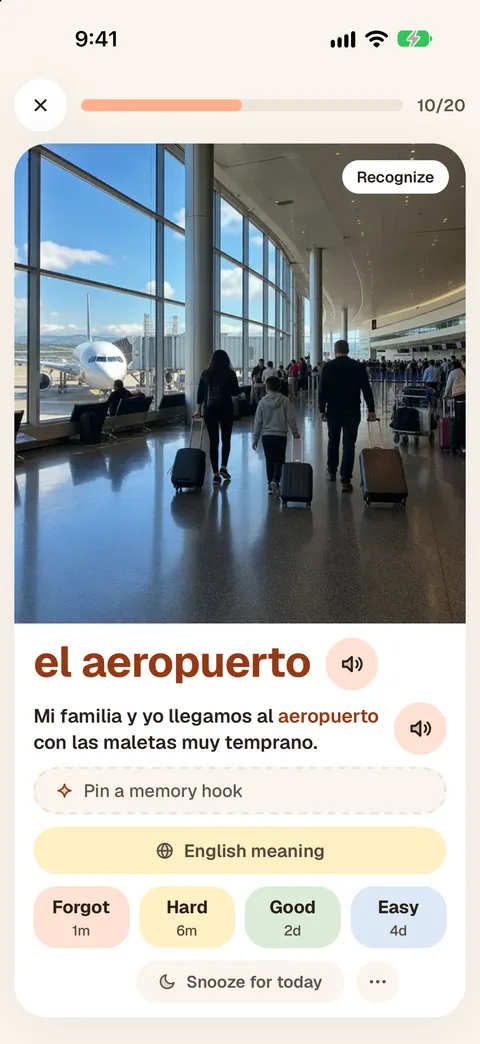
Verbamor turns the words from your own lessons and recordings into flashcards, and brings each one back before you’d forget it.

Open Voice Memos and scroll back to March. "New Recording 12", 47 minutes long: the Spanish lesson you meant to listen back to and never did.
You already paid for that hour, and you've forgotten enough since March that it'll teach you something on the second pass. One import is capped at 90 minutes, so check the length first.
What gets in: nine formats, 90 minutes, 50 MB
First, play 30 seconds from the middle of the file on your phone speaker. If you can't make out individual words, transcription won't either, and you get a card list built on guesses. Group classes recorded from the back of a room are the usual failure.
Tap Record, then Import audio. iOS opens the Files browser filtered to audio.
Nine formats go through: m4a, mp3, wav, aac, flac, ogg, opus, aiff and webm. That covers Voice Memos and Zoom (m4a) and WhatsApp voice notes (ogg or opus). Everything else is greyed out.
Video is the gap. An mp4 or a mov can't be selected, though ElevenLabs Scribe, the speech-to-text model underneath, takes video files too.
Pull the audio out first: open the file in QuickTime Player, then File, Export As, Audio Only. There's no paste-a-link route, so YouTube is out.
Past 90 minutes an import is refused with its length quoted back: "That file is 1 hour 43 minutes. Recordings must be under 90 minutes." Nothing uploads.
The pass that mines the transcript for vocabulary reads it in parts of 4,000 characters, with a ceiling of 28 parts: 112,000 characters.
That ceiling was set against a real 88 minute two-speaker lesson. It transcribes to 74,187 characters without speaker labels and 69,407 with them, because labelling merges runs of short turns into fewer, fuller lines.
The 88 minute lesson used about two thirds of it, so the 90-minute cap turns a file away before the ceiling comes into play.
Size is checked second, against a 50 MB ceiling, and it's a poor guide to length. That same 88 minute lesson is about 21 MB from the app's recorder at 16 kHz mono, and 82 MB from a laptop at 48 kHz stereo.
Anything over 50 MB but under 90 minutes is re-encoded on the phone to 16 kHz mono at 32 kbps, bringing the 82 MB file to roughly 21 MB.
Check the language, then tap the counter
Your profile holds one learning language, and an import is stamped with it before a word is transcribed. The two often disagree: the file is last year's Portuguese class, your profile now says French.
Scribe detects the spoken language itself, and that beats the profile stamp as long as it names one of the six the app teaches: Spanish, French, Italian, Portuguese, Russian or German. Cards are then filed under the detected language, so you never switch profiles for an old lesson.
A detection outside those six doesn't win, so a Dutch or Japanese file still produces cards filed under whatever your profile said. Titles are in English whatever was spoken, so a Dutch lesson filed as French looks identical to a French one.
The transcript is the tell, because it's verbatim: Dutch text under an English title. Read it before you touch the counter.
Tapping "Add 14 words" saves at once, and there's no undo window. Every card row is written to the database inside that tap, two to three seconds for 14 words. Text, image and the two sentence recordings fill in over the next minute, on cards that already exist.
Get the language wrong and 14 Dutch words sit in your French rotation under a French flag until you take them out by hand.
Deleting the recording doesn't do it. That removes the recording, its transcript and its audio, and leaves every card standing.
The 14 removals are manual. Open Library and tap Remove from study on each, which suspends the card without erasing it: the card "will leave your study rotation. Your progress is kept." There's no bulk undo and no multi-select.
One 47 minute lesson gave 38 candidates, and 14 were kept
A 47 minute one-to-one Spanish lesson, recorded on a phone on the table, imported five months later. The upload took under a minute on wifi.
Transcription came back in about four minutes, and it runs in the background, so the app can be closed. The mining pass read it in parts and surfaced 38 candidates: 26 words and 12 phrases, inside the caps of 60 and 30.
Fourteen were kept. Most of the 24 discards fell into three groups, and one keeper needed a fix first:
- Already known. Trabajo, ciudad, difícil, and eleven others, surfaced because the teacher said them. The biggest discard group, and it grows as you improve.
- Proper nouns. Valencia, Mercadona. A card asking you to recall a supermarket's name teaches nothing.
- Too rare for a slot. Alcachofa, artichoke, said once while listing vegetables: a real word with no second encounter coming.
- Wrong sense, so corrected and kept. Quedar came out of the transcript as "to remain", but the lesson used it twice to mean "to arrange to meet". It stayed, with the sentence carrying the second meaning.
Most of the 14 keepers were phrases: me da igual, quedamos a las ocho, no me acuerdo, se me ha olvidado. A four-word chunk your tutor used to soften a disagreement can't be assembled from its parts.
The 38 candidates come back as one scrolling list, grouped into sections with a time range on each. Each row shows the Spanish term, its translation, and a tag naming why it surfaced: "you paused here", "corrected", "you used this", "taught".
Anything already in your study set is greyed out, every row arrives unselected, and the counter is the save button. The full transcript sits below as speaker turns, which settles a case like quedar.
A card is studyable as soon as it has text, while its image and recordings build. Every card gets its own worker, fired at once, so 14 cards don't take 14 times one card. Verbamor's support page gives the figure to expect: "under a minute and pull to refresh", then write in if it's still bare.
Ten minutes a day affords about 27 keepers per weekly import
Soren Bjornstad published the arithmetic at Control-Alt-Backspace, in How much to learn with Anki. He puts a typical review at 5 to 10 seconds and reports his own average sits just under 7. Use 7 seconds until you can check your own.
Verbamor schedules with FSRS-6 on stock settings, through the ts-fsrs library. FSRS is an open-source algorithm that predicts when you're about to forget each card. A new card rated Good returns in 10 minutes, then 2 days, then 11 days.
Each word makes two cards, recognition and recall, scheduled independently. So 14 keepers is 28 cards, and about 28 reviews land two days from now: at 7 seconds each, a little over 3 minutes.
Forty keepers is 80 cards, so 80 reviews on that day, about 9 minutes, before whatever your last import queued.
The steady state matters more, and Bjornstad gives that conversion too. Daily reviews settle at roughly 10 times your new cards per day, about one minute of daily study per new card per day.
Import weekly and 14 keepers is 4 new cards a day, so about 40 reviews and 5 minutes a day once the schedule fills. Forty keepers a week is 11 new cards a day, near 114 reviews, about 13 minutes every day, including the days you want to skip.
Turn that around for a ceiling you can set now. Bjornstad's formula for the reviews you can clear is 54 times your daily minutes, divided by your seconds per review. Divide that by 10 for new cards a day, then by 2 for words, then multiply by the days between imports.
Ten minutes a day at 7 seconds a review is about 77 reviews, so importing weekly comes to about 27 keepers per import. Fifteen minutes buys 40.
Under that ceiling, tick freely. Over it, cut the words you half-know. Then look at the due count for the day after tomorrow: that's the promise you just made to yourself.
Podcasts make poor material, and with no recordings the app is the wrong buy
Podcasts and audiobooks import fine and make poor material. The mining pass looks for what a learner met, and an hour of native-speed monologue hands back a list you can't rank.
Transcription is capped at 450 minutes a day, resetting at UTC midnight. Six 75 minute lessons use the day exactly, and a seventh is refused: "You've used all 450 minutes of transcription for today."
A file offered while budget remains gets the remainder quoted back: "You have 12 minutes of transcription left today and this recording is 47 minutes."
The honest disqualifier is bigger than these. If you have no recordings and nothing coming up that could produce one, this app does much less for you. You'd have the Essentials deck of about 650 common words, and anything past it you'd add by hand, since the Translate screen saves any word or phrase you look up.
Nothing here manufactures input, and past that starter deck there's no premade content. Buy it when you have a tutor, a language partner, or a habit of recording yourself.
Verbamor costs $19.99 a month, and Anki trades money for typing time
Two plans. Explorer is US$19.99 per month, Native US$129.99 per year, about $10.83 a month.
The 7-day free trial is on the annual plan only, so Explorer bills immediately. There's no free tier.
Anki is the free alternative and a fair one: US$24.99 once on iOS, nothing on desktop. What it won't do is take an audio file and give back the words in it.
Gabriel Wyner, who wrote Fluent Forever, timed himself building Anki vocabulary cards. He got 110 cards from about 40 words in 1.5 hours, roughly 49 seconds a card. At that rate the 28 cards here are about 23 minutes of typing, plus replaying the audio to find the words.
Each card here also carries two recordings of its example sentence. One is a complete read for the answer side. The other, for the recall side, has the answer replaced by a tone.
The first is a single take. Reproducing the second by hand means reopening that take in an audio editor and cutting the answer out.
Cancel by day six, and a lapse locks your library and keeps it
To cancel: open Settings, tap your name, tap Subscriptions, tap Verbamor, then Cancel Subscription. Apple's instruction is to cancel at least 24 hours before the trial ends, so do it by day six and you aren't charged. Access runs to the end of the paid period.
After that, the library is locked, and nothing is deleted. Everything stays on the server: the recordings, the transcripts, the 28 cards, their images and both sentence recordings each.
The app opens on the paywall and the tabs are gated, so you can't reach any of it while lapsed. Resubscribe and the review history is intact, so long-overdue cards land in one large due pile.
You can export your cards to CSV, so the words themselves follow you out. The export is a spreadsheet. Rebuilding it elsewhere means mapping the columns yourself, and the audio and images stay behind.
To clear it, delete your account, which the privacy policy commits to completing within 90 days. That doesn't cancel the Apple subscription: cancel first, then delete.
Open Voice Memos. Find the oldest recording over ten minutes, check it against the 90 minute cap, and trim a copy if it runs over.
Tap the three-dot button, Save to Files, then import it. Read the transcript to confirm the language, and keep only the words new to you, up to the ceiling your daily minutes bought.
That old lesson recording still owes you cards.
Verbamor imports audio you already have, transcribes it, and mines the words you actually met, so a lesson from March still turns into cards worth reviewing today.
Start 7 days freeThe 7-day free trial is on the yearly plan.