 Verbamor
A picture on a flashcard helps only if the card makes you say the word
A Spanish card in Verbamor's database once paired the word for yesterday with a photo of a woman ladling soup, and it passed every automated check. Carpenter and Olson's experiments found the same problem in miniature: picture flashcards left learners overconfident by nearly 20 points while adding no extra recall, until the test forced them to produce the word first. Get the picture wrong, and it teaches soup.
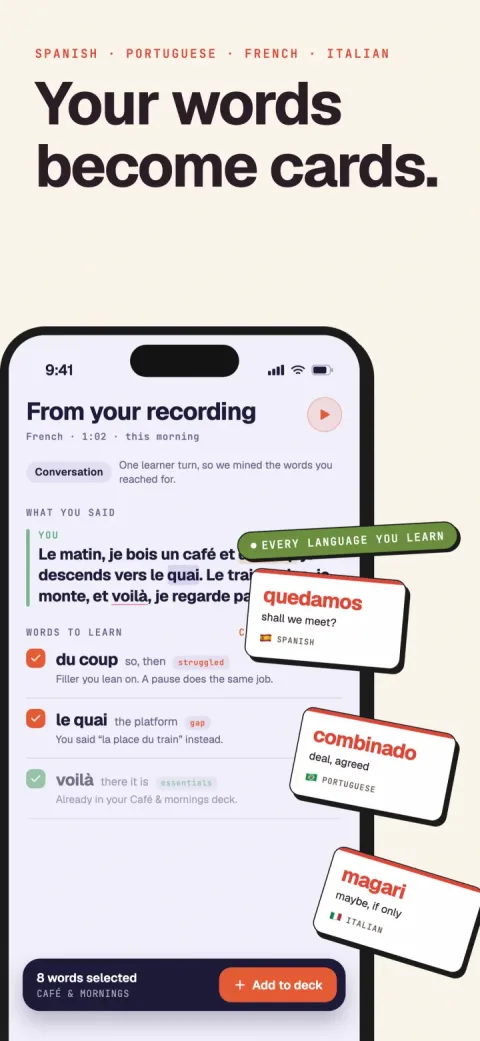
Verbamor turns the words from your own lessons and recordings into flashcards, and brings each one back before you’d forget it.

A Spanish card in our database once showed the word ayer, which means yesterday. The picture was a woman ladling soup in a kitchen.
The card had passed an automated quality check. So had 2,743 others, because the check was written to trust the answer it was given, and it never said no to anything. Every card in that batch read "pass."
A picture isn't free. It occupies the part of the card your eye goes to first, and it teaches whatever it happens to show. Get it wrong and you've built a card that teaches soup.
Pictures help once you have to produce the word yourself
Shana Carpenter and Kellie Olson ran four experiments on this, published in the Journal of Experimental Psychology: Learning, Memory, and Cognition, 38(1), 92 to 101. English speakers at Iowa State learned Swahili words.
Some saw the word paired with an English translation. Others saw it paired with a picture.
Experiment 1 used 116 students and 43 Swahili words, each pair shown twice for 6 seconds. Recall from the picture pairs came out statistically level with recall from the translation pairs.
The same students did show the usual picture advantage when asked to free-recall the pictures themselves, so the pictures were encoded (stored in memory) well. They just didn't carry the Swahili word with them.
Experiment 2 gives the number the whole argument turns on. Twenty-four students learned 42 items, 21 with photographs and 21 with translations.
They rated each on a 0 to 100 percent scale: how confident are you that in five minutes you will recall this Swahili word from this cue?
The gap between that rating and actual recall was 19.83 points for the picture-paired words and 15.46 points for the translation-paired words. Both were overrated. The pictures were overrated by more.
Recall itself showed no significant difference on that first test, t(23) = 1.54, p = .137. (A p-value that high means a gap that size could easily be chance.)
Then the researchers removed the overconfidence, in two different ways.
In Experiment 2 they gave learners retrieval practice: two more tests where the learner had to produce the word from memory and then saw the right answer. By the third test the confidence gap had inverted to minus 4.13 points for pictures, and the picture words now beat the translation words at p below .005.
In Experiment 3, 50 students were split in two, and half were simply told not to be overconfident. That warning cut the picture confidence gap from 17.74 points to 4.02.
Only the warned group recalled more Swahili from pictures than from translations, F(1, 48) = 4.43, p = .041.
Experiment 4 asked 64 more students why. They rated picture pairs as easier to study than translation pairs, 64.33 against 51.43 on the same percentage scale, and easier to link, 45.62 against 28.46. The picture feels like it's doing the work, so the learner stops doing it.
So the effect is real and conditional. A picture helps when you're made to produce the word.
It costs you when you're allowed to look at it, feel a flush of recognition, and move on.
This is why the front of a Verbamor card withholds the word in two places at once. You see the picture and the example sentence with the target word replaced by a blank, and the recording plays that sentence with a soft tone where the answer belongs.
The word is missing from the text and from the audio, so the picture can't be checked against anything until you've said the word yourself. The complete recording is held back for the answer side.
The picture has to match the example sentence
Most picture flashcards pair an image with a bare word: a photo of a beach, the word la playa, done.
Verbamor builds the card in a fixed order. The model describes the scene first, then writes the example sentence about that exact scene: same subject, same action, same setting. The sentence and the image become two views of one moment.
The ordering matters because a picture paired with a lone word is ambiguous. A photo of a woman drinking coffee on a terrace could teach woman, coffee, terrace, drink or morning. The learner's guess can land on a different word than the card intends.
When the picture and the sentence describe the same scene, the sentence names everything else in the frame and the blank is the only thing left unnamed. Then the picture points at one word, instead of hinting at the general area.
The card generator enforces one more rule. The blank must be the headword itself, or a correctly inflected form of it, and never a synonym or the name of some other object in the scene.
A card that shows a kitchen and blanks out pan when the word you saved was cocina teaches the wrong thing while looking correct.
Abstract words are depictable, and the fallback is a trap
The usual objection to picture cards is that you can only picture concrete nouns. Dogs and beaches, fine. What about yesterday, please, maybe, she?
The lazy answer is a typeset word on a blank background, which is text pretending to be an image and adds nothing. Verbamor uses a fixed set of visual metaphors instead, written into the generator as explicit rules. Some of them:
- yesterday: a close-up of a calendar page with the previous day crossed out or faded, and the current day marked.
- please: hands pressed together in a polite request.
- we: a small group with arms around each other, one person gesturing at the whole group.
- she: two people in frame, the woman sharp and lit and forward, the other person turned away and softly out of focus.
- maybe: someone stopped where a path forks, half-turned between the two, under a sky split between cloud and sun.
Two rules govern all of them, and both come from watching bad cards ship.
First, the metaphor has to be the picture itself. A prop inside it doesn't count: a kitchen scene with a calendar on the back wall isn't the calendar metaphor for yesterday.
Second, the scene mustn't read more naturally as some other everyday word. If a beginner would sooner call what they see "apple" or "eating," the card is teaching that word instead.
The she rule shows why this needs stating. A single woman alone doing something reads as the action, or as the word woman.
Both are separate vocabulary words. What a pronoun does is select someone, so the selection has to be what the picture is about.
Code now judges each picture, after the soup card slipped through
The automated check that passed the soup card asked a vision model to look at each finished card and return a verdict. It returned "pass" 2,744 times out of 2,744.
Three holes let that through.
The check collected an observation about whether the image matched the sentence, then never read it. So a picture and a sentence describing unrelated scenes couldn't fail anything.
Abstract words were judged under a leniency clause so loose that any ordinary photo satisfied it. And nothing compared the finished image against the description it was generated from, so a render that wandered off its own brief was invisible.
The rewrite moved the pass and fail decision out of the model and into code. The model now reports observations only, and the schema (the list of fields it must fill in) grew from 11 required fields to 15.
Does the image depict the headword's meaning? Does it match the sentence, and the description it was generated from? Is it one continuous photograph, does it contain readable text, and what would a beginner most likely call this picture?
Any single bad observation fails the card. That last question caught cards that were technically correct and useless.
The photograph rule came from its own small disaster. Fourteen cards had shipped as collages, four-panel grids and torn-paper splits.
Mostly that was because category words like sport and season are required to show several examples, and a grid is the lazy way to do that. The several examples now have to sit inside one photographed scene: a football, a racket, goggles and a helmet on one gym floor.
A failed card gets repaired rather than deleted. If the image is wrong, the system regenerates it from the word's meaning, rewrites the sentence to describe the new picture, then re-records the audio.
If the image is fine but the sentence disagrees with it, only the sentence is rewritten. Ground truth is always the word's meaning, because the sentence may be the thing that's wrong.
The strict check has its own failure mode, and it showed up on the first live run. Spanish porque, which means because, is drawn as rain falling on a wet street.
Every observation said the image was right. The check failed it anyway on the question about what a beginner would call the picture, because a beginner would say rain.
A metaphor always reads literally as something else. The rule now exempts an abstract word whose metaphor the model has confirmed.
After a few weeks of saved words the pictures start doing a second job. Every scene is set in the culture of the language you're learning.
So a Portuguese card and an Italian card for the same English meaning get different photographs, generated separately. Portuguese scenes are set in Brazil, Italian ones in a piazza or a trattoria, French ones in a Paris street or a village bakery.
Some cards still miss, and they're mostly abstract words. They surface the same way each time: you keep failing one card and you can't say why. The picture is teaching a neighbouring word and pulling your answer toward it.
Skip this if your Anki picture deck already works
If you already keep a picture deck in Anki and it works, nothing here obliges you to move. Anki holds images fine.
You'll be sourcing and checking those images yourself. And Anki ships SM-2, an older fixed scheduling formula, by default, with FSRS (a newer one that predicts when you'll forget each card) opt-in at the bottom of deck options.
Pictures are also the wrong tool for a real slice of vocabulary. Grammar terms, legal and technical words, and words whose meaning is a written label, like a specific weekday or month name, don't resolve into a scene. Verbamor sends that last group to a typeset text template and doesn't pretend otherwise.
And if your cards let you flip and judge without producing anything, add the picture last. On a recognition-only card, Carpenter and Olson's Experiment 2's first test is the relevant result: learners overrated picture words by about 20 points, and recalled them no better than translations.
Try one card today, and ask what a stranger would call the picture
Take one word from your last lesson. Write a sentence about a specific scene you can see, then blank out the word.
Ask yourself what a stranger would call the picture if they saw it with no sentence. If the answer is a different word than the one you're learning, the picture is teaching that other word. Change the scene, and leave the sentence alone.
A picture only teaches once you say the word.
Verbamor blanks the target word from both the text and the audio, so the picture can't be checked against anything until you've said it yourself.
Start 7 days freeThe 7-day free trial is on the yearly plan.