 Verbamor
One tap moves that card by 23 days
On Tuesday you spend nine seconds digging out one word and tap Good. On Saturday you spend the same nine seconds on a different word and tap Hard, because the search felt unpleasant that day. Same performance, two different grades, and the scheduler reads both as facts about your memory.
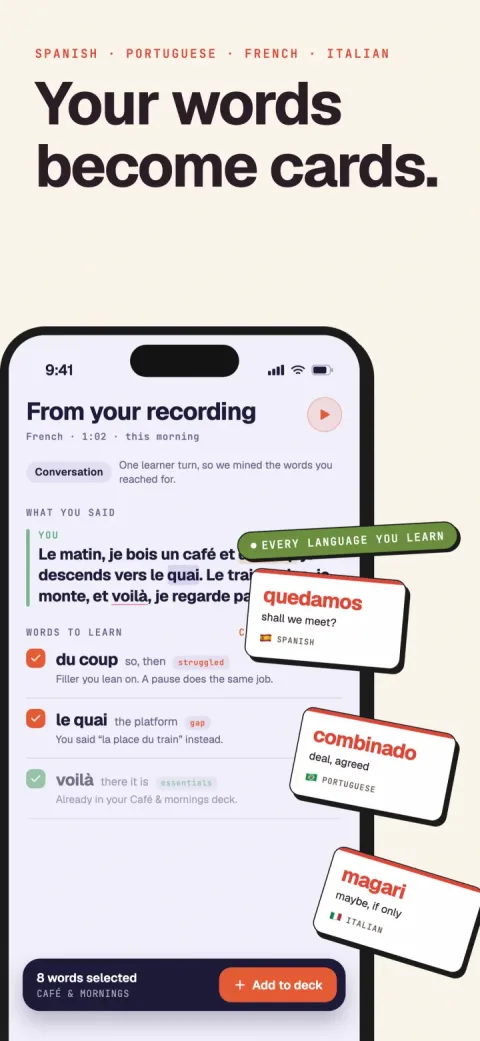
Verbamor turns the words from your own lessons and recordings into flashcards, and brings each one back before you’d forget it.

On Tuesday you took nine seconds to dig out aprovechar, got it, and tapped Good. On Saturday you took nine seconds to dig out desarrollar, got it, and tapped Hard because the search felt unpleasant. Same performance, two different grades.
Neither grade was dishonest. The leak is that your standard moves: with sleep, with how much time is left in the session, with whether the previous card went badly. The scheduler reads all of that as facts about your memory.
Consistency is a separate skill from honesty
Most advice covers honesty. Koriat and Bjork (2005) showed why.
When you judge your knowledge with the answer visible, its presence inflates the judgment, which "can instill a sense of competence during learning that proves unwarranted during testing."
An inconsistent deck feels random: some words keep coming back while others vanish for a month and return as strangers.
Take one card at 40 days of stability (the number of days until your odds of recalling it fall to 90%). Graded Good, it comes back in 98 days; graded Hard, in 75.
Grade it Hard on a bad morning and Good on a good one, and your average is right. But every interval you shipped was off by 23 days.
FSRS, the open-source scheduling algorithm, fits a memory model to your own review log. Anki's manual describes the fitting step plainly: "The FSRS optimizer uses machine learning to learn your memory patterns and find parameters that best fit your review history."
That fitted model reads the spread in your grades as a property of your memory. So inconsistent input produces a model confident about the wrong thing. Your average grade can be perfectly calibrated while that spread makes every interval wrong.
Decide what each grade means, and write it down
Write it somewhere you'll see it. Verbamor has four grades, one per swipe direction: left for Again, down for Hard, right for Good, up for Easy. Change this rule if you want, but change it before the session.
- Again. The word did not come out of your head before the answer appeared, including when you recognize it afterwards.
- Hard. You produced it, but you searched for more than about five seconds, or got the gender or conjugation wrong first.
- Good. You produced it correctly with a beat of effort. Most cards.
- Easy. It arrived with no search at all.
Take a card at 40 days of stability, reviewed on the day it came due, with desired retention (the recall rate the scheduler aims for) at the default 0.9. Stability is the number of days at which your chance of recall falls to 90%.
I ran every number below through the reference FSRS-6 implementation in the open-source py-fsrs scheduler, using its published default parameters. Difficulty is held at 6.0 on the 1 to 10 scale.
Grading Good adds a stability increase of 58.3 days, taking stability from 40 to 98.3. FSRS applies a fixed penalty to Hard: parameter w15, which is 0.6014 in the defaults, multiplies that increase.
Hard adds 58.3 × 0.6014 = 35.1 days, taking stability to 75.1. At a desired retention of exactly 0.9, the conversion to days changes nothing, by construction. So the cards come back in 98 and 75 days.
One tap moved that card by 23 days.
Nothing here rests on the 6.0. Because w15 multiplies the increase, Hard lands at 0.6014 of the Good gain at every difficulty.
A harder or easier card changes the size of the gap, never its direction. The gap grows with stability: the same card at 15 days gives 41 on Good against 30 on Hard, and at 150 days gives 325 against 255. Pick a number and use it for a month.
Verbamor grades each word in two directions: recognition, where you see the word and recall its meaning, and recall, where you see the meaning and produce the word. Write your rule for recall and let recognition inherit it.
Grade before you flip, while the answer is still hidden
Nelson and Dunlosky (1991) named the effect that makes timing matter. Judgments of learning made immediately after studying an item predict later recall poorly, while delayed judgments become "extremely accurate", the phrase they titled the paper around.
The immediate judgment reads how fresh the item feels; the delayed one has to go and look.
Your session already supplies that delay, since every card arrives days after you last saw it.
What you can lose is the ordering. Flip first and grade second, and you're grading with the answer in front of you, the condition Koriat and Bjork found inflates the judgment. So say the grade out loud before the answer appears.
On a Verbamor recall card, the cloze audio plays the sentence with the answer replaced by a tone, which gives you a moment to commit. And a spoken guess can't be quietly revised into a pass.
If you slip, shake the phone: the Study screen keeps an undo stack.
Run a two-week calibration check on yourself
This is worth doing at roughly 20 reviews a day or more. Below that, read the last section first.
You can't feel drift from inside a session, but you can measure it afterwards. It takes ten seconds per session plus ten minutes at the end of the fortnight.
Start today. At the end of each session, write one line in a notes app in this shape:
Aug 23 · 6/42 = 14% · tired
That's the date, the cards you graded Again over the cards you reviewed, that share as a percentage, and one word for your state (rested, tired, rushed).
Verbamor doesn't surface an Again count, so you supply the numerator. A card you grade Again comes back later in the same session. So at the end, write down the words you saw twice, rather than keeping a stroke tally mid-swipe.
The session-complete screen gives you the denominator, in a line reading something like "42 reviewed · 6 new".
A numerator off by one moves a 42-card session by 2.4 points, well inside the branches below. So if you can't remember whether a word repeated, drop that day rather than guessing.
I expect your Again rate to go down when you're tired. An Again asks you to admit something and see the card again tomorrow, while a Good ends the card.
I haven't measured this across Verbamor users, so check whether it holds for you. If your tired rate comes out higher instead, read branch 2 below, which covers that case and needs no change to the rubric.
An invented fortnight:
# invented example, not measured data Rested days: 19% 22% 17% 24% 20% 18% Tired days: 9% 7% 11% 6% 8%
Sort the rows by that last word and average each group. Rested averages 20%, tired 8.2%: tired runs 11.8 points lower, so your rule loosened when you were tired.
Had the tired days read 29, 32, 28, 31 and 30, tired would average 30 against 20, running 10 points higher. That would mean your recall degraded under fatigue while your rule held.
The 10-point line comes out of the same card. A Good on it ships 98.3 days.
An Again runs a different formula, built from parameters w11 through w14, whose defaults in py-fsrs are 1.4835, 0.0614, 0.2629 and 1.6483. From the same run at difficulty 6.0 and retention 0.9, those four terms multiply out to 1.4835 × 0.8958 × 1.6546 × 1.1792 = 2.5929.
So stability drops from 40 to 2.6. The scheduler rounds intervals to whole days, so it ships 3.
Average those across 100 cards and a 14% Again rate ships 84.9 days, while 24% ships 75.4. Ten points of drift moves the average interval by 9.5 days, about 11%, the same size as the Good-against-Hard gap on a single card.
The 5-point line and the four-day minimum are my rules of thumb, not derived from the model.
- Tired lower by 10 points or more. Your rule loosened, and the cards you waved through carry intervals your memory didn't earn. Apply one of the two fixes below.
- Tired higher by 10 points or more. Your memory degraded and your rule held. Shorten the tired sessions or move study to a better hour, and leave the rubric alone.
- A gap under 5 points either way. Your rule is holding, so stop tallying.
- A gap between 5 and 10 points. Too small to separate from noise at this sample size. Run the log two more weeks and read it again. Read none of these branches unless you have at least four days in each group, because two or three days average noise.
Two fixes
- Say the grade aloud before the flip on every card for one week. Speaking it makes it a commitment. This is the fastest correction, and it feels tedious for about three days.
- When you're too tired to grade carefully, bury instead. Verbamor's bury control pushes a card to tomorrow without a rep and without a lapse, leaving the FSRS state untouched. Half a session of careful grades plus five buried cards beats a full session of guesses. Use bury for the last stretch of a long session.
Read your struggling list as a report on your grading
Verbamor flags a word-direction as struggling once you've forgotten it twice without recovering to durable, or whenever it's relearning. The badge reads as a fact about the word.
Read it as a fact about your grading too. Ask one question per entry: is this word genuinely hard, or did I pass it early on days when I was being generous?
A word you've failed repeatedly after several early Goods is usually a grading artifact, because those Goods bought long intervals the memory could not hold.
When the answer is yes, don't reset the card and don't delete it. Grade it Again next time, even if you half-produce it.
On the same 40-day card, that Again drops stability to the same 2.6 derived above. That's below where a single Good from scratch would have put it, and the interval rebuilds from a stability your current rule supports.
Drift costs little on a small queue or a young deck
The cost of drift scales with how many intervals the scheduler computes, so a small queue makes it small. On the card above, 98.3 ÷ 75.1 = 1.31, so each drifted grade adds 0.31 of a review.
If one grade in ten drifts, a 30-review day drifts 3 reviews: 3 × 0.31 × 30 days = 28 extra reviews a month. The same arithmetic gives 9 at 10 reviews a day, and 5 at 5 reviews a day. That's about one extra review a week, which almost any active deck clears.
The review-history limit is stronger. Anki's manual names the failure case: "Low number of reviews (less than a few hundred). As a machine learning algorithm, FSRS needs data to learn from."
Below that, your parameters are still the defaults, and at 10 reviews a day a few hundred is about a month of study. If you're recovering from a two-week gap, grade the backlog before you start the log.
Tonight, before you open Study, write your four rules on paper next to where you sit. Run one session against them, note the words that came back twice, and write one line underneath in this shape:
Aug 24 · 6/42 = 14% · tired
One tap. Twenty-three days of drift.
Verbamor's FSRS scheduler treats every grade you give it as ground truth about your memory, so a written rule for what Hard actually means is worth more than any setting in the app.
Start 7 days freeThe 7-day free trial is on the yearly plan.