 Verbamor
94 cards due after a week off: a four-day drain that deletes nothing
Four days of normal-sized sessions clear a backlog of 94 due cards against a daily limit of 20, and nothing needs deleting: FSRS keeps every card's stability and difficulty exactly where you left them. Only the odds you'd recall something today have slipped. Keep the limit where it was and take one top-up batch, never four.
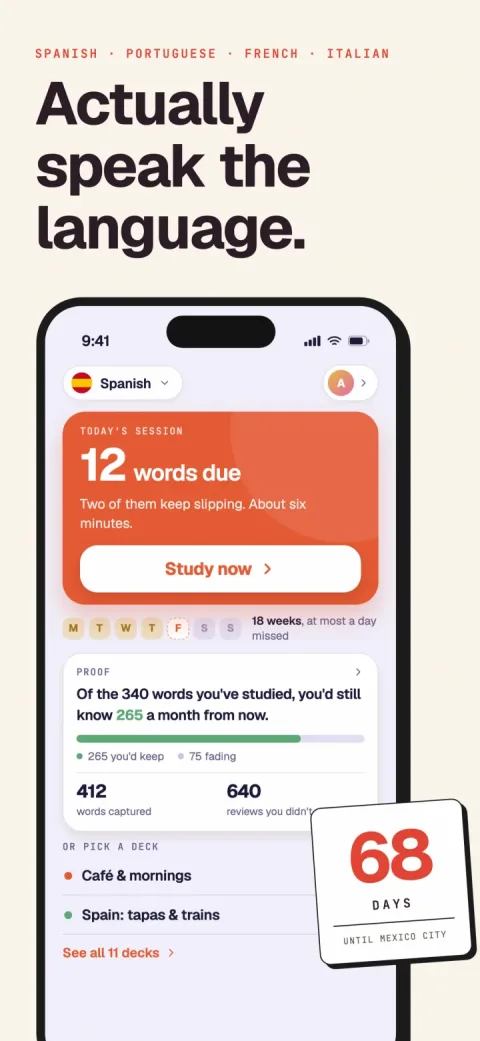
Verbamor opens on one short session a day: the words that are due, and about how long they’ll take.

You open Study on a Tuesday and the number says 94. Your daily limit is 20. The last review you did was nine days ago, before the work trip and the head cold.
The honest reaction is to close the app, and a lot of people close it for good right there.
Your 94 due cards are a queue that grew while nobody was serving it. Here's what happened to those cards during the gap, and the order to work through them in. You can start today and be back to a normal-sized session inside four days.
Nine days off faded some cards and left the rest untouched
Verbamor schedules with FSRS, short for the Free Spaced Repetition Scheduler: an algorithm that predicts when you're about to forget each card. It tracks three numbers per card, and the Open Spaced Repetition wiki defines them plainly.
Retrievability is the probability you can recall the card right now. Stability is "the time, in days, required for R to decrease from 100% to 90%" (R is retrievability). Difficulty is how hard that particular card is for you.
Time passing only moves retrievability. Stability and difficulty sit where you left them.
A card with a stability of 60 days didn't lose its 60 days because you took a week off. It kept every review you ever gave it.
What dropped is the odds of you producing the word this afternoon. That drops on a curve, slowly at first for a strong card and fast for a shaky one.
Retrievability moving on its own is why the backlog is lopsided. Take two cards from the same nine-day gap.
The first you had seen twice and it was due at four days. So it's five days past a four-day interval, more than double the delay it was scheduled for. That card has faded.
The second card you had seen eleven times and it was due at two months. So it's nine days past a sixty-day interval, a delay of about fifteen percent. That card is where you left it.
Both sit in the same pile of 94, and they need completely different amounts of your attention.
The count on the screen hides that split between faded and untouched cards, which is most of why it looks frightening. A 94 made of ninety strong cards and four weak ones is twenty minutes of work.
The number can't tell you which you have. The first session can.
A second effect works in your favour. The FSRS documentation states it directly: "As the delay increases, retrievability (R) decreases. If the review was successful, the subsequent stability (S) would be higher."
A card you still remember after nine days of neglect has proved it's stronger than the schedule assumed, so the scheduler pushes its next review further out. The same document notes the increase levels off at an upper limit, so a very long absence doesn't hand you infinite credit.
Should you reset your deck after a week off?
Don't reset the deck, and don't delete cards to make the number smaller. Both throw away the review history the scheduler fitted its model to.
FSRS reads your own log to decide how your memory behaves, and nine days of not reviewing added no bad data to that log. Deleting nine months of good data to escape a nine-day gap is the only move here that causes real damage. And it's the one the panic recommends.
Anki's manual describes the same design in its own scheduler: "When you are returning to Anki after a long break, you don't have to start anew and can just start back from where you left."
The recovery has one governing rule: keep your daily limit exactly where it was.
In Verbamor the limit is a hard cap on the plan. A backlog of 94 with a limit of 20 gives you a session of 20, and the other 74 roll to tomorrow. The app won't quietly serve you 40 because you were away.
Day one. Twenty cards, reviews only. Open Study and work the session as normal. Don't add new cards, don't record a lesson, don't go browsing in Library.
Anki's manual gives the same advice for its own backlogs: "If you have a backlog of overdue review cards, it is recommended that you stop introducing new cards until you catch up with that backlog." Twenty reviews from a stale deck takes longer than twenty from a fresh one, so budget about fifteen minutes instead of the usual eight.
Day two. Twenty more, and grade harder than feels fair. Overdue cards produce a specific illusion. The word arrives half a second late and feels close enough. If you didn't produce it before the answer appeared, that's Again.
Your grades are the only channel the scheduler has into your memory. A week of generous grades during recovery builds a deck that looks caught up and isn't.
Day three. Twenty more, plus the top-up if you have time. By now the oldest and weakest cards are behind you and the session moves faster. Finish it and the completion screen lists what the daily cap left behind, as "N cards still due today" above a button reading "Study N more cards due today".
Take one top-up batch. A single opt-in batch of 20 turns a five-day recovery into a four-day one. Four batches turns tonight into an hour and tomorrow into a skipped day.
Day four. Clear the rest, then resume new cards. Once the due count is at or below your limit for a full session, the backlog is gone. Record a lesson, save cards from it, and go back to your normal routine. Not before.
Watch the due count each morning, because it's the only progress number that matters this week. From 94 it should read roughly 80, then 65, then 45, then under 20.
It doesn't fall by exactly 20 a night. Cards you graded Again return within a day or two, and cards that weren't due on Tuesday become due on Thursday. A drop of twelve on a night you did twenty is normal and means the deck is working.
If day four opens at 45 instead of under 20, you're on the five-day version. Run day two's instructions again, graded strictly, and take one top-up batch of 20 on both remaining evenings. That clears 45 by the end of day five.
Extend to a sixth day only if day five still opens above 40. If the count is flat or rising after three sessions, your limit is lower than your deck's daily demand. That's a settings problem, and more discipline won't fix it.
Use three fixed numbers on the failing cards
Some of the 94 were a problem before the gap and will still be a problem after it. Verbamor labels a card struggling once you've forgotten it twice and it hasn't recovered since.
You can see the exact set: open Library and tap the red "Struggling" filter chip, which lists every card in that state. Today's share of them is on the Home plan card, as "N fighting you" under the session count.
On a normal day that count is low. Coming off a bad week it'll be higher, because the cards on short intervals were the ones most damaged by nine days of silence.
Use three fixed numbers, so you aren't making a judgement call on each card.
Eight. If more than eight of tonight's session are flagged, stop treating them as session noise and give them their own twenty minutes on a separate evening. Below eight, absorb them into the normal session and do nothing special.
Three. The third Again on the same card inside one week means suspend it. Anki automates the same rule. Once a card has lapsed (been forgotten) eight times, by default, Anki tags the note as a leech and suspends the card. A leech is a card you keep failing.
Three in one week is the faster trigger, because a recovery week compresses lapses that would normally spread over months.
Five. Suspend no more than five cards in a recovery week. The cap is the point.
Suspension is the same act as deleting, slowed down. Suspending thirty cards hollows out the deck by hand and loses the history that makes the schedule fit.
Five is small enough that the deck stays the deck. Past five, the problem is the daily limit.
Suspend from the card's page in Library, using Remove from study. Verbamor keeps the FSRS state: the confirmation says your progress is kept, so adding it back later picks up where you left off.
Bring a suspended card back once the backlog is cleared and you've gone two normal weeks without a new lapse, using Add to study on the same page. Anki's manual recommends the same round trip for cards that interfere with each other: suspend one until the related concept is learned, then reactivate it.
Before suspending, look at what's on the card. Verbamor cards carry the example sentence, the image and two recordings of it, one with the answer replaced by a tone and one complete. Play the complete one.
If the sentence still means nothing to you, the card is the problem. The better move is the Record tab: say the word in a sentence from your own week and save a card from that.
Kornell, Hays and Bjork (2009) found across six experiments that unsuccessful retrieval attempts followed by the answer produced better later learning than being handed the answer directly.
Their materials were general-knowledge questions and word pairs rather than foreign vocabulary, so read it as encouragement rather than proof. The failed attempts you've been making on those cards weren't wasted.
Two situations break the four-day plan, and both want a smaller limit
Four days assumes one missed week and a deck built at a sustainable pace. Two situations break it.
If you've been away for two months, the arithmetic stops working. A 400-card backlog at 20 a day is twenty days of catch-up, and the queue keeps aging while you drain it.
Cut your daily limit to something you'll do every evening, accept that the recovery takes a month, and let the strongest cards drift further overdue. Their stability is high and they can wait.
The alternative is a fortnight of hour-long sessions ending in another quit.
If you're missing a week most months, the thing to fix is your daily limit. Cepeda and colleagues (2006) reviewed 317 experiments on distributed practice (spreading study out over time). They found spacing reliably beats massing the same study time into one sitting.
A person who does 20 cards on four days a week is doing distributed practice. A person who does 60 on Sunday isn't, and is also the person who quits in November.
Drop your daily limit to a number you'd still do on your worst evening. Ten cards you actually complete beats a limit of 30 you meet twice a month.
Open Study now and do the first twenty. Tomorrow morning that 94 should read about 80.
Nothing you learned is gone.
Verbamor's FSRS scheduler remembers every review you've ever done, so a missed week just means a few catch-up sessions before you're back to a normal-sized morning session.
Start 7 days freeThe 7-day free trial is on the yearly plan.