 Verbamor
Capture habits after your first 500 cards
Past 500 cards, keep about five words from a 60-minute lesson, save only the ones you tried and failed to say, and suspend any card you wouldn't save again. Saving more makes your deck worse now: every word costs two scheduled items, so older cards wait longer and fail more often.
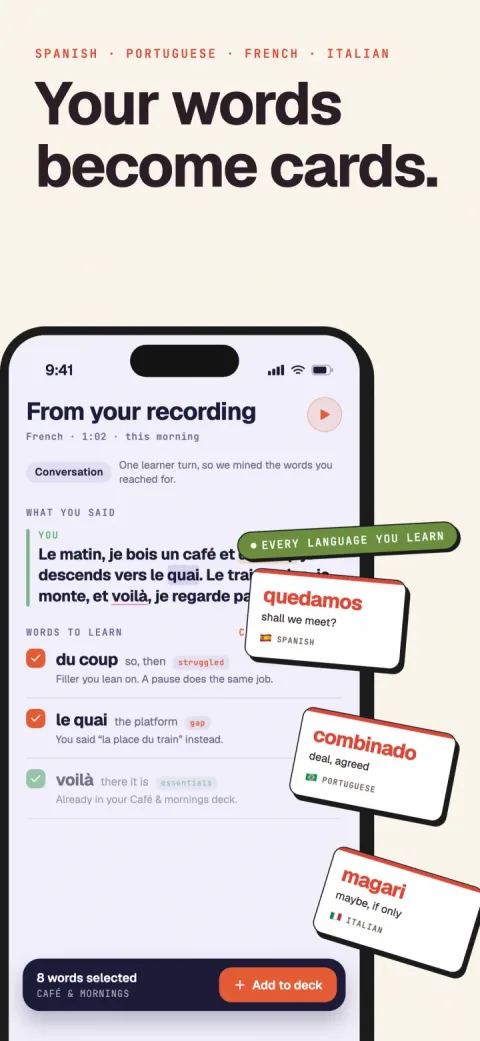
Verbamor turns the words from your own lessons and recordings into flashcards, and brings each one back before you’d forget it.

Once you're past 500 cards, keep about five words from a 60-minute lesson, stick to ones you tried and failed to say, and suspend any card you wouldn't save again. If struggling cards run past about one in ten of your total, you're saving words faster than you can carry them.
At 500 cards your deck stops being a list and starts being a schedule. A card you saved in March comes back in August whether or not you still care about it.
The words you keep today decide how many minutes you owe yourself every morning for the next year. By card 500, that bill is real enough to feel.
Most people who stall at 500 cards didn't stop studying. They kept capturing at the same rate they used in week two, when everything was new and every word felt worth keeping. The fix is to get selective about what enters the deck at all.
Count your struggling cards first
Open Library and read the stats strip. It gives you three numbers: total cards, due today, and mastered. Then look at the four filter chips, because those are the real diagnostic: new, learning, struggling, mastered.
A card counts as struggling when you've forgotten it twice after learning it and haven't yet recovered. A card counts as mastered when it's durable, past roughly 80 days of stability (the scheduler's estimate of how long the memory holds). Those are the two ends of your deck's health.
Tap the struggling chip and count. If struggling cards are running past about one in ten of your total, your deck has a capture problem. You're saving words faster than you can carry them.
Those cards return often, and they push real reviews out of the daily budget. They're the main reason a morning session starts feeling like a chore.
Now check your daily load. In the profile sheet, the session size stepper runs from 5 to 60 cards in steps of 5, and it defaults to 20. That number caps due reviews and new cards together under one budget, so the queue only serves what the day still owes.
Each word carries up to two scheduled items, recognition and recall, counted separately. So a 20-card day is closer to 10 words than 20.
Here's the arithmetic people miss. Every new word you save eventually costs two scheduled items, forever, at a decreasing rate. Save 15 new words a week and you've added 30 items to a queue you already capped at 20 a day.
The cap doesn't break. It just means older cards wait longer, and waiting cards fail more often.
Save a word you reached for and could not say
By card 500 you've met the common words already. What arrives now is longer tail, and much of it isn't worth two items a day of your attention. These are the rules I use.
Save a word only if you already tried to say it. The strongest candidates are the words you reached for in a lesson and couldn't produce. That gap is the evidence. A word you merely read past in a transcript hasn't proved anything about your memory.
Slamecka and Graf's work on the generation effect is the reason this ordering matters: material you produce yourself is remembered better than the same material read.
Prefer the phrase over the word. Verbamor mines multi-word phrases from a transcript alongside single words, and the phrase is usually the better card. A phrase carries the preposition, the article and the word order you'd otherwise get wrong.
One card for darse cuenta de teaches you more usable Spanish than three cards for dar, cuenta and de separately.
Skip anything you can guess from English. Cognates with an obvious shape don't need scheduling. If you can read it cold, it doesn't earn two items a day. Save the near-cognate whose meaning has drifted instead, since that one will actually catch you.
Cap the session. Decide how many cards you'll keep from one recording before you open the multi-select list, and hold to it. Five from a 60-minute lesson is a healthy number at this stage.
The list will offer more, and every one of them will look worth keeping while you're looking at it. That's exactly the problem.
Here's one lesson run through those rules. A 50-minute Spanish conversation about a house move produced a list of 31 candidates. Four survived:
- mudanza, because I said "el moving" out loud and my tutor corrected me.
- echar de menos, a phrase whose parts tell you nothing about its meaning.
- el trastero, a storage room, a thing I need a word for and will use again.
- hipoteca, a mortgage, close enough to nothing in English to be worth scheduling.
The 27 I dropped included casa, grande, and eleven words I could read but had never once tried to say.
Suspend the cards you would not save again
Do this once, today, and then monthly.
- Open Library and select the struggling filter with no deck scope, so you see every language you study.
- Read each card and sort it into one of three piles as you go: still want it, do not want it, want it but the card is broken.
- For the second pile, remove the card from study. A suspended card keeps its history and stops entering the queue, so this is reversible and costs you nothing.
- For the third pile, look at what is actually wrong. Usually the example sentence is one you would never say, or the word has a second meaning that is fighting the card.
- Count what you removed. If it was more than 20 cards, your capture rate for the last two months was too high, and the four rules above are the correction.
Most people clearing this backlog for the first time remove between 20 and 40 cards. The next morning's session is noticeably shorter, and the cards that remain are ones you chose twice.
There's a lighter tool for a single bad day. Snoozing a card direction pushes it out of today's queue without touching its schedule. It applies to one direction, so you can bury a recall item and still see the recognition one.
Use snooze when a card is in your way today. Use suspend when it shouldn't have been saved.
Lower the session size before you lower your standards
Four things move the number of minutes you owe per day, and only one of them is obvious.
Session size. Lower it before you lower your standards. A learner grinding 40 cards a day and grading generously to get through is worse off than one doing 15 honestly.
The stepper's time hint runs about two cards a minute, so 20 cards is roughly a 10-minute session.
Which direction you owe. New words enter as recognition first, with the paired recall item streaming behind. Recall is the harder direction and the one that transfers to speaking.
If your sessions feel too easy and your speaking hasn't moved, the deck is probably heavy on recognition items you keep passing.
Deck scope when you audit. Library's stats read the deck you've selected, so scoping to one deck tells you which part of your collection is rotting.
A card can sit in more than one deck and will show under each, so the section counts can add up to more than your total. That's expected. Scope to a single deck when you want a diagnosis, and clear the scope when you want the true size of your daily load.
Grading honestly. The scheduler reads only your grades. Karpicke and Roediger found something worth carrying here. After students learned foreign vocabulary, repeated studying had no effect on delayed recall, while repeated testing produced a large positive effect.
In the same study, students' predictions of their own performance were uncorrelated with actual performance. Your sense of which cards you know isn't reliable.
The grades are what fix the schedule, so a generous grade is a schedule error you'll pay for in a month.
The images on your cards deserve one note here, because they interact with grading. Carpenter and Olson tested exactly this. Swahili words were not learned better from pictures than from English translations, and learners were more overconfident recalling from a picture than from a translation.
Only when that overconfidence was removed, by retrieval practice or by an explicit warning, did the pictures help. So use the image, and don't let the flash of recognition it gives you turn into a Good grade you haven't earned.
When should you save every word you meet?
Under 200 cards, or when you have a date: the advice above is wrong for those two people.
If you're under 200 cards, ignore every rule above. Early on, volume is the point. Most words you meet are genuinely high value, and the queue isn't yet long enough for a bad card to cost you anything. Capture greedily and sort it out later.
If you have a date, capture wide and study narrow. Someone with a trip in six weeks or an exam in three should save every relevant word and let the near-term reviews handle them. The spacing research points the same way.
Cepeda and colleagues taught more than 1,350 people a set of facts, gave a review after a gap of up to 3.5 months, and tested up to a year later.
The optimal gap, measured as a proportion of test delay, ran from about 20 to 40% of a one-week delay down to about 5 to 10% of a one-year delay. Short horizons want short gaps and more contact. Long horizons want restraint.
Their earlier review of 317 experiments across 184 articles found the same joint relationship: the interval producing maximal retention increases as the retention interval increases.
Pick your keep number before you record
Open Library, tap the struggling filter, and read the first ten cards. Suspend the ones you wouldn't save again today. That takes about four minutes, and it's the whole audit in miniature.
Then, at your next recording, decide your keep limit before you open the list. Write the number down if you have to.
The words you leave behind will come back if they matter. If they never come back, they didn't matter.
Fewer words, kept on purpose.
Verbamor mines words and phrases straight from your recorded lessons, so what makes the cut is what you actually reached for, not everything you happened to hear.
Start 7 days freeThe 7-day free trial is on the yearly plan.