 Verbamor
A year in, losing the thread when two natives talk is the expected result
Thirty minutes a day for a year works out to about 180 hours. The State Department's language school spends roughly 1,200 hours reaching the same level, full time, with professional teachers. Losing the thread when two natives talk to each other a year in is the expected result, not a sign you did something wrong.
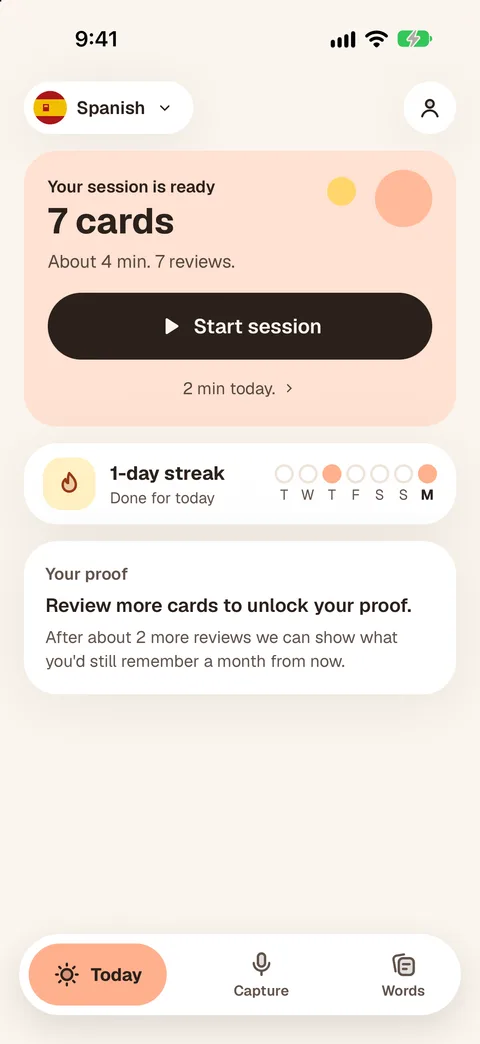
Verbamor opens on one short session a day: the words that are due, and about how long they’ll take.

Thirty minutes a day for a year is 180 hours. The Foreign Service Institute, the State Department's language school, spends roughly 1,200 hours on the same languages. They're taught full-time by professionals to adults who are paid to be there.
You've done about a sixth of that course. So a year in, following a slow conversation and losing the thread when two natives talk to each other is the expected result. It doesn't mean you did it wrong.
The words you add now are rarer, so each one changes fewer conversations. And the words you already have need holding, which is invisible work that produces no new tile on the screen.
Two readers should stop here.
If year one was 15 minutes a day rather than 30, add ten minutes and hold it for a quarter before you do any of what follows. Structure applied to a habit that isn't stable yet just gives you more ways to fail.
And if you're preparing for an exam with a published syllabus, follow the syllabus. It already made these decisions for you.
Full-time training takes about 1,200 hours, and your year was 180
The FSI publishes what full-time instruction costs for each language. Its Foreign Language Training page lists Category I as 24 to 30 weeks and 552 to 690 class hours.
Spanish and French are both at 30 weeks, and Italian and Portuguese at 24. The same page gives the weekly shape: 23 hours in class and 17 hours of self-study.
Thirty weeks at 40 hours a week is about 1,200 hours. At 30 minutes a day you reach about 365 hours by the end of year two. At 45 minutes it's about 550, close to the 552 class hours the FSI gives Italian and Portuguese, though without the classroom, the teacher or the other students.
Cap the reviews, then spend the rest on one narrow front
Holding the words you have and adding new ones are different jobs competing for the same 30 minutes. Give reviews the first slice: do your due cards, then stop even if more are available.
Work out what that slice costs you. A card comes due at roughly its own stability, the interval at which the scheduler predicts a 90% chance you'll recall it.
So a deck of 800 cards averaging 60-day intervals asks for about 13 reviews a day. The same deck at 30-day intervals asks for 27. Divide your card count by your typical interval to get your daily due count.
If reviews are eating more than half the session, the deck has grown faster than the time you have. The fix is upstream, in how many cards you add each week. Studying longer doesn't fix it.
That's where the intake ceiling comes from. Thirty new cards a week is about 1,560 a year.
A deck of that size at year-two intervals settles near 15 to 25 reviews a day. That fits inside a 30-minute session with room to add. Double the intake and the review half alone outgrows the session by spring.
Spend the rest on one narrow front for a whole quarter, written down with the date you'll change it. Say the front is Spanish cooking.
The material is Cocina abierta de Karlos Arguiñano, which airs weekdays at 13:20 on Antena 3. Since June 2026 his son Joseba takes the Friday episode, which gives you a second voice for free.
The recipes are published free on hogarmania.com, so twelve weeks of supply costs nothing and never runs out.
The worked examples here are Spanish, so here's the property to look for in your own language: a daily programme you can follow every weekday, built around one kind of talk.
In Italian that's È sempre mezzogiorno, the Rai 1 cooking programme that started in September 2020 and runs weekdays from just before noon to 13:30.
In Portuguese it's Bom Dia Portugal, on RTP1 every weekday from 06:30 to 10:00. It gives fixed slots to news, sport, weather, traffic and the economy, so you can take one slot at a time.
Import three episodes a week into Record. Keep 8 to 12 words and phrases per episode.
Three episodes at that rate is the 30 a week the review arithmetic above allows. At 20 an episode, you'd be at 60 a week and break it.
Write the ceiling down next to the date, because intake is the number you'll be tempted to raise in week two.
Twelve weeks inside cooking, or inside your actual job, gets you the words that turn up together. You meet them again and again, and every one arrives with a sentence around it.
It also concentrates your failures. When three words that all mean something close to "fry gently" show up in the struggling filter together, they're interfering with each other rather than being forgotten. Suspending two of the three for a month is the fix.
A broad front spreads its failures too thin for that pattern to be visible. Change the front at the quarter. Getting bored in week three isn't a reason to switch.
Raise the difficulty of what you feed in
The most common year-two mistake is buying more time when the fix is harder input. An hour of material you already understand mostly rehearses what you have. Raise the difficulty one rung at a time:
- Drop the training wheels one at a time. If you've been reading the recipe while you watch Cocina abierta, stop, and follow the episode by ear. Hold that for four weeks before you change anything else, so only one variable moves.
- Move from prepared speech to unprepared speech. Radio Ambulante, the Spanish-language narrative podcast NPR has distributed since November 2016, is written and edited before it's read, and it publishes Spanish transcripts you can check yourself against. That's the top of the prepared tier.
- Then take the rung above it. Le téléphone sonne on France Inter has run since 1978, weekdays from 19:20 to 20:00, a live studio debate where listeners phone in. In Spanish the nearest equivalent is Hablar por hablar, the Cadena SER night phone-in running since 1989. Callers interrupt, trail off and use words the guests don't.
Here's the countable test for whether you're on the right rung. Play ten minutes without pausing, then count the words you couldn't catch.
Under about three and the material is too easy, so move up. Somewhere around five to fifteen is the working range. Past twenty-five you're decoding rather than listening, and you should drop back a rung and raise the length instead.
Count rewinds the same way: needing to rewind more than about four times in ten minutes means the rung is too high for now.
Read three numbers your own cards produce
Words studied and kept in 30 days. These sit on the Home proof card and multiply out. Studied times the kept percentage is roughly the number of words you'd still know a month from now.
Watch the percentage. The app schedules against a 90% recall target. The cards themselves put a floor and a ceiling on what you should see.
On FSRS's own forgetting curve, a card with about three and a half weeks of stability predicts about 88% kept over 30 days, and a card at the 80-day mastered line predicts about 95%. So a settled year-two deck reads somewhere in the high eighties to mid nineties.
Below about 85%, you're adding faster than you're holding, and the intake ceiling is what to cut.
The forecast curve. Tap the proof card and you get two lines over a year: what you keep if you review on schedule, and what fades if you stop today. The gap between them is what the upkeep buys, and it's worth looking at on a week you don't feel like studying.
Mastered count. The scheduler tracks a stability figure for every card. FSRS, the open-source algorithm that schedules your cards, defines it as the interval at which it predicts a 90% chance of recall.
Verbamor calls a card mastered once that figure passes 80 days.
On FSRS's default settings a new card needs about five successful reviews in a row to get there, at gaps of 2, 11 and then 46 days, so they're spread over two months or more. So expect the mastered count to climb by something like 2 to 5% of your deck each month: 15 to 40 cards a month on a deck of 800.
Below that, look at the struggling list, because cards that keep lapsing never reach the ladder's top rung.
Cepeda and colleagues (2008, Psychological Science) tested spacing across more than 1,350 people. They found the best gap depends on how long you need the material.
Measured as a share of the test delay, the optimal gap fell from about 20 to 40% of a one-week delay to about 5 to 10% at a year.
That's where a growing mastered count comes from. As stability rises, the scheduler stretches the gaps, so fewer cards come due even as you hold more words.
Check these on the first of the month, spend five minutes, and change one thing.
Fix the struggling cards instead of grinding them
A card counts as struggling once you've forgotten it twice after learning it, and it stays there until it recovers. Some of these are normal.
At a 90% recall target, a card taking six to ten reviews to mature has roughly a one-in-nine to one-in-four chance of lapsing twice on the way. So 10 to 25% of a working deck sitting in that filter is ordinary.
Above about a third, something is wrong with the material or the cards.
A card you've forgotten four times won't be fixed by a fifth review. Open the filter and sort each card into one of these:
- The sentence doesn't pin the meaning. A word in a sentence that would work with ten other words gives recall nothing to grab. Delete the card, find the word in your own recorded material, and rebuild it from a sentence where it carries weight.
- You're learning two words at once. Near-synonyms and near-homophones interfere. Pedir is to ask for a thing and preguntar is to ask a question, and meeting both in the same fortnight makes them easy to swap. Suspend one for a month, learn the other properly, then bring the first back.
- You don't need it. A word you saved once and have never met since is a word your material doesn't contain. Delete it. It will come back if it matters.
Wiklund-Hörnqvist, Jonsson and Nyberg (2014, Scandinavian Journal of Psychology) taught undergraduates key concepts from an introductory psychology course. They compared repeated testing with feedback against rereading.
Testing with feedback came out ahead at every delay they measured. The advantage held for students whatever their working memory capacity.
Retrieval is what holds a word, and a broken card blocks retrieval from happening.
If you’re moving abroad soon, go wide on survival words instead
If you're moving to the country in six months, ignore the quarterly-front advice and go wide on survival vocabulary instead.
Nation (2006) measured coverage of unscripted spoken English. He found the first 2,000 word families cover just over 89% of running words in ordinary conversation, while 3,000 plus proper nouns reach just over 96%. (A word family is a word plus its forms, like talk, talks and talked.)
Aim at the top 2,000 in your language. Over 26 weeks, that's about 77 words a week, or 11 a day.
That's around two and a half times a normal year-two intake, which is why you drop depth to get it. Coverage first, depth after you land, when the street supplies it.
For everyone else, do two things today. Open Library, filter to struggling, and fix or delete the worst ten cards. Then write your next twelve-week front on a piece of paper, with the date you'll change it.
Three numbers tell you what's actually working.
Verbamor's proof card tracks what you've kept and what you're about to lose, and the struggling filter shows which cards keep lapsing, so a five-minute check on the first of the month tells you what to fix before the next quarter starts.
Start 7 days freeThe 7-day free trial is on the yearly plan.