 Verbamor
The cards you keep failing, and what to do
There's a card you've failed nine times: it comes up, you draw a blank, you tap Again, and four days later it does the same thing. Anki calls that a leech and suspends it after eight lapses by default. Most stuck cards trace to one of four fixable causes, from two words competing for the same slot in your memory to a sentence that doesn't actually force the answer.
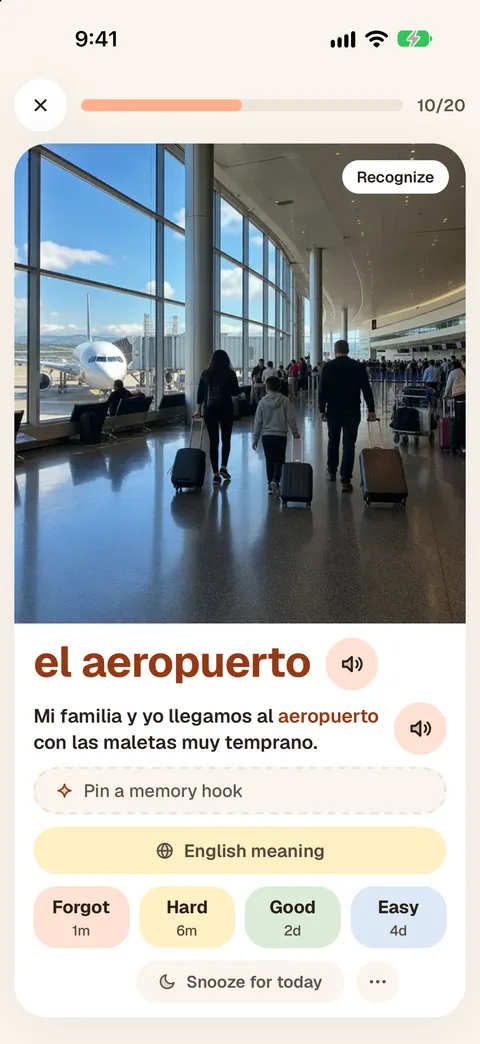
Verbamor turns the words from your own lessons and recordings into flashcards, and brings each one back before you’d forget it.

There's a card you've now failed nine times. It comes up, you draw a blank, you tap Again, and four days later it does the same thing.
You've started to recognize it by the shape of the sentence before you've even read the word. Meanwhile the cards around it are sitting on three-month intervals and behaving themselves.
Anki has a name for this card. It calls it a leech, and the name is well chosen: a small number of these cards will eat a large share of your review time.
In Anki's default settings, per its manual, a card that lapses 8 times gets tagged as a leech and suspended. (A lapse is a failed review of a card you'd already learned.) After that first tag, warnings repeat at half the threshold, so every 4 further lapses.
Verbamor doesn't suspend anything automatically, so the job of noticing falls to you. Here's how to do it, and what to do next.
One failure is normal, and eight mean the memory never formed
A card you fail once is normal. Forgetting is the mechanism the whole system runs on, and a failed attempt followed by the answer is genuinely useful.
Kornell, Hays and Bjork (2009) ran 6 experiments where the retrieval attempt was designed to fail. The materials were trivia questions and word pairs, not foreign vocabulary, but unsuccessful attempts still improved later learning compared with simply being shown the answer. Treat a single Again as the system working.
A card you fail eight times is a different case. Eight failures spread over weeks means the memory never formed at all, and the scheduler has been patiently trying the same approach the whole time.
The scheduler can't see why you're failing. It sees a grade, adjusts an interval, and tries again. It will keep doing that forever, because that's all it does.
So the useful question is what is different about this card. In my experience there are four answers, and they need four different repairs.
The four reasons a card sticks
It's fighting another card. This is the most common cause and the least obvious. Nakata and Suzuki (2019) had 133 Japanese university students study 48 English-Japanese word pairs, half of them related in meaning to each other.
Posttest scores didn't differ much between related and unrelated words. But the related items produced more interference errors: learners kept answering with the wrong word from the set.
Say you have saber and conocer in your deck, or sortir and partir, or ancora and anche. The pair is competing for one slot in your memory, and both cards will thrash.
It has more than one answer. A card that could correctly accept two or three words is a card you can never reliably pass. You produce a valid answer, see a different valid answer, and have to decide what grade that deserves. You'll get that decision wrong in both directions over eight repetitions, and the scheduler receives noise.
The sentence doesn't force the word. If the example sentence would still make sense with a different word in the blank, the sentence is scenery around the blank, with nothing pointing at the answer. You're being asked to guess from nothing, which is why the answer feels arbitrary every time.
You don't know what it means in English. This one is quietly common with abstract words and phrases. You recognize the Spanish, you can even pronounce it, and you've never quite pinned down when a speaker would actually use it. No amount of repetition fixes a definition you never had.
Find your stuck cards in ten minutes
Do this today, before you study.
Open Library and scan for the cards you dread. You already know several of them by name, and that recognition is reliable data.
A card you can identify by feel before you check any number is a card that has been costing you. Write down every one you can name from memory. Most people produce between five and fifteen.
Then go through your next review session with a pen. Any card that produces a blank, or produces the wrong word from a pair you know you confuse, goes on the list.
Don't repair anything mid-session. Finish the session, then sit with the list.
For each card, answer one question: which of the four reasons is this? Say it out loud. Interference, ambiguous answer, weak sentence, or unknown meaning.
If you can't pick one, it's almost always interference, because interference is the one that disguises itself as ordinary difficulty.
Ten to fifteen cards, three minutes of sorting, and you now have a repair list instead of a vague sense that studying has got harder.
Rewrite a stuck card, with one repair per cause
The Anki manual gives the same first answer, and it's right: "The most efficient method to deal with leeches is to change how the information is presented." A stuck card is a design problem. Rewriting it is the fix, and more reps won't do it.
For interference, quarantine one word. Pick the member of the pair you meet more often in real life. Keep that card.
Delete or park the other one until the first is solid, which usually takes two or three weeks of clean passes. The manual recommends exactly this for interference leeches: leave one suspended "until you have learned the other one well, and then unsuspend it."
Trying to learn both at once is what created the problem, and no scheduler setting will resolve it.
When you bring the second word back, save it from a real sentence where the contrast is visible. Record or import a lesson where your tutor uses both, and build the card from that audio. A card that carries the contrast inside its own example teaches the difference instead of hiding it.
For an ambiguous answer, tighten the sentence. Rewrite the example so exactly one word fits. The blank should have a single correct filling that a native speaker would agree on.
In Verbamor, this means editing the card so the sentence constrains the answer. Changing the sentence clears both recordings of it, so the card will regenerate its audio.
That's expected. Let it finish before you study the card again.
For a weak sentence, make it specific and personal. Replace a generic sentence with one describing something that actually happened to you.
Slamecka and Graf (1978) named the generation effect: material you produce yourself is remembered better than the same material read. A sentence about your own Tuesday gives the retrieval something to grab.
For an unknown meaning, stop reviewing and go learn the word. Look it up properly. Read four or five real examples.
Ask your tutor to use it in three sentences in your next lesson. Then rebuild the card.
Reviewing a word whose meaning you never learned is a category error. It's the one case where the repair happens outside the app entirely.
Delete more than feels comfortable
Some cards aren't worth repairing. The manual's second option is blunt about this: "If the material you're struggling with isn't important enough to justify the time spent, you can simply delete the card."
Apply a test. Would you notice this word missing from a conversation you actually have?
A rare literary verb you saved from a podcast, a regional term nobody around you uses, a phrase you can't remember the context for: delete them. They'll come back if they matter, because words that matter keep appearing. Next time you'll meet them with more surrounding language to attach them to.
Deleting feels like failure, and it's worth pushing through that feeling. Every stuck card you remove returns its share of your session to the hundreds of cards that are working. A deck of 400 cards you can pass is worth more than a deck of 600 where 40 are quietly consuming a third of your daily reviews.
Dunlosky and Rawson (2012) found that students who judged their own answers too generously stopped studying early and retained less.
The reverse error is the one here: keeping cards you've judged important without checking whether they are. Both are self-assessment problems, and both get better when you write the judgment down instead of leaving it as a feeling.
Skip this in your first three weeks, or during a backlog
Two cases.
If you've been studying for less than about three weeks, you don't have leeches yet. You have new cards that are still new.
A word needs several successful reviews before repeated failure means anything. Reworking cards in week two mostly rewrites cards that were about to succeed.
If you're coming back from a break with 300 cards due, don't start here either. Clear the backlog first, or reduce your daily limit and clear it over a week.
Failure rates run high on overdue cards for reasons that have nothing to do with card design. A repair list built from a backlog session will be full of false positives. Wait until your reviews are current, give it a week, then make the list.
Open Library now and name the three cards you dread most. Those three are your repair list for tonight.
A stuck card is a design problem, and design problems have fixes.
Verbamor lets you rewrite a card's example sentence directly and regenerates its audio, so a leech gets fixed instead of repeated at you forever.
Start 7 days freeThe 7-day free trial is on the yearly plan.