 Verbamor
Is Duolingo Max worth it? Start with the number nobody prints
Nobody buys Max instead of nothing. They buy it instead of Super, so the gap between the two is the only figure that decides this. No review I checked computes it, and Apple's own listing has a surprise waiting.
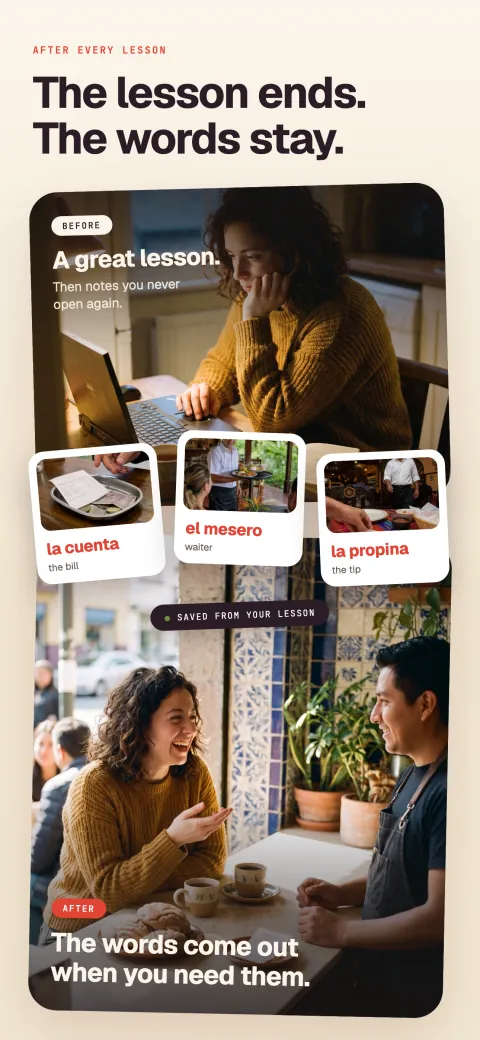
Verbamor records your lesson and turns what your tutor taught into cards that come back on schedule.

Two declarations before a single number, because both change how you should read the rest.
First, I haven't used Duolingo Max. No trial, no subscription, no screenshots.
Everything below is built from Duolingo's own live pages, Apple's listing, and three reviews I read and checked on 21 September 2026. Where somebody else did the hands-on work, I name them and credit it.
Second, I make a paid language app. It competes for the same budget. One short section near the end, and otherwise I leave it alone.
Now the thing that took me by surprise. On 21 September 2026 I pulled Duolingo's US App Store listing and read the In-App Purchases panel. It lists 10 entries.
Six are subscriptions, and every single one is named "Super Duolingo." Not one says Max.
So the honest answer to "how much is Duolingo Max" is that I can't tell you, and neither can any of the reviews I read. That matters more than it sounds, and I'll show you why.
Apple lists six subscriptions, and none is named Max
Here's the panel, transcribed exactly as Apple served it.
I read three other reviews, and all three print a confident $29.99 a month and $168 a year. I couldn't reach a Duolingo page or an Apple listing carrying either figure.
I'm not calling those numbers wrong. Duolingo sells inside the app, while you're logged in, in your region. Three independent writers landing on the same pair is decent evidence they saw it on a real checkout screen.
But none can show you where it came from.
Read your own checkout screen before you trust anybody's arithmetic about this, mine included.
Every review I read asserts a price with a confidence the source material doesn't support.
The step up from Super costs about $84 a year
Here's the framing error underneath all three: they all price Max against zero.
You already have the free tier, or you already pay for Super. So what decides this is what the step up costs and what the step up contains. Call it the delta.
On the reported figures, that delta runs about $84 a year: $168 for Max against roughly $84 for Super. That takes the $83.99 entry on Apple's list as the annual plan, which Apple doesn't label, and Duolingo discounts annual heavily, so read it as an estimate. The Max side is the reported figure from those pages, not one I could confirm.
Roughly half of what you'd pay for Max is buying you things Super already gave you. So a page that leads with $168 has overstated the decision by a factor of two.
Now the other half of the fraction, and this is where it gets interesting. What does that $84 buy?
Duolingo's own announcement page, still live on 21 September 2026, names exactly two: "Duolingo Max is a new subscription tier above Super Duolingo that gives learners access to two brand-new features and exercises: Video Call and Roleplay."
At launch there were three. Explain My Answer was the third, and Duolingo's own post of 1 January 2026 says it "is now free for all Duolingo learners." The same post narrows that to "most learners" in the Spanish, French, German, Japanese, Portuguese, Italian and Korean courses.
This page first credited that change to Nibble's page, because I couldn't reach Duolingo's post in September. I read it on 18 October 2026. It fits the shape of the announcement page too: Duolingo's own page now describes Max as two features, and the phrase "Explain My Answer" appears on it zero times.
Catch what that does to the reviews you're reading. Krioda's review calls Explain My Answer "one of Duolingo Max's most useful features" and rests part of its verdict on it. Fair when written, stale now. You'd be paying for something you already have.
The $84 buys two features, and the calls vary in length
So the real question is narrow. Is roughly $84 a year worth Video Call and Roleplay?
On Video Call, the sharpest number in any review belongs to Krioda, who paid for 3 months across Italian, French and Spanish. He calls them "extremely short," at "around 30 seconds," and "I barely had time to say anything before Lily ended the session."
David Rosales, who has paid for Max for 2 years, reports longer calls that vary unpredictably by level. Separately, he says Lily repeats the same questions and cuts him off mid-sentence.
Two paying users, different lengths. Take from that what it deserves: the call length is inconsistent, which is itself worth knowing before you buy a product whose main feature is the call.
I went looking for a third source neither of them has, and found one on Apple's own listing. Duolingo's US reviews are public, dated and attributable, so I read the 490 most recent, on 21 September 2026.
10 of 490 mention Max at all. That's about 2%, and most of those 10 are complaints about being advertised at. One is a Max Family subscriber.
One 3-star review from 19 September says the "video calls" are "way to hard and if you speak too slowly the app only listens to the first few words you say."
And one review turned up a mechanic no review site mentions. A 4-star review from 17 September: "if you have max, you cannot go down to super."
I can't verify that against a Duolingo page, and I'd treat it as one person's experience. But it points at something real. Apple handles downgrades, and its rule is that a lower tier "continues until the next renewal date, then is renewed at the lower level and price," instead of taking effect when you ask.
Worth knowing before you pick the annual.
One more restriction, placed high up where it belongs. Krioda reports Max is limited to iOS and Android with no web access. That's a hard blocker if you study at a desk, and one of the three other reviews mentions it, near the end.
Max features depend on your course pair
This is the best under-reported finding I came across, and it's sitting in a personal blog.
Rosales pays for Max and still doesn't get all of it: "Not every course even has Duolingo Max. If you have your base language set to something that's not English, you're less likely to have it." His girlfriend's English-to-Spanish account got features his Spanish-to-French account still lacks.
Duolingo's own page backs the shape of it. Video Call and Roleplay both went to "English speakers learning Spanish, French, German, Italian, and Portuguese," while Japanese, Korean and Chinese learners got Video Call only.
That's a 2023 snapshot and coverage has surely moved. So treat it as evidence the rollout was uneven by course pair, and don't read it as a current map.
The practical upshot survives either way. If your course isn't English into a big European language, check what you actually get before paying. The reviews you're reading were written by people on the best-served pair.
A free chatbot talks better, and Max sells the habit
Any general AI assistant will hold a conversation in Spanish, correct you, and explain why, at no cost. That's the objection, and both honest reviewers I read raise it.
Rosales concedes it in his heading, "Yes, You Could Just Use ChatGPT for Free. But I Just Won't," then gives his reason: "If I've spent money on Duolingo Max, I'm not going to let my subscription go to waste. It's using the sunk cost fallacy to your advantage."
I think he's identified the right mechanism and mislabelled it. Paying for a thing you then use is a commitment device, and commitment devices work on the people who need them. What he's describing is buying adherence.
So price it as adherence. Roughly $84 a year over Super buys a conversation partner that's scheduled, sits inside a course that knows what you studied, and nags you. A free chatbot does the talking better and does none of that.
If you've had a free assistant on your phone for a year and never once opened it to practise Spanish, that's your answer. It's a point in Max's favour.
If you would use it and just haven't got round to it, save the $84 and set a recurring reminder.
Credit where it's genuinely due: Duolingo's streak mechanics beat mine at getting people to show up, and I'd rather say that plainly than pretend otherwise. What a streak proves about your Spanish is a separate argument.
Beginners and laptop learners should skip it
Beginners. Video Call and Roleplay are conversation tools, and there's no conversation to have yet. Stay free until you can hold one. Nibble reaches the same conclusion and deserves credit for committing to it in writing.
Anyone whose course pair isn't well covered. Check first.
Anyone who studies on a laptop, given the mobile-only limit.
And anyone currently on Super who's honest about why they stopped opening the app. Removing a limit you weren't hitting changes nothing, and a second AI feature won't fix a habit problem. That's the same trap as buying Super to remove ads that weren't what stopped you.
The buy case is narrow and real: you're past beginner, on a well-covered course, on your phone, and you'll use a scheduled speaking rep you wouldn't otherwise take. Take the monthly first if the option exists in your app. An annual you abandon in week 6 costs the whole year.
Whichever you pick, Apple owns the exit. Its instructions are verbatim: "Tap Subscriptions. Tap the subscription. Tap Cancel Subscription." And if you're on a trial, "cancel it at least 24 hours before the trial ends," which makes cancelling immediately after signing up the sensible default.
Now my part. I build Verbamor, an iOS app that turns vocabulary from your own lessons and conversations into fill-in-the-blank cards with audio. FSRS (an open-source algorithm that predicts when you're about to forget each card) schedules them, in 5 languages.
It's $19.99 a month or $129.99 a year, with a 7-day trial on the annual plan and no free tier. Both are US prices, read off the app's own plan definitions on 21 September 2026; the App Store sets a different number in other countries.
It solves a different problem from Max: past a starter deck of about 650 common words, it holds words somebody already taught you, and it has no course to take you from zero. Those prices sit on a page you can read without logging in, which is the only comparison I'll draw.
And the honest version. If you're starting from zero, the free Duolingo tier beats everything here including mine. If you'll build your own cards, Anki is free on desktop and Android and runs a serious scheduler. The case for paying anyone is narrower than any of these reviews admits.
Sources
What Apple and Duolingo actually publish
- Apple App Store (read 21 September 2026). Duolingo: Language Lessons, US listing, app version 7.140.0 released 14 September 2026. Source for the full In-App Purchases panel, transcribed verbatim: six subscription entries all named "Super Duolingo" ($9.99, $12.99, $79.99, $83.99, $95.99, $119.99), four gem packs ($0.99 to $19.99), no billing term on any entry, and no occurrence of the string "Duolingo Max" anywhere on the page.
- Duolingo Blog (14 March 2023, live 21 September 2026). Introducing Duolingo Max. Source for the quoted definition of Max as a tier above Super containing "two brand-new features and exercises: Video Call and Roleplay", for the description of both features, and for the launch language coverage (Video Call and Roleplay for English speakers learning Spanish, French, German, Italian and Portuguese; Video Call only for Japanese, Korean and Chinese). A 2023 page, treated here as evidence of an uneven rollout rather than current coverage.
- Duolingo Blog (1 January 2026). Explain My Answer is now free for all learners! Read 18 October 2026. Source for Explain My Answer being "now free for all Duolingo learners" and for the seven courses it names.
- duolingo.com/max, /super, /pricing and /plans, all fetched 21 September 2026. Each returns roughly 11KB of client-side shell with no price string in the HTML. Basis for the claim that Duolingo publishes no Max price on the open web.
- Apple Support. If you want to cancel a subscription from Apple. Read 21 September 2026. Source for the cancellation steps quoted verbatim and the instruction to cancel a trial "at least 24 hours before the trial ends."
People who actually paid for it
- Krioda. Duolingo Max review. Read 21 September 2026. Three months of use across Italian, French and Spanish. Source for the ~30-second Video Call measurement and the "I barely had time to say anything" line, for Roleplay responses feeling "scripted", for the mobile-only restriction, and for the stale praise of Explain My Answer as a Max feature. Note the page carries a heading reading "WHY I RATE BABBEL WITH 7/10" inside a Duolingo Max review, which is a template artefact rather than a judgement about either product.
- David William Rosales (27 September 2025). I've had Duolingo Max for 2 years. Read 21 September 2026. Source for the course-pair unevenness quoted verbatim, for the repeated questions and mid-sentence cut-offs, for call lengths varying by level, and for the sunk-cost passage quoted above. Predates the January 2026 Explain My Answer change.
- Apple App Store customer reviews, US, 490 most recent read 21 September 2026 via Apple's public review feed. 10 mention Max, Video Call or Lily. Source for the 19 September 3-star quote about video calls being "way to hard", and for the 17 September 4-star line "if you have max, you cannot go down to super", which is one learner's report rather than documented policy.
The pages this one is arguing with
- Nibble (published 20 June 2026, updated 26 August 2026). Is Duolingo Max worth it? Read 21 September 2026, measured at about 3,100 words across 19 headings. First source for the January 2026 Explain My Answer change, before Duolingo's own post was read. Credited above for committing to a flat "no" for beginners. Its final third is a funnel for the publisher's own app.
- All three other reviews print Duolingo Max at $29.99 per month and $168 per year, and the family plan at $240. Read live on 21 September 2026. None cites a first-party source for any of those figures, and none appears on Apple's listing or on a Duolingo page I could reach, which is why no Max price is stated as fact anywhere above.
What I could not verify
- Any Duolingo Max price, in any currency. Not on Apple's listing, not on a Duolingo page. The roughly $84 delta discussed above is my arithmetic on the reported $168 for Max and the $83.99 Apple entry that looks like an annual Super plan; neither term is confirmed.
- Which billing term belongs to which of the six App Store figures. Apple labels none of them.
- Whether a Max subscriber can downgrade to Super. One App Store review says no; no Duolingo or Apple page states a rule specific to these products.
- Current Max language and course coverage. The only first-party list found is the 2023 launch post.
Keep the words you already paid a tutor for.
Verbamor turns your lesson vocabulary into fill-in-the-blank cards with audio, scheduled so they're still there next month.
Start 7 days freeThe 7-day free trial is on the yearly plan.