 Verbamor
What actually causes the intermediate plateau
The 2,000 most common word families cover about 89 percent of everyday spoken English, and Spanish counts follow the same curve, so early progress feels enormous. The next 4,000 buy only nine more points of coverage, which is why month 18 doesn't feel like month 9. From here, the move that pays is one narrow domain, where the rare words repeat.
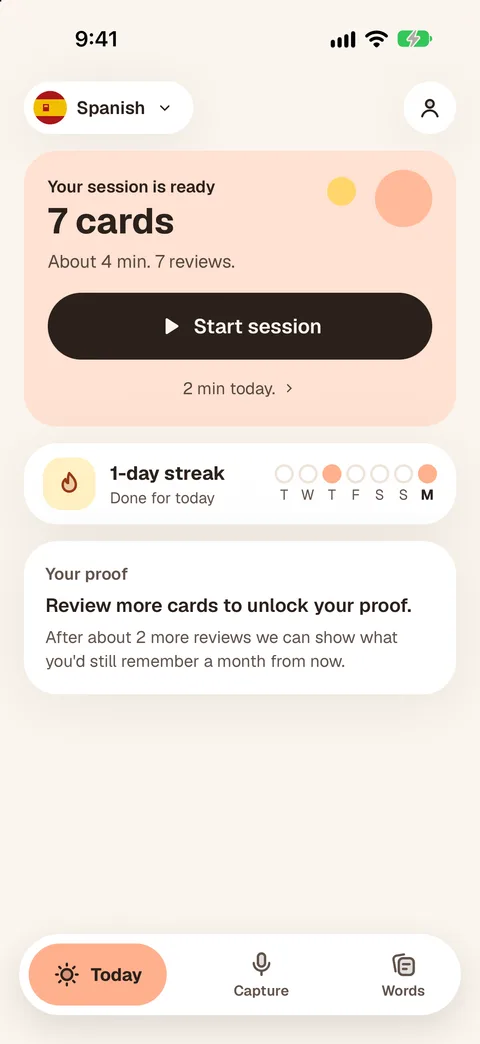
Verbamor opens on one short session a day: the words that are due, and about how long they’ll take.

You can order lunch, argue about the bill, tell a taxi driver where you live, and follow a friend's story about her sister. Then someone at the table says something about the local council, and the whole thing closes over your head.
This happened last month too. It happened six months ago. Your Spanish was clearly getting better for a year, and now it's doing something that doesn't feel like getting better at all.
Your discipline is fine. What changed is what each new word buys you.
The first two thousand words do almost all the work
Paul Nation ran the numbers on what vocabulary size gets you what coverage of real language. (Coverage is the share of words in a text or conversation you already know.)
In his 2006 paper in the Canadian Modern Language Review, he measured transcripts of unscripted spoken English against frequency lists. The lists came from the British National Corpus, which holds a hundred million words of real language.
The most frequent 2,000 word families cover just over 89% of that speech. (A word family is a word plus its forms, like speak, speaks and speaking.) Add the third thousand and proper nouns and you're just past 96%.
Nation treats 98% as the point where you can follow a text without outside help. To reach it, you need 6,000 to 7,000 word families for speech, and 8,000 to 9,000 for written text.
Nation counted English. Spanish bends the same way. Mark Davies counted a Spanish corpus in 2005 and found the first thousand words cover 87.8% of speech. The second thousand add 4.9 points, and the third add 2.3.
Davies counted dictionary headwords, which are narrower than word families, so his figures and Nation's don't line up to the decimal. Both curves go flat in the same place. I use Nation's 89% and 96% for the rest of this piece.
Read those two numbers next to each other. Two thousand words buys you 89%. The next four thousand buys you nine points.
Nation puts a number on what those nine points cost you in a live conversation. At 95% coverage, a listener meets about 7 unknown words in every minute of speech at a speaking rate of 150 words per minute. Run the same sum at 98% and you get three.
Seven misses a minute is the sensation you know. You're following, and then you're reconstructing, and then the topic has moved.
That's the plateau, written as a fraction. In your first year, every hundred words you learned turned up constantly, in every conversation, the same day you learned them. The reward was immediate, and it was large.
You were climbing the steep part of a curve that flattens hard. And you were reading that steepness as progress in general, when it was progress at that particular altitude.
Rarity has a second effect that's easy to miss. A word from the first thousand gets rehearsed for free, dozens of times a week, by ordinary life. A word from the fifth thousand might not cross your path again for a month, which is long enough to lose it.
So the words you're learning now buy less, and they also leak, and you read the leaking as failure.
Now you're past the bend. Do the division and the gap is stark.
These are band averages, and no particular word matches them, because coverage is uneven inside a band. The first hundred words are worth far more than words 1,900 to 2,000.
Spread 89 points of coverage across the first 2,000 words and each one averages roughly 0.045 points. The nine points that take you from 89% to 98% are spread across roughly 4,000 more words, which averages about 0.002 points each.
A word in your first two thousand bought you about twenty times what a word in the next four thousand buys. And the later word takes just as much of your evening to learn.
The scale diplomats are graded on puts you at level 2
The people who train diplomats have graded this exact position for decades. The Interagency Language Roundtable scale, used across the US government, has a level that reads like your week: Speaking 2, called Limited Working Proficiency.
At Level 2 you can "handle with confidence, but not with facility, most normal, high-frequency social conversational situations." The scale then names the exact failure you keep hitting: "Vocabulary use is appropriate for high-frequency utterances, but unusual or imprecise elsewhere."
High-frequency utterances. That's the 89%. Everything else is the nine points.
The next rung is Level 3, General Professional Proficiency. It describes someone who can "participate effectively in most formal and informal conversations in practical, social and professional topics" and whose errors "virtually never interfere with understanding."
Between 2 and 3 sits 2+, where the scale says a speaker "is generally strong in either structural precision or vocabulary, but not in both."
The flat stretch is a documented stage in a graded sequence. It has its own description, and a half-step above it before the next level starts.
The descriptions are public, on the ILR's Speaking page. Reading it for ten minutes is the cheapest diagnostic available to you.
Find the highest level whose description you can honestly claim in full, including the parts you'd rather skip. If you feel stuck, expect to land on 2 and want to claim 2+.
The real hours behind the diplomats’ course come to 1,200
The US State Department's Foreign Service Institute publishes how long its full-time courses run. For Category I languages, the ones closest to English, that is 24 to 30 weeks and 552 to 690 class hours. Spanish and French sit at 30 weeks. Italian, Portuguese and Romanian sit at 24.
The detail almost everybody drops when they quote this is on the same page. FSI describes a typical week as 23 hours in class and 17 hours of self-study.
So the real total behind Spanish at 30 weeks is 40 hours a week for 30 weeks, or 1,200 hours of directed work. A teacher is in the room for more than half of it.
And the target for those hours is stated on the same page: an integrated score of 3 across speaking and listening. That's Level 3, one full level above the one you're standing on.
The full-time diplomatic course, running seven months, aims one level up from where you're stuck.
Compare that to twenty minutes a day on your phone. Twenty minutes a day for a year is about 121 hours. It's a fine habit, and it was enough to carry you across the cheap part of the curve.
The expensive part costs several times more per point of progress, on the same budget. That's why month 18 doesn't feel like month 9.
The room has stopped stretching you
The material you use has quietly stopped being hard. It's podcasts made for learners, the same three friends, a tutor who has learned to speak to you in the vocabulary you already own. This is the part you control most directly.
If the material feels comfortable, you're probably sitting near 98% coverage. That's the threshold Nation names as the point where a listener needs no outside help.
It's the three-misses-a-minute level or better, and it's input that teaches you very little that's new. The input that stretches you sits nearer 95%, the seven-misses-a-minute level, and it feels like failure while you're inside it.
You have built a life inside your own 89%. Everyone around you is helping you stay there, because they are being kind.
The numbers say to go narrow and count your hours
Stop trying to learn more words in general, and start choosing which four thousand.
Pick one domain and go narrow. Rare words stop being rare inside a subject, and the size of a subject is countable. Chung and Nation counted the technical vocabulary in two textbooks in 2003.
An anatomy text of 452,192 running words held 4,270 distinct technical words. Those words covered 31.2% of the text, close to one running word in three. A shorter applied linguistics text held 835 technical words, covering 20.6% of it, one word in five.
So a hard technical field costs a few thousand words, and an ordinary professional one costs under a thousand. In those two books, that bought a fifth to a third of every page.
Football, your job or local politics probably sits nearer the applied linguistics end than the anatomy end. Budget several hundred words, far short of four thousand, and expect them to repeat.
Do this today. Take one real conversation you were part of this week, or a ten-minute clip of something made for native speakers. Write down every word you didn't know. You'll get somewhere between five and twenty.
That list, from your own life, is worth more than the next chapter of any course. Those words already proved they occur in the rooms you sit in.
Count how many hours you're actually giving it. Write the honest number of minutes for last week. Multiply by 52 and divide by 60. That's your hours per year: twenty minutes a day comes out at 121.
Now divide 1,200 by that number. At twenty minutes a day, the answer is ten years to buy what FSI buys a full-time student in 30 weeks.
Write your own year count down. It's the number your expectations should have been built on.
Change who you talk to, or ask them to stop helping. Say this to your tutor: "Please stop simplifying for me. Say it the way you would say it to a friend, at your normal speed, and do not swap the hard word for an easy one."
Then measure the result against a target. You want to be missing something roughly every ten seconds, which is the seven-misses-a-minute rate, about 95% coverage.
If a whole minute goes by and you caught every word, the setting is still too easy, and you should ask again.
This doesn't apply to slow listening, frozen speaking or a four-month start
Say your listening collapses the moment someone speaks at full speed, on words you know perfectly well on a page. Then your bottleneck is processing speed. That wants hours of audio at full speed, and a word list will do very little for it.
If you can read a newspaper comfortably but freeze when you have to say something, you have a production problem. The ILR scale grades speaking, listening and reading separately for a reason: you can sit at a different level in each. More input won't fix a mouth that never practices.
And if you've been at this for four months, you're still on the steep part, having a bad fortnight. The advice above will slow you down.
Sit with something made for native speakers for ten minutes tonight, and write down what you missed. Mark each item as one of three things: a word you've never met, a word you knew but didn't catch in time, or a thing you understood and could never have said.
Those three piles need three different years of work. Until you've counted them, you're guessing at which one you're in.
Learn the words that are actually yours.
Verbamor builds cards from your own lessons and conversations, so the rare words you review are the ones already proven to show up in your life.
Start 7 days freeThe 7-day free trial is on the yearly plan.