 Verbamor
You learned nine words on Tuesday. Three things happened to them by Thursday.
You forget a word between Tuesday's lesson and Thursday for one of three reasons: it never got enough encounters to be learned, it faded fastest on Tuesday night, or you practised recognizing it and never saying it. Each needs a different fix, and a four-minute sort of your notes tells you which.
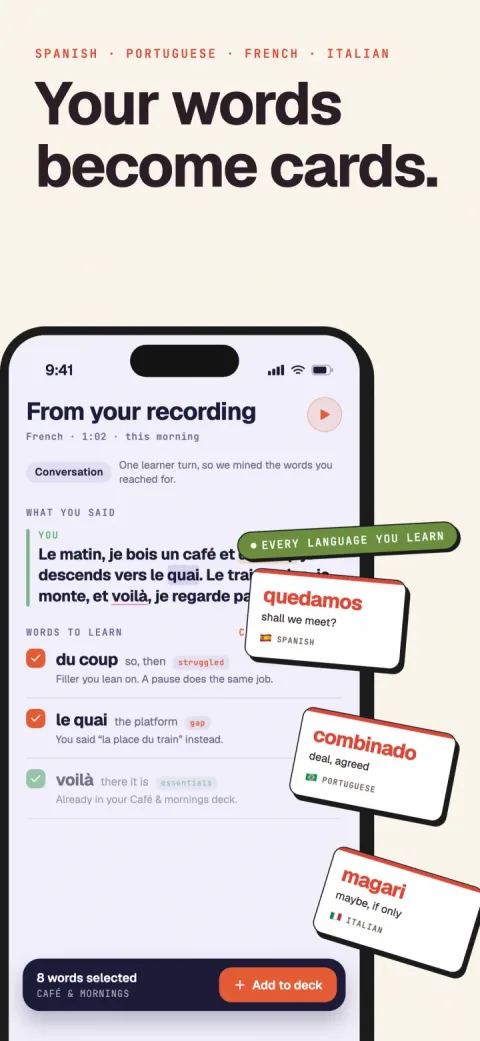
Verbamor turns the words from your own lessons and recordings into flashcards, and brings each one back before you’d forget it.

Tuesday, 6pm. Your tutor uses a word you've never heard. She explains it, you repeat it, you write it in your notes, and for the rest of the hour you understand it every time she says it.
You leave the lesson feeling like you learned nine or ten new words.
Thursday morning you try to use one of those new words in a message and nothing comes. You open your notes. There it is, in your own handwriting, and you don't remember writing it down.
Forgetting a word between Tuesday and Thursday is the normal result of three separate things going wrong. They're different enough that a fix for one does nothing for the other two.
The word never got in at all
Start with the harshest possibility. Some of the words on your page were never learned in the first place. You watched your tutor explain them, and watching an explanation is a different operation from storing a word.
During the lesson, the word is on the screen, in the air, or in the sentence your tutor just said. You have the answer in front of you the entire time you're judging whether you know it. Nothing tests whether you could produce it from a cold start, because the word is never absent.
Stuart Webb measured how much of a word gets built up per encounter. He gave 121 Japanese learners of English unknown words at 1, 3, 7 and 10 encounters in context. Then he tested ten different aspects of word knowledge: spelling, meaning, grammar, the words it associates with.
Knowledge on at least one of those aspects went up every single time the encounter count went up. His conclusion for the top condition is worth reading slowly. At ten encounters "sizeable learning gains may occur", and "to develop full knowledge of a word more than ten repetitions may be needed" (Webb, 2007, Applied Linguistics 28(1), 46-65).
Count your lesson honestly. A word your tutor introduces and uses twice more in passing got three encounters. Webb's three-encounter group learned something real, and it was a long way from full knowledge of the word. On Thursday you were reaching for a word you'd built about a third of.
The word got in, then decayed fastest on the first night
Memory for new material drops fastest immediately after you learn it, then the decline slows down.
Murre and Dros (2015, PLOS ONE 10(7), e0120644) rebuilt Ebbinghaus's 1885 experiment as closely as they could. A single subject spent about 70 hours learning and relearning lists of nonsense syllables, tested at the same delays Ebbinghaus used, from 20 minutes out to 31 days.
They measured savings: the share of relearning time you get back compared with learning a list from scratch. Savings for the replicated subject dropped hardest in the first hour, kept falling through the first day, and were down to single digits by 31 days.
The curve tracked Ebbinghaus's 130-year-old data closely enough that the paper calls it a successful replication. Most of the loss happens early, and very little of what survives the first day is still there a month out.
The practical part of that curve is the timing. The steepest loss from your Tuesday lesson happens Tuesday evening and Tuesday night, two days before you finally look at your notes on Thursday. By the time most learners get around to reviewing, the cheap part of the save is already gone.
Sleep decides a lot of what survives. Gais, Lucas and Born (2006, Learning & Memory 13(3), 259-262) taught high-school students English-German vocabulary and tested them 48 hours later.
Students who slept within a few hours of learning recalled more than students kept awake that first night. The gap was still significant after the deprived group had a full recovery night, and that detail rules out simple tiredness on test day.
What the study manipulated is how soon sleep followed learning. So do your first pass on lesson night before bed, instead of the next morning.
You learned to recognize it, and saying it is a separate skill
The word is completely obvious the moment you see it, and completely unavailable when you need to produce it.
Recognizing a word and saying it are two different abilities, and researchers measure them with two different tests. Receptive knowledge is understanding a word when you meet it. Productive knowledge is getting it out of your own head when you need it.
Hajiyeva (2015, English Language Teaching 8(8), 31-45) tracked 159 first-year English majors at an English-medium university. She tested both abilities, with the Vocabulary Levels Test for reception and the Productive Vocabulary Levels Test for production. Each was given once at the start of the year and again a year later.
Receptive vocabulary barely moved over that year. Productive vocabulary grew by 21%, and even after that growth it still trailed receptive vocabulary by a wide margin.
Recognizing a word is the faster-building skill. Saying it is the one that takes a full year of instruction to close even part of the gap.
Apply Hajiyeva's finding to the page in front of you. A one-hour lesson gives you nowhere near a year of exposure. So if anything, the gap between what you recognize and what you can say is wider on Thursday than it will ever be again.
Most of the words that go silent on you are words you'd recognize instantly if your tutor said them first.
A lesson trains recognition hard and production barely at all. Your tutor supplies the word, you understand it, the conversation moves on. Reading your notes afterward does the same thing again: the word is right there on the page, so you're practising recognition one more time.
Here's the experiment that measures what recognition-only review costs. Larsen, Butler, Aung, Corboy, Friedman and Sperling ran a randomized controlled trial published in Neurology in 2015. (In a randomized controlled trial, chance decides who or what gets each treatment.)
The learners were doctors who attended courses at a neurology annual meeting. Every key point from each course was assigned at random to one of three follow-ups: repeated short-answer quizzing, repeated studying of the material, or no further contact with it at all.
A final test came 5.5 months later. Points that had been quizzed scored 55%. Points that had been restudied scored 46%. Points left alone scored 44%. Restudying landed almost on top of doing nothing.
The restudy group and the quiz group both spent time on the material. One spent it recognizing, the other spent it producing. The pretest average was 36%. So measured against where these doctors started, quizzing held on to close to twice as much of what the course taught.
Reviewing your notes is the restudy condition. It sits next to the group that did nothing, and it feels like the most productive thing you could have done. That's why your sense of how well a lesson went is so consistently wrong.
A four-minute test on Thursday sorts your words into three piles
Take the list from your last lesson and sort each word into one of three piles. This takes about four minutes and tells you which failure you're actually dealing with.
- Cover the target-language column. Look only at the English meanings. Say the target word out loud.
- If it comes out, correct, within about five seconds, put it in pile A.
- If nothing comes, uncover the word and look at it. If seeing it produces an immediate "oh, of course", put it in pile B.
- If seeing it produces nothing, and the word feels new, put it in pile C.
Pile C words never got enough encounters to build anything, so testing yourself on them now tests nothing. Get them to seven encounters, which is Webb's next condition up. Write the four extra encounters into the week: ask your tutor to reuse those words next lesson, and find them twice in something you read before then.
Pile B is the recognition-only pile, and for most people it's the big one. Those words are in your head and can't get out, so they need retrieval (pulling the word out of memory) rather than more reading.
Cepeda and colleagues (2008, Psychological Science 19(11), 1095-1102) ran more than 1,350 people through study sessions at different gaps and tested them at different delays. For a one-week test delay, the best gap was about 20 to 40% of that delay.
Note the limits before you trust it too far. The gaps in that study ran up to 3.5 months and the final tests up to a year. So a seven-day cycle sits at the very short end of what was measured.
Do the arithmetic anyway, because it gives you a date. 20 to 40% of seven days is 1.4 to 2.8 days, which puts your first real retrieval of the pile B words on Wednesday night or Thursday.
Pile A is what you actually own from that lesson, and it's usually a smaller number than the lesson felt like. Leave those words alone until the following Monday, the day before your next lesson. Touch them then only to check they're still there.
Why do two five-minute sittings beat one twenty-minute one?
Spaced study reliably beats massed study (the same time in one block). That holds across the 317 experiments on distributed practice that Cepeda's team reviewed, drawn from 184 articles (2006, Psychological Bulletin 132(3), 354-380).
The gap between study sessions that produced the best retention got longer as the time until the test got longer. Two learners can spend the identical number of minutes studying and land in very different places, purely from how those minutes were split up.
That's why the plan is five minutes on two days instead of twenty minutes on one.
Two kinds of learner can skip this
Two honest exceptions. Maybe your lessons are conversation practice in a language you already speak reasonably well. Then most of what happens in the hour is production already, and the recognition trap barely applies to you. Keep doing what you're doing.
The second exception is bigger. If you finish a lesson and can't remember what the topic was, the problem is upstream of memory. That's a comprehension problem or a pacing problem, and no review schedule fixes it.
Tell your tutor the level is too high. Reviewing material you never understood produces a deck of words you can spell and can't use.
For everyone else: open your notes from the last lesson, cover the target-language column, and count how many words are really in pile A. Then take the pile B words, the ones you recognized but couldn't say. Say each one out loud from the English side tonight before you sleep.
Six words recognized. Four you can actually say.
Verbamor builds two separate cards for every word, one that asks you to recognize it and one that asks you to produce it out loud, so the gap this post describes shows up in your own review queue instead of on Thursday morning.
Start 7 days freeThe 7-day free trial is on the yearly plan.