 Verbamor
A first week checklist, day by day
Verbamor's trial runs seven days, and Apple wants your cancellation at least twenty-four hours before it ends, which leaves six usable days and one real decision. Most people spend that week poking around without ever feeding the app anything real. This is the version where each day has one job, and the whole week costs about an hour.
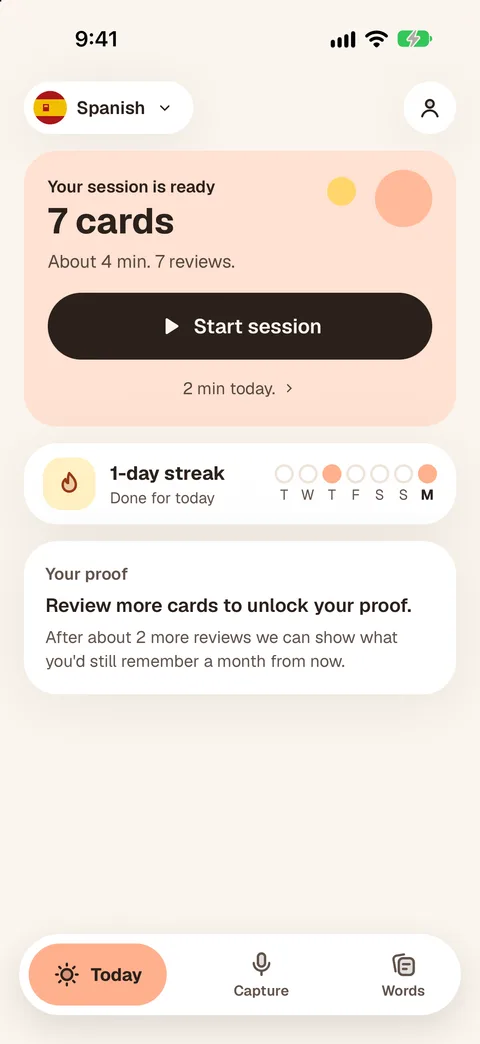
Verbamor opens on one short session a day: the words that are due, and about how long they’ll take.

The trial on Verbamor's annual plan runs 7 days, and Apple wants your cancellation at least 24 hours before it ends. That gives you six usable days and a decision on the sixth.
Most people spend those days poking at the app and never feed it anything real. Then they either pay out of guilt or cancel without ever having seen it work.
Here's the other version. Each day below has one job and a time cost.
The whole week runs about an hour: 55 minutes across the first five days, plus the decision on day 6. By day 6 you'll have a deck built from your own language and enough review history to know whether the thing holds.
Print this or put the days in your calendar now. The week only works if day 1 happens on a day you actually have.
Day 1: install, answer, and feed it one real thing
Budget 15 minutes. Two of those minutes are setup and the rest is the part that matters.
Verbamor runs on iPhone, iPad and Apple Watch, and the iPad app runs on Apple silicon Macs. There's no Android or web version.
It teaches Spanish, French, Italian, Portuguese, Russian and German, and nothing else. If you want Japanese or Korean, close this page: there's no version of the week below that helps you.
Onboarding is a run of one-question screens. Answer them honestly, because two of the answers change what happens next.
One screen asks where your language comes from: a tutor, a class, a conversation partner or podcasts. That decides what you'll be recording all week. The screen asking your level sets how hard the example sentences on your cards come out.
Then make an account and start the trial. The trial sits on the Native annual plan at US$129.99 a year, about $10.83 a month.
The monthly plan, Explorer, is US$19.99 and carries no trial. There's no free tier, so the annual plan is the only door with a trial behind it.
Now the actual job of day 1. Go to the Capture tab and give the app one real thing:
- Record live during a lesson or a conversation. A single capture runs up to 90 minutes, so a full tutor session fits inside one recording.
- Import audio you already have: a file your tutor sent, a downloaded podcast episode, a voice memo.
- Paste text if you have no audio at all: lesson notes, a chat transcript, a paragraph you read.
The app transcribes it and pulls out the single words and the multi-word phrases you met. It hands you a list. Keep 10 to 15 items, no more.
Cards you keep cost you review time for months. So a word you'll never say again is a tax on every session between now and next year.
Before you put the phone down, set a reminder. Put it in your phone's own reminders app for day 6, titled "cancel or keep Verbamor".
Do this on day 1. A trial you meant to handle on day 7 is the single most common way people pay for something by accident.
Day 2: study, and grade a late answer as Again
Budget 10 minutes. Open Study.
Each item you kept on day 1 is now a card with an example sentence, an image, and two recordings of that sentence. One recording has your word replaced by a tone, so you hear the sentence with a hole in it. The other is the complete read.
The front asks you to produce the missing word. Say it out loud before you flip. That's the whole method, and Butler (2010) is the reason.
Across four experiments in the Journal of Experimental Psychology: Learning, Memory, and Cognition, students read prose passages and then either restudied them or took tests on them. A week later they were tested.
Some got the same questions back. Others got new questions requiring an inference, in the same subject or in a subject they hadn't studied. Repeated testing beat repeated studying on all of them.
So a test builds more than the exact answer you practiced. That's what you want from a word you'll meet in a sentence you've never heard.
Then grade yourself: Again, Hard, Good, Easy. One rule carries most of the weight. If the word arrived after you flipped the card, that's Again, including when you recognized it instantly.
Recognizing a word and producing one are different skills, and the scheduler can't tell the difference unless you tell it.
Ten to fifteen cards takes about 5 minutes on the first pass.
Day 3: the day it feels pointless, and the day to record again
Budget 10 minutes: 5 studying, 5 recording.
Day 3 is where people quit. The queue is short, half the words are ones you graded Again yesterday, and nothing feels like progress.
That's the correct shape of day 3. The cards are being re-timed against your actual grades, not against a calendar.
The useful thing to do with the low feeling is to feed the machine again. Record or import a second source. Keep another 10 items.
You now have two sessions of vocabulary from two different days. That's the point at which the queue starts arriving with variety instead of the same twelve words.
If day 3 has no lesson in it, play 3 minutes of a podcast in your language out loud and record that. It's a worse source than your own conversation, because none of it is language you tried and failed to produce. It still works, and it keeps the pipeline moving.
Day 4: save one sentence you couldn't say, through Translate
Budget 10 minutes.
Do the study block first. It should be growing now, somewhere in the 15 to 25 card range depending on how much you kept.
Then open Translate and use it once for a real sentence: something you actually wanted to say this week and couldn't. Translate gives you the sentence, and you can save the whole phrase to your deck as one card.
Test that on day 4 specifically. A phrase you needed and couldn't produce is the highest-value card you'll ever make, and this is the surface that catches those.
Check Library while you're there. Every card you've made lives in it, searchable, with the complete recording of each sentence.
Library answers the question "what have I actually learned". On day 4 the answer is small enough to read in full, and it's worth having looked at once.
Day 5: say four new sentences out loud
Budget 10 minutes, and do this one on purpose.
Study as normal. Then, at the end, do something the app doesn't ask you to do.
Take four words you've reviewed this week and say a sentence with each one out loud, about your actual day. Make each one a new sentence of your own.
That's the test the whole week has been building to. If four sentences come out, the method is working on you, and the app is a fair thing to keep paying for. If nothing comes out, you've learned something equally useful for the price of five minutes, and day 6 is going to be an easy decision.
Sleep matters here in a small, checkable way. Gais, Lucas and Born (2006) had high-school students learn English-German vocabulary.
Those who slept within a few hours of learning recalled more at a test 48 hours later than those kept awake the first night. The deficit was still there after a night of recovery sleep.
A review session in the evening isn't worse than one in the morning. If your only free 10 minutes are before bed, take them.
Day 6: decide, because day 7 is too late
Day 6 is the real deadline. Apple's rule, from its support page on cancelling a subscription: "If you signed up for a free or discounted trial subscription and you don't want to renew it, cancel it at least 24 hours before the trial ends."
To cancel on an iPhone, the same page gives four taps: open Settings, tap your name, tap Subscriptions, tap the subscription, then tap Cancel Subscription.
You may need to scroll to find the Cancel Subscription button. Cancelling stops the renewal, so the annual charge never lands. Do day 6's study block before you cancel, in case your access ends when you do.
To keep it, do nothing, and the annual charge lands. Then put your next three recording sessions in the calendar. The failure mode of month 2 is running out of material to feed it.
Two honest reasons to cancel. If you have no tutor, no class, no conversation partner and no listening habit, the app has nothing to mine. Past the starter deck of about 650 common words, you'll be paying for a flashcard system you must fill by hand.
And if you want a scheduler and nothing else, Anki does that well for a one-time US$24.99 on iOS, as AnkiMobile Flashcards. You build every card yourself, though. You also have to turn on FSRS, the newer scheduler, yourself. Anki's manual page on Deck Options describes it as an alternative to the older SM-2, which is what Anki ships with.
Six days isn't long enough to learn a language. Cepeda, Pashler, Vul, Wixted and Rohrer (2006) reviewed 317 experiments on distributed practice. They found the gap that produces the best retention grows with how far away your test is.
So the intervals that matter most haven't even come due yet by day 6. What six days is long enough for is to find out whether you'll do it.
Open Record. Give it three minutes of something real. That is day 1.
Six days, one job each, then you decide.
Verbamor builds your first cards from a lesson or recording you actually feed it, so by day six you're deciding based on your own review history instead of a guess.
Start 7 days freeThe 7-day free trial is on the yearly plan.