 Verbamor
Language app too repetitive? Find the cause, then fix it
A language app feels too repetitive when it shows you words you know on a fixed schedule, or the same exercise formats every day. Useful review shows a word again just before you'd forget it, so the gaps keep growing.
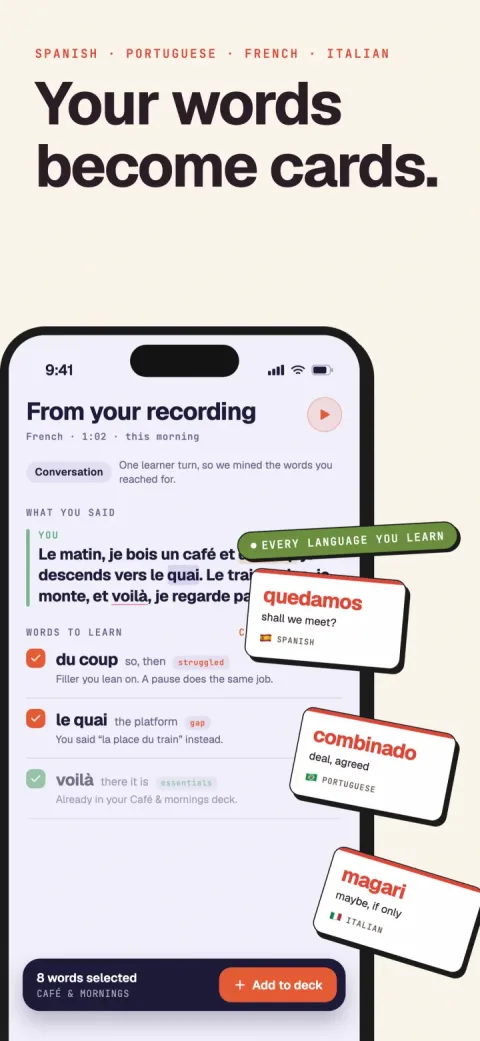
Verbamor turns the words from your own lessons and recordings into flashcards, and brings each one back before you’d forget it.

Flashcard review is repetitive by nature. You can fix the repetition that doesn't match your memory or your level.
A 1-star App Store review of Duolingo puts the feeling plainly: "answer the same questions thousands of times despite getting it right". That feeling usually has one of 5 causes:
- Known words on a fixed path. An easy word returns as often as a hard one.
- A leech. One word you keep missing returns again and again.
- The same exercise formats in every lesson.
- A plateau. The drills stay below your level.
- A review queue that's too big, from too many new words.
Is repetition necessary to learn a language?
Yes, and the research is clear about which kind works.
Cepeda and colleagues reviewed 317 experiments from 184 articles in 2006. Spaced practice beat massed practice. And the best gap between sessions grew as the time you wanted to remember grew.
Karpicke and Roediger taught students 40 Swahili-English word pairs in 2008. Students who kept recalling the words remembered about 80% a week later. Students who only re-studied them remembered 36%.
So useful repetition has 2 features: you pull the word from memory, and the gaps grow. Recall that feels hard is often the useful kind, as I explain in desirable difficulty.
Why does my app keep showing me words I already know?
Your app most likely runs a fixed ladder of gaps. Every word climbs the same steps, however easy it is for you.
Babbel's help centre lists its ladder: 1 day, then 4, 7, 14 and 60 days, then 6 months (read 5 Sep 2026). Memrise's blog listed 8 steps in 2022, from 4 hours to 6 months.
A 2-star App Store review of Memrise says "The app gets stuck in long stretches of reviewing words you already know."
A per-card scheduler such as FSRS sets each gap from your own ratings, so an easy recall earns a longer gap. I explain the model in how FSRS schedules your reviews.
The fix: move your review to a per-card scheduler, such as Anki with FSRS enabled.
Why do I keep seeing the same hard word?
Every miss shortens a word's gap, so a word you keep missing returns often. Anki calls this card a leech.
At 8 lapses (Anki's word for misses), Anki tags the note as a leech and suspends the card.
A fixed ladder makes a leech worse. Memrise's 2022 blog says one miss sends a word back to the first step, 4 hours. Clozemaster's FAQ says one miss resets a sentence to 0% mastered.
The fix: change the card, which Anki's manual calls the most efficient method. Start with a memory hook.
If 2 similar words cause the miss, study them a few days apart. If the word doesn't matter to you yet, remove it.
Why does every lesson look the same?
Many course apps build lessons from a small set of exercise formats, such as matching pairs or putting word tiles in order. After a few weeks, you know the format better than the words.
A 1-star App Store review of Busuu says "the structure of the lessons are practically the same from lesson to lesson".
Tap-and-match formats show the answer among the options, so you can recognize a word you can't yet recall. Karpicke and Roediger's result says recall is the step that builds memory.
Game loops add a second layer. A streak counts days of study, and an easy day counts the same as a hard one.
The fix: add input and speaking outside the app.
Why do language apps stop working at the intermediate level?
A course app's drills stay at the course's level. Once you outgrow that level, the same formats feel like busywork.
Check your course's ceiling first. On 22 April 2026, Duolingo said its Spanish, French, Italian and Portuguese courses now teach through CEFR B2 for most learners. Duolingo says most of those learners could only reach A2 content before that.
So a comparison that puts Duolingo's ceiling at A2 or B1 may predate that change. Russian wasn't on Duolingo's B2 list.
Past the ceiling, these 4 activities add the context and speaking a drill can't:
- Shows and podcasts. Real speech puts words you know into new sentences. Lingopie, for example, plays TV with clickable subtitles (read 11 Aug 2026).
- Whole sentences. Clozemaster blanks 1 word in each sentence, and its sentences come from the Tatoeba dataset. Its FAQ calls it an answer to "What should I do after Duolingo?"
- Speaking from meaning. Duolingo's speaking exercises put a sentence on screen before you speak. A conversation makes you find the words yourself.
- A weekly talk with a person. Saito and Akiyama followed 30 Japanese university learners for a semester in 2017. Those with weekly video calls improved in comprehensibility, speech rate, word variety and grammar.
In the same study, pronunciation didn't improve significantly. And a flashcard app can't fix this cause. That includes Verbamor, which I build.
Why is my review queue so big?
A big review queue usually comes from too many new words a few weeks earlier.
Anki's manual gives a rule of thumb: 20 new cards a day leads to about 200 reviews a day. A queue that size is mostly familiar cards, so it feels repetitive.
In Anki with FSRS, a higher desired retention also means more reviews. The default is 90%.
The fix: add fewer new words each day. The queue shrinks as older cards reach longer gaps.
How do language apps space their reviews?
Each row gives the date I read the company's own page.
| App | How the gap is set | After a miss, or other limits | Read |
|---|---|---|---|
| Babbel | Fixed ladder: 1, 4, 7, 14 and 60 days, then 6 months. | You can't add your own words to review. | 5 Sep 2026 |
| Memrise | Fixed ladder: 4 hours up to 6 months, in 8 steps. | A miss sends the word back to 4 hours. | Blog post from 2022, live 12 Oct 2026 |
| Clozemaster | Fixed ladder: 1, 10, 30 and 180 days. Pro users can change the gaps. | A miss resets the sentence to 0%. | 13 Oct 2026 |
| Anki | SM-2 by default. FSRS, built in since version 23.10, is opt-in. The longest gap defaults to 100 years. | Anki suspends a card as a leech after 8 misses. | 17 Oct 2026 |
| Quizlet | Spaced repetition since 21 Aug 2026, with 4 rating buttons. Quizlet names no algorithm. | Spaced repetition works only on the Quizlet website. | 21 Sep 2026 |
| Duolingo | Published half-life regression in 2016. Duolingo hasn't published what schedules reviews today. | The Practice tab has a Mistakes review for all learners. | 17 Oct 2026 |
| Verbamor | FSRS-6 for every card. You set 5 to 60 reviews a day. | You can snooze a card for the day or remove it from study. | 17 Oct 2026 |
My longer comparison of the 2 designs is in spaced repetition for language learners.
What can I change today?
Steps 8 and 9 happen outside your app.
- Cut your new words per day by half for 2 weeks.
- Rate a card Easy when the answer is instant.
- Rate a near miss as a miss.
- Find the word you miss most often.
- Add a memory hook to that word.
- Remove that word from study if the hook doesn't help.
- Add 10 words from your own week, such as words you said or heard.
- Listen to a podcast or show in the language 3 times a week.
- Book a weekly conversation with a tutor or a language partner.
What does my app do about repetition?
Verbamor schedules every card with FSRS-6, so a word you know well waits longer between reviews.
You set daily reviews from 5 to 60 and new words per day from 5 to 30. You can snooze a card for the day, remove it from study or add a personal note as a memory hook.
Cards come from Essentials, a starter deck of about 650 common words, or from words you save from lessons, audio files, pasted text or Translate. Ask people's permission before you record a conversation.
It still repeats. Each new word becomes 2 cards, so 10 new words add 20 cards to your review queue. There's no desired-retention setting to trade some memory for fewer reviews.
A streak exists, and skipping a day resets it to 1. There's no course beyond Essentials. AI models write the card text, example sentences and pictures, with automated checks and no human review.
Who should pick something else?
If you want more variety inside one app, stay with Duolingo and use its Practice tab and Stories. Duolingo said on 18 February 2026 that Practice tab sessions are open to all learners at no cost.
If you want no flashcards at all, use an input app, podcasts or a tutor. Verbamor is a flashcard app, so it won't suit you.
If you want a scheduler with no subscription, use Anki or Clozemaster. Anki is free on desktop and US$24.99 one-time on iPhone, and it needs some setup, including enabling FSRS. Clozemaster's FAQ says it's free to sign up and play.
If you want a set course with grammar lessons, or an Android app, Verbamor has neither.
Questions people actually ask
Is repetition necessary to learn a language?
Yes. Cepeda and colleagues reviewed 317 experiments in 2006, and spaced practice beat massed practice. In Karpicke and Roediger's 2008 study, students who kept recalling word pairs remembered about 80% a week later, against 36% for re-studying.
How often should I review a word?
Review a word just before you'd forget it, so the gaps grow each time. Babbel's fixed ladder is 1, 4, 7, 14 and 60 days, then 6 months. Per-card schedulers like FSRS set each gap from your own ratings.
Why does my language app keep showing me words I already know?
Your app most likely runs a fixed ladder, so every word climbs the same steps. Memrise's blog listed 8 steps in 2022, from 4 hours to 6 months. A per-card scheduler such as FSRS gives an easy word longer gaps.
Why do I keep seeing the same hard word?
Every miss shortens a word's gap, so a word you keep missing returns often. Anki calls this card a leech and suspends it after 8 misses. Add a memory hook, or remove the word from study.
Why do language apps get boring at the intermediate level?
Course apps repeat a few exercise formats, and the drills stay at the course's level. Add input and speaking, such as a show with subtitles or a weekly talk with a tutor.
Will switching apps fix a repetitive language app?
Switching helps when a fixed ladder keeps showing known words. It won't help when the cause is too many new words or inaccurate ratings. Flashcard review repeats in every app, so find the cause first.
Sources
Research
- Cepeda, N. J., Pashler, H., Vul, E., Wixted, J. T., & Rohrer, D. (2006). Distributed practice in verbal recall tasks: A review and quantitative synthesis. Psychological Bulletin, 132(3), 354–380.
- Karpicke, J. D., & Roediger, H. L. (2008). The critical importance of retrieval for learning. Science, 319(5865), 966–968.
- Saito, K., & Akiyama, Y. (2017). Video-based interaction, negotiation for comprehensibility, and second language speech learning: A longitudinal study. Language Learning, 67(1), 43–74.
- Settles, B., & Meeder, B. (2016). A trainable spaced repetition model for language learning. ACL 2016.
How each app works
- Babbel help centre, Vocab workout: Review. Read 5 Sep 2026.
- Memrise blog, February product roundup, dated 21 Feb 2022. Live 12 Oct 2026.
- Clozemaster, FAQ. Read 13 Oct 2026.
- AnkiMobile, US App Store listing. Read 13 Oct 2026.
- Anki manual, Deck options and Leeches. Read 17 Oct 2026.
- Quizlet help centre, Studying with Spaced Repetition. Read 21 Sep 2026.
- Duolingo blog, guide to the Practice Hub, dated 18 Feb 2026. Read 17 Oct 2026.
- Duolingo blog, Our top courses now teach advanced content, dated 22 Apr 2026. Read 13 Oct 2026.
- Duolingo blog, Duolingo's approach to speaking skills, dated 9 Feb 2026. Read 18 Oct 2026.
- Lingopie, homepage. Read 11 Aug 2026.
Reviewer quotes
- Apple App Store customer reviews of Duolingo, Memrise and Busuu, fetched 17 Oct 2026. Quotes are verbatim.
Review that spaces out as a word gets easy.
Verbamor schedules every card with FSRS-6, so a word you know well waits longer between reviews. It's still daily flashcards, with gaps that grow.
Start 7 days freeThe 7-day free trial is on the yearly plan.