 Verbamor
Te quiero or te amo: which one to say, and to whom
Say te quiero to your mother, your best friend and your partner. Save te amo for the moments that would make you say “I love you” slowly in English. In Google’s Spanish books, te quiero turns up about twice as often as te amo, and only a small share of that comes from querer meaning “to want.”
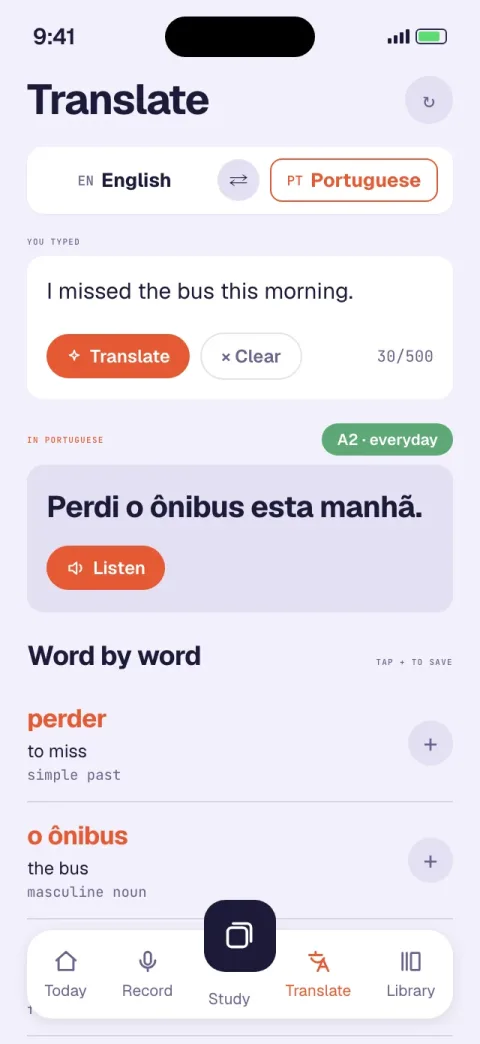
Verbamor translates a phrase, breaks it down word by word, and saves the words you tap as cards.

Te quiero is the everyday “I love you”, and te amo is the heavier one. Spanish speakers say te quiero to parents, children, friends and partners. Te amo is usually romantic, and it lands with more weight. If you only learn one, learn te quiero.
The mistake to avoid is the birthday message. Type “love you!” to a friend, let a translator turn it into te amo, and you've sent something closer to a confession than a birthday wish.
If you're collecting phrases like this for real conversations, the Spanish flashcards guide covers where good cards come from. This page is about the two that matter most.
Te quiero is the everyday one, and te amo is the heavy one
Use te quiero by default. It covers the people you love in ordinary life, and it doesn't sound like a proposal.
Use te amo when the moment is big and romantic: an anniversary, a wedding, the first time you say it to a partner and mean it. Some parents say it to their children too, and some couples say it every night. It reads as deeper and more solemn than te quiero.
English has the same gap in a softer form. “Love you!” at the end of a phone call and “I love you” said slowly at a kitchen table are different events. Te quiero stretches across both. Te amo lives mostly at the kitchen table.
In Spanish books, te quiero turns up about twice as often
In the Google Books Ngram data for Spanish, te quiero appears about 8.0 times per million words in 2022. Te amo appears about 4.2 times. That's a ratio of roughly 1.9 to 1.
The lead has held for over a century. In every year from 1900 to 2022, te quiero came out ahead, by anything from 1.3 to 4.2 times.
The “a lot” versions split even harder. Te quiero mucho shows up about 0.38 times per million words, and te amo mucho about 0.05. That's about 7 to 1.
I read that as a clue about tone. Te quiero mucho is warm and casual, the kind of thing you'd write on a card to an aunt. Te amo rarely needs a mucho, because it's already the big version.
Two limits on these numbers. Books aren't conversation, and the Ngram corpus can't be split by country. It also counts every te quiero, including the ones that have nothing to do with love, which is the next section.
Querer also means “to want,” and context decides which
Querer is the everyday verb for wanting. Quiero un café is “I want a coffee.” So te quiero also turns up inside phrases like te quiero decir algo, “I want to tell you something.”
Those uses are in the book counts above. Te quiero decir alone appears about 0.24 times per million words, and te quiero ver about 0.13. They're a small slice of the 8.0, so the love sense still wins by a wide margin.
In speech, the context settles it. A te quiero on its own, at the end of a call, is love. A te quiero followed by a verb is wanting.
One grammar point catches English speakers. When querer means loving a person, the person takes a: quiero a mi madre, “I love my mother.” Drop the a and the sentence starts to sound like you want to acquire her. Te already marks the person, which is why te quiero needs nothing else.
Amar has one job. It means to love, and it never means to want, which is part of why it sounds heavier.
Who gets which: a rule of thumb
This table is my rule of thumb, built from the usage above. It's a default to start from, and your own people will adjust it.
| Who | Default | Notes |
|---|---|---|
| Parent or grandparent | te quiero | Often te quiero mucho. Some families use te amo too. |
| Your child | te quiero | Plenty of parents say te amo. Both are normal. |
| A close friend | te quiero | Te amo to a friend reads as a joke, or as a confession. |
| Someone you're dating, early on | neither yet | Me gustas (“I like you”) is the honest step. |
| A partner | te quiero | Te amo for the big moments, or every day if that's your habit together. |
| Vows, anniversaries, a proposal | te amo | This is where the heavier word fits best. |
The one row I'd defend hardest is the friend. A te amo on a friend's birthday message gets a laugh at best. A te quiero gets a yo también.
With a partner, say back what you hear
With a partner, match their habit. If they say te amo every night, say it back. If they end calls with te quiero, that's your phrase.
Where people use which phrase is the part I'm least sure of. Plenty of blogs say te amo is more common between partners in Mexico or Colombia than in Spain, and plenty say the reverse. I looked for a corpus count by country and found none, so I won't give you a ranking.
What I can say is that a partner's own habit beats any national average. Families have their own versions too. Some never say te amo out loud and write it in cards; some say it on every call.
Saying it first is a separate question. Te quiero said early is a warm, safe step. Te amo said early is a declaration, and it carries the same risk the English sentence does.
To answer either one, add yo también: yo también te quiero, “I love you too.” Matching the verb they used is the polite default.
Me gustas, te adoro and te extraño cover the rest
Spanish has more words for this than the two famous ones, and a few of them fill the gaps around te quiero.
- Me gustas. “I like you,” in the crush sense. It's attraction, and it's the honest thing to say in month one.
- Me caes bien. “I like you” as a person, with no romance in it. Useful for a new colleague, and safe.
- Te adoro. “I adore you.” Affectionate and a little playful, said to partners, kids and close friends.
- Te echo de menos and te extraño. Both mean “I miss you.” You'll hear the first a lot in Spain and the second across much of Latin America.
Watch the verb gustar with people. Me gusta Ana is a crush on Ana, so “I like Ana as a friend” wants me cae bien Ana. It's one of the more common ways to say more than you meant.
Learn each phrase inside a sentence, out loud
Learn these as whole sentences you can say, attached to a real person. Te quiero mucho, mamá sticks better than querer on a vocabulary list, because the sentence is the thing you'll actually produce.
Say it out loud while you practise. Words you say aloud are remembered better than words you read silently, which is the production effect. And the phrase has to come out with a person in front of you. That's a different job from recognizing it on a screen, as why you know the word in the app and not at the restaurant explains.
Honestly, you don't need an app for two phrases. Write te quiero and me caes bien on a sticky note, say each one to the mirror, and you're done.
An app starts to earn its place later, when the phrases come from your own life. Think of the nickname your partner's mother uses, or the way a friend signs off a voice note. That's what I built Verbamor for. You record or type what came up in a conversation, and it makes fill-in-the-blank cards with native-accent audio, scheduled so each phrase comes back before you lose it. It's on iPhone and iPad, at $19.99 a month or $129.99 a year.
Questions people actually ask
Can I say te quiero to a friend?
Yes. Te quiero is the normal thing to say to close friends in Spanish, and te quiero mucho is common in messages. It carries no romantic signal on its own. Te amo to a friend would sound like a joke or a confession.
Is te amo stronger than te quiero?
Usually, yes. Te amo is the heavier, more romantic phrase, and it suits big moments like anniversaries and vows. Te quiero covers everyday love for family, friends and partners. Some couples say te amo daily, so follow your partner's habit.
How do you reply to te quiero?
Say yo también te quiero, “I love you too.” If someone says te amo, the matching reply is yo también te amo. Replying with the same verb they used is the safe default.
Does te quiero mean “I want you”?
Not when it's said on its own as affection. Querer does mean “to want,” so te quiero decir algo is “I want to tell you something.” But a te quiero at the end of a call or a message means “I love you.”
Sources
How often each phrase appears
- Google Books Ngram Viewer. te quiero, te amo, Spanish corpus, 1900–2022, no smoothing. Read 13 October 2026: te quiero 8.0 and te amo 4.2 per million words in 2022.
- Google Books Ngram Viewer. te quiero mucho, te amo mucho, te quiero decir, te quiero ver. Read 13 October 2026: 0.38, 0.05, 0.24 and 0.13 per million words in 2022.
Keep the phrases they actually say to you.
Verbamor turns the words and phrases from your own conversations into fill-in-the-blank cards with native-accent audio, so the right one comes out when you need it.
Start 7 days freeThe 7-day free trial is on the yearly plan.