 Verbamor
Ser vs estar: the quick rule, and the six places it breaks
Use estar for where something is and for the state it’s in (está aquí, está cansado). Use ser for what something is: identity, origin, job, time, and where an event takes place. The “permanent vs temporary” rule gets most sentences right and fails on about six kinds, and the Instituto Cervantes curriculum spreads them from A1 all the way to C2.
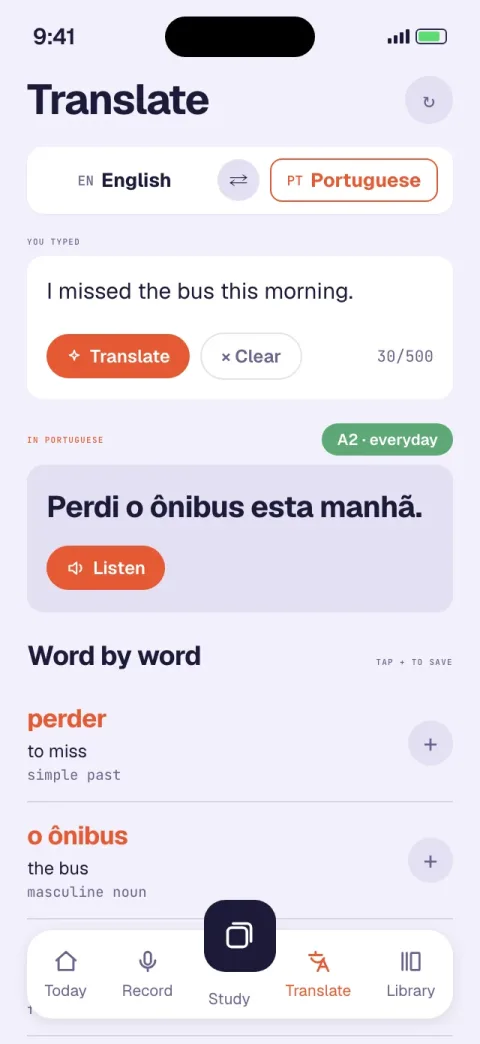
Verbamor translates a phrase, breaks it down word by word, and saves the words you tap as cards.

Estar is for where something is and how it is right now. Ser is for what it is. El café está frío: the coffee's cold at the moment. El café es colombiano: that's what it is. That rule gets most sentences right.
It fails in a handful of places that come up constantly, and those are the sentences that make ser and estar feel random. This page gives you the quick rule, the six exceptions, and a test you can run in two minutes.
If you're carding these as you go, the Spanish flashcards guide covers what a good sentence card looks like, and the verb flashcards page has the conjugation side.
Estar is where and how something is; ser is what it is
Start with the uses the Instituto Cervantes curriculum puts at A1 and A2. Instituto Cervantes is the Spanish government's language institute, and its Plan Curricular lists what learners meet at each level, with examples.
Ser, at the start:
- Who someone is: Soy Elena.
- What group they belong to, such as origin or job: Soy español. Soy estudiante.
- The day or the time: Es lunes. Son las tres.
- Traits that belong to someone: Luis es sincero.
Estar, at the start:
- Where something is: Está aquí.
- How someone is doing: Está bien. Está contento.
- The “-ing” form: Está escribiendo.
- A state that resulted from something: El coche está estropeado, the car is broken.
Two shortcuts help here. If you could ask “where?” or “how are you?”, it's probably estar. If you could ask “what is it?” or “who is it?”, it's ser.
Permanent vs temporary fails in six predictable places
The textbook shortcut is “ser for permanent, estar for temporary.” It works often enough to be dangerous. Here are the six places it breaks, most of them taken from the Cervantes curriculum's own examples.
1. Death takes estar
Está muerto, he's dead. Nothing is more permanent, and it still takes estar, because death is a state someone ended up in. Think “how is he?” and the verb follows.
2. Events take ser, even for where
Location is estar, unless the thing is an event. The curriculum puts the two side by side: La cita es en el cine Callao, the date is at the Callao cinema. El cine está en la plaza de Callao, the cinema is in Callao square.
A party, a meeting, a concert or a wedding “is” somewhere with ser: la fiesta es en mi casa. A building or a person “is” somewhere with estar.
3. A job you're doing for now takes estar de
Your job is ser: es médico. A job you're filling for a while takes estar de: está de médico en La Paz, he's working as a doctor in La Paz. Cervantes places this one at B1 or B2.
4. Prices and temperatures that move take estar
A price that changes from day to day takes estar a: el euro está a… and then the rate. So does the temperature: estamos a tres grados, it's three degrees. A fixed price with ser asks what it costs: ¿cuánto es?
5. Some adjectives change meaning between the two
Most adjectives work with both and shift the angle. Es delgado says he's a slim person; está delgado says he looks slim now, maybe after being ill. The curriculum gives that pair at B1 and B2.
A few change meaning outright, and the curriculum names two of them:
- Es listo means he's clever. Está listo means he's ready.
- Es verde means it's green. Está verde means it's unripe.
6. A trait shown once can take estar
This one sits in the C1 to C2 list. Ha sido muy amable al invitarme, it was very kind of her to invite me, describes her kindness. Ayer estuviste muy amable, you were very kind yesterday, frames it as how you were on one occasion.
Both are correct. The difference is a shade of meaning, and it's the reason advanced speakers still pause over ser and estar now and then.
Cervantes teaches ser and estar across all six levels
The Instituto Cervantes curriculum doesn't treat ser and estar as one lesson. It spreads them across all three pairs of levels, A1 to C2, and adds new uses at each stage.
| Levels | Ser | Estar |
|---|---|---|
| A1–A2 | Soy Elena. Soy estudiante. Es lunes. Luis es sincero. | Está aquí. Está contento. Está escribiendo. Estamos a tres grados. |
| B1–B2 | Events: El concierto es en el auditorio. Meaning shifts: es listo | Está de médico en La Paz. El euro está a… Está delgado. |
| C1–C2 | Ha sido muy amable al invitarme. Es listo como el hambre. | Ayer estuviste muy amable. Está para salir. Está que arde. |
That table is the good news. If ser and estar still trip you at B1, you're on the curriculum's schedule. The institute behind Spain's official DELE exams spreads the full picture over all six levels.
It also tells you what to learn next. If you've got the A1 column, the next step is events and the meaning-changing adjectives. Skip está para salir until much later.
Learn each use as a sentence, first apart and then mixed
Learn ser and estar as whole sentences, one use at a time, and contrast them only once each one is solid. Two words this close interfere with each other when they arrive together.
That interference has been measured for vocabulary. Thomas Tinkham found in 1993 and again in 1997 that learners given sets of closely related words needed more trials to learn them. Those studies tested word sets, not grammar, so take it as a reason to separate them rather than a proof.
So spend a week on estar for location and states, with sentences about your own flat and your own day. Then a week on ser for people, jobs and events. Then mix them, which is where interleaving pays off: mixed practice forces you to choose, and choosing is the skill.
Every card should be a sentence you might say, with the verb missing. Pulling the verb out of memory does more than rereading the rule, which is the testing effect. And grade yourself strictly: if you needed to see the answer, mark it wrong (more in how to grade yourself honestly).
A tutor or a grammar book is the right place to learn the rules themselves. Verbamor has no grammar lessons. It's for the sentences you've already met. You record or type what came up in a lesson or a conversation, and it makes fill-in-the-blank cards with native-accent audio, scheduled to come back before you forget them. If la fiesta es en mi casa came up on Tuesday, you can save that phrase as a card. It's on iPhone and iPad, for $19.99 a month or $129.99 a year.
Ten sentences to check yourself
Cover the right-hand columns and say each sentence out loud with the verb. Then check the answer and the reason.
| Sentence | Answer | Why |
|---|---|---|
| La fiesta ___ en mi casa. | es | An event |
| Mi casa ___ cerca del metro. | está | Where a place is |
| ___ las tres y media. | Son | The time |
| La sopa ___ fría. | está | How it is right now |
| Mi hermano ___ médico. | es | His job |
| Este verano ___ de camarero. | estoy | A job for now |
| El plátano todavía ___ verde. | está | Unripe |
| Tu hija ___ muy lista. | es | Clever |
| ¿___ listos? Nos vamos. | Estáis or Están | Ready |
| El pez ___ muerto. | está | A state, however final |
Missed the event, the job-for-now or the fish? Those are exceptions from the list of six above, and they're the ones to card this week.
Questions people actually ask
Is muerto used with ser or estar?
With estar: está muerto. Death is permanent, but Spanish treats it as a state someone is in, so it takes estar. That's the clearest case where the “permanent means ser” rule fails.
Why is it “la fiesta es en mi casa” and not “está”?
Because a party is an event, and events take ser for where they happen. Places and objects take estar: mi casa está en el centro. The Instituto Cervantes curriculum teaches this contrast at B1 to B2.
What's the difference between es listo and está listo?
Es listo means he's clever, and está listo means he's ready. A few adjectives change meaning like this, including verde: es verde is green, está verde is unripe.
Is there one simple rule for ser and estar?
The closest is this: estar for where something is and how it is right now, ser for what it is, including time, jobs and where events happen. It covers most sentences. The exceptions are a short list worth learning as example sentences.
Sources
Which uses come at which level
- Instituto Cervantes. Plan Curricular, Gramática, inventario A1–A2, section 12.1. Read 13 October 2026.
- Instituto Cervantes. Plan Curricular, Gramática, inventario B1–B2, section 12.1. Read 13 October 2026.
- Instituto Cervantes. Plan Curricular, Gramática, inventario C1–C2, section 12.1. Read 13 October 2026.
Why close pairs interfere
- Tinkham, T. (1993). The effect of semantic clustering on the learning of second language vocabulary. System, 21(3), 371–380.
- Tinkham, T. (1997). The effects of semantic and thematic clustering on the learning of second language vocabulary. Second Language Research, 13(2), 138–163.
Keep the sentences, and the verb comes with them.
Verbamor turns sentences from your own lessons into fill-in-the-blank cards with native-accent audio, so la fiesta es en mi casa comes back whole, verb included.
Start 7 days freeThe 7-day free trial is on the yearly plan.