Verbamor
Is Babbel worth it? I read the study it advertises
Babbel's headline says a semester of Spanish in 15 hours. Its own report says 21 hours for ordinary users, measured on a reading and grammar placement test. Built from Babbel's published material, by someone who sells a competing app.
Yes, if you're starting from zero and you want grammar explained by people who can teach. No, if you're past the intermediate wall, or if what you actually want is to speak.
Two disclosures before anything else, because they change how you should read this.
I sell a competing app. Verbamor is mine, and Babbel losing a subscriber is good for me. So treat every critical sentence here as coming from an interested party, and check the links.
And I haven't used Babbel. No trial, no lessons, no screenshots.
Everything below comes from Babbel's own published pages and the two efficacy studies (tests of whether it works) it cites, read on 21 September 2026. The three pages ranking above this one all describe the product from the inside, and at least one of them runs a discount code while it does it.
Babbel explains grammar well, and its audio beats mine
Here's what Babbel does well, stated plainly by someone with every reason to say otherwise.
It explains grammar. Babbel's own description: "Lessons are created by Babbel's in-house team of linguists and educators and are voiced by native speakers."
That second half is real and it beats me. Babbel's help centre claims native speakers over "all 100,000 hours of our content."
My cards use synthesised speech. On that axis Babbel wins and I lose.
Lessons are short: "Most take about 5 to 10 minutes (the average is 6 minutes!)". Speech recognition listens to your pronunciation. Review is scheduled for you.
What none of the pages ranking for this question mention is that Babbel has commissioned actual research, and that you can read it. Two studies, both with real findings and real limits.
Every review on the first page of results skips them entirely. That's odd, because they're the best evidence a buyer has.
Babbel paid for two efficacy studies and publishes both. Not one page ranking above this one mentions either.
The 15-hour headline is a subgroup, and the test had no speaking
Babbel's press release is headlined "A Semester of Spanish in 15 hours". That figure comes from a 32-page report by Roumen Vesselinov and John Grego, which I downloaded and read on 21 September 2026.
The report's executive summary lists two numbers, one after the other:
- "Babbel users need on average 21 hours of study in a two-month period to cover the requirements for one college semester of Spanish."
- "Truly novice users with no knowledge of Spanish need on average 15 hours of study in a two-month period to cover the requirements for one college semester of Spanish."
21 is the headline result. 15 is a subgroup. The press release put the subgroup in the headline, and every article that ever quoted "15 hours" inherited that choice.
Now the part that matters more than either number. The test was the WebCAPE, a university placement exam the report describes as measuring vocabulary, reading and grammar.
Nobody was asked to hold a conversation. So "a semester of Spanish in 15 hours" means a placement score, not a speaking ability.
The study is decent work, and the funding is disclosed on page 5: "This study was funded by Babbel but the data collection and the analysis were carried out independently by the Research Team." The press release doesn't mention who paid.
Two more figures worth having. 391 started, 325 finished, so 17% left and the results describe those who stayed.
And 92% of finishers improved their score. That sounds enormous until you notice that almost any study where people work at something for two months and retake the same test produces a number like that.
On a speaking test, 59% moved up one sublevel in 12 weeks
Babbel's method page points at Michigan State, Yale and CUNY, saying "learners who use Babbel regularly improved their oral proficiency in the language they studied." The Michigan State one is the interesting one, because it was published in a peer-reviewed journal and it did test speech.
Shawn Loewen and Daniel Isbell had 85 undergraduates use Babbel for 12 weeks, with 54 completing every requirement. Speaking was measured with an Oral Proficiency Interview, which MSU calls "a well-established and valid speaking test."
The result: "59% of participants improved oral proficiency by at least one sublevel on the American Council on the Teaching of Foreign Languages proficiency scale." It ran in Foreign Language Annals.
Read 59% against 92% and you can see the shape of the thing. On a reading and grammar test, nearly everyone improves.
On a speaking test, over a longer period, a little over half move up one sublevel. And 31 of the 85 didn't finish.
That's still a better evidence base than almost any app has, and better than mine, since Verbamor has no efficacy study at all. Read it as the honest ceiling on what the research supports: Babbel moves the reading and grammar needle fast, and the speaking needle slowly.
Babbel covers a first semester, and you can't add your own words
The question behind "is it worth it" is usually how much of the journey a subscription covers. There's a decent scale for that.
The US State Department's Foreign Service Institute puts Spanish and French at 30 weeks, or 690 class hours, to reach professional working proficiency. That's on a week of 23 hours in class plus 17 hours of self-study.
That's the deep end and no app competes with it. But it sets the units.
Against that, 21 hours buys you the first college semester's worth of vocabulary and grammar. Real progress, and a rounding error against 690.
Mezzoguild's reviewer worked through the Russian course and reports it "only has Beginner and 'Newcomer' courses". That points at something worth knowing before you pay: Babbel sells 14 languages on one subscription, and the depth behind each one may differ.
That's his first-hand account of two languages rather than a documented fact. Babbel's support centre blocks automated reading, so I can't confirm the per-language picture. Check the course list for your language before subscribing.
One thing I can confirm, from Babbel's own help centre, matters more than the level ceiling for anyone taking lessons: "the vocabulary added to your review is predefined based on the lessons you complete. It is not possible to manually add random words or phrases to your review."
Words from your tutor, your book or your trip can't go in. The review queue holds Babbel's syllabus.
And that review is a fixed ladder, published in the same article: one day, then four, seven, 14, 60 days, then six months. Six steps and it stops, the same for everyone, with strength shown as "Weak, Medium or Strong".
A scheduler like FSRS, an open-source algorithm that predicts when you're about to forget each card, fits its intervals to your own review history instead. Whether that difference is worth anything depends on how much you review.
Babbel's price loads in your browser, so check it yourself
Every page above this one gives you a price table. Mine doesn't, and here's why.
Babbel's pricing page redirects to my.babbel.com, which builds the plan table in your browser after the page loads. I fetched it on 21 September 2026 and got a 1.2 KB shell with no dollar figure anywhere in it. So any price I printed would be copied from another page that copied it from somewhere else.
That's exactly what happened to the competition. Fluent in 3 Months gives one monthly figure for the annual plan, on a page updated 25 June 2026. TestPrepInsight gives a different one for the same plan, updated 17 September.
Mezzoguild gives a range and admits it's dated. Three pages, three different answers, all confident.
There's a second reason a price table on a Babbel page ages badly. Babbel runs a countdown sale close to permanently. So the list price and the price you'll actually be shown are usually different numbers, and a badge reading "save 50%" is a standing feature rather than an event.
Open my.babbel.com yourself. It takes 20 seconds, and it's the only figure true for you, in your country, today.
What I can tell you without a price: Babbel lets you start free. Its help centre says "Registering with Babbel is completely free, and the first lesson of every course is free to try."
Try your language's first lesson before paying. No Babbel page states a trial length in days, so ignore anyone who gives you one.
Buy it as a beginner, and skip it if you want to speak
Buy Babbel if you're starting a language from close to zero and you want someone to explain how it works. Written by teachers, voiced by native speakers, short lessons, with two studies behind it.
For a beginner that's a good product, and I'd recommend it over most things.
Skip it if you're past intermediate, because the courses end there.
Skip it if the thing you want is to speak. There the evidence is 59% moving one sublevel in 12 weeks, and time speaking with a person is the better bet.
Skip it if you're already taking lessons and need to hold on to what came up in them, because you can't put your own words into Babbel's review.
And skip every paid app, including mine, if you'll build your own cards. Anki is free on desktop and Android, $24.99 once on iPhone, and runs a serious scheduler.
It ships no language content at all, so you write every card yourself. People who'll actually do that are better served there than anywhere, and I've written the honest version of that trade.
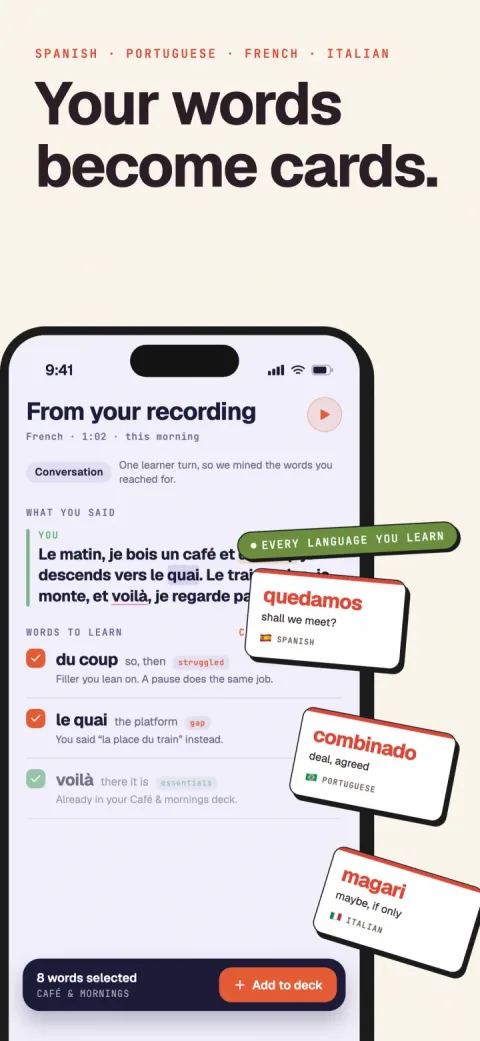
My own thing is the narrow case. Verbamor is an iOS app that works best next to the lessons you already take, though you don't need a tutor to use it. It turns the words from a lesson you've already paid for into fill-in-the-blank cards with spoken audio, scheduled by FSRS, in Spanish, French, Italian, Portuguese or Russian.
Beyond a starter deck of about 650 common words, it teaches you nothing new, which is the opposite of what Babbel is for. $19.99 a month, or $129.99 a year with a 7-day trial on the annual plan.
Both are US prices, read off the app's own plan definitions on 21 September 2026. The App Store sets a different number in other countries. There's no free tier, and Babbel has one, which is a real reason to start there instead.
If you're picking between them, the test is whether anyone is already teaching you. If nobody is, Babbel.
If someone is, the words you're forgetting are coming out of those lessons, and that's where the money leaks.
Sources
The efficacy studies
- Vesselinov, R., & Grego, J. (2016). The Babbel Efficacy Study. 32-page final report, downloaded and read 21 September 2026. Source for the 21-hour and 15-hour figures as printed in the executive summary, the 92% improvement rate, the WebCAPE placement test measuring vocabulary, reading and grammar, the initial sample of 391 and final sample of 325, and the funding disclosure on page 5: "This study was funded by Babbel but the data collection and the analysis were carried out independently by the Research Team."
- Babbel press release (29 September 2016). A Semester of Spanish in 15 hours. Read 21 September 2026. Carries the 15-hour headline and the 21-hour figure in its body. Names CUNY and the University of South Carolina; does not name the funder.
- Loewen, S., & Isbell, D. R. (2020). The effectiveness of app-based language instruction for developing receptive linguistic knowledge and oral communicative ability. Foreign Language Annals. Figures quoted from Michigan State University's own newsroom account, read 21 September 2026: 85 undergraduates, 12 weeks, 54 completing all requirements, and "59% of participants improved oral proficiency by at least one sublevel on the American Council on the Teaching of Foreign Languages proficiency scale," measured by an Oral Proficiency Interview.
What Babbel says about Babbel
- Babbel. How Babbel works, read 21 September 2026. Source for "Lessons are created by Babbel's in-house team of linguists and educators and are voiced by native speakers," the 5 to 10 minute lesson length with a 6-minute average, the speech recognition and scheduled review descriptions, and the 14 languages.
- Babbel. The Babbel method, read 21 September 2026. Names Yale, CUNY and Michigan State, and states that learners "improved their oral proficiency in the language they studied." Links the studies rather than giving figures.
- Babbel Help Center, Vocab workout: Review, and Benefits of learning with Babbel. Source for the six-step review ladder (one day, four, seven, 14, 60 days, six months), the "Weak, Medium or Strong" strength label, the line that "it is not possible to manually add random words or phrases to your review," the "all 100,000 hours of our content are voiced by native speakers" claim, and the free first lesson of every course. These articles return 403 to automated fetching; the quotes are carried from this site's verified competitor fact base, checked in a browser on 5 September 2026, rather than re-fetched today.
Scale and alternatives
- US Department of State, Foreign Service Institute. Category I languages, 24 to 30 weeks and 552 to 690 class hours, on "23 hours per week in class and 17 hours of self-study." Spanish and French sit at 30 weeks. Covered in full in the post on FSI's revised hours.
- Anki: free on desktop and Android, US$24.99 one-time on iOS, ships no language content of its own. FSRS is opt-in rather than the default, covered in the FSRS explainer.
What I could not verify, and the pages this argues with
- Every Babbel price. babbel.com/prices redirects to my.babbel.com, which renders its plan table client-side. Fetched 21 September 2026: a 1.2 KB document containing no dollar figure. No price appears on this page for that reason. The pages that print one are linked below, and I haven't endorsed their figures.
- Per-language course depth. Babbel's support centre returns 403 to automated fetching, so the claim that some of the 14 languages carry less content than others rests on Mezzoguild's first-hand account of Russian, attributed above rather than stated as fact.
- TestPrepInsight (updated 17 September 2026). Is Babbel Worth It in 2026? Read 21 September 2026. Quotes a monthly figure for the 12-month plan, scores Babbel "9.4/5" on a five-point scale, cites no study, and runs a discount code.
- Fluent in 3 Months (updated 25 June 2026). Babbel review. Read 21 September 2026. Quotes a different monthly figure for the 12-month plan, from a one-month trial of the Portuguese course. Cites no study.
Keep the words you already paid a tutor for.
Verbamor turns your lesson vocabulary into fill-in-the-blank cards with spoken audio, scheduled so they're still there next month.
Start 7 days free