 Verbamor
A semester in Peru buys about 300 hours of Spanish
A semester abroad buys about 300 hours of actual Spanish: the students Slagter and Pyper tracked in Spain, Peru and Honduras spoke 25.7 hours a week, about 9 of them in English, over 18 weeks. Two hours of audio a day plus 20 minutes of review at home reaches 294 in the same 18 weeks.
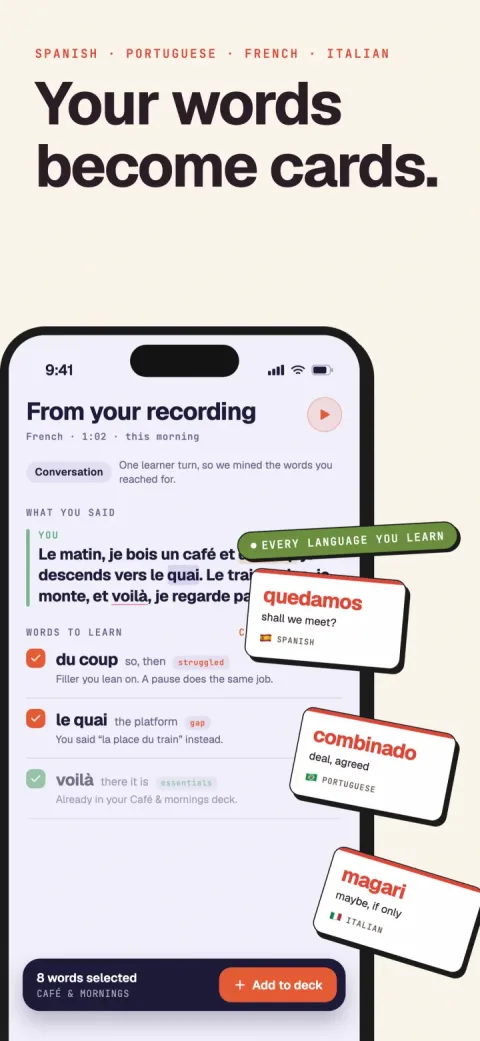
Verbamor turns the words from your own lessons and recordings into flashcards, and brings each one back before you’d forget it.

Cynthia Slagter and Marcie Pyper spent three years tracking undergraduates through semester-long Spanish programs in Spain, Peru and Honduras. Each program ran 18 to 19 weeks. Every student lived with a local host family, and every class was taught in Spanish.
Before leaving, 89.5% of them expected to come home at the Advanced level on the ACTFL proficiency scale (the US standard for rating how well someone speaks). Of those who took the test at both ends, 50% got there.
Then the researchers asked what had held the students back. The students ranked the barriers themselves, and the top-scoring one was their own personal choice to speak English with the other students in the group.
Living somewhere supplies four things, and you can buy three
Volume of contact. Hours per week with the language in your ears and in your mouth.
Stakes. You order the food or you don't eat. The sentence gets produced under time pressure, in front of a person who is waiting.
Variety of speakers. A bus driver, a landlord, a ten-year-old, a pharmacist. Different speeds, different accents, different slang.
No opt-out. The language is there when you're tired and when you'd rather not.
Three of the four ingredients are purchasable where you already live. The fourth one isn't, and no software hands it to you.
Why do people live abroad for years and stay stuck?
Because hours in a country only count when they're spent in the language. The Slagter and Pyper numbers show the size of the gap.
Their students reported an average of 25.7 total speaking hours per week. Of those, the average time spent speaking English ranged from just under six hours to 13 hours.
At the high end, half of every speaking hour was in the wrong language. That was inside a program where all classes and all official activities ran in Spanish. The students who reported less time in English showed the largest gains on the Versant Spanish Test.
The researchers named the mechanism linguistic loneliness. You have enough language to buy bread and not enough to say anything you mean. So conversations stay shallow, and you retreat to the people who can hear the real you.
One participant in Spain said she had avoided time with her host family because she wanted to be alone, and she knew it had cost her Spanish.
There's a second reason people stay stuck abroad, and it's the harder one. Input you can't parse teaches you nothing.
Sitting in a café where the conversation moves past your comprehension sounds the same as sitting at home with a radio on. The hours pile up and the vocabulary doesn't.
The students who never left the country beat the students who did. Freed, Segalowitz and Dewey (2004) compared 28 students of French across three settings.
The settings were an ordinary at-home classroom, a semester of study abroad, and a seven-week intensive summer program run inside the United States. They measured oral fluency at both ends on four things: total words spoken, length of the longest turn, rate of speech, and fluidity.
The domestic intensive group gained significantly on all four. The study abroad group gained on fluidity alone. The classroom group gained on nothing. The variable that separated them was reported hours of French use per week, in class and out of it.
Dan Dewey's companion 2004 study points the same way in a different skill. Comparing 15 learners of Japanese in Japan against 15 in a domestic intensive program, he found no significant difference between the two contexts in vocabulary knowledge gains.
Both studies are small. Freed's 28 students split three ways is roughly nine per condition, and Dewey ran 15 a side. Numbers that size tell you a direction, and they can't give you a dose.
They're enough to say that hours beat geography, and not enough to say by how much. So treat the arithmetic below as a plan. It's no prediction.
At home, 18 weeks can deliver 56% of a semester abroad
The Foreign Service Institute trains United States diplomats and publishes its own timeline. Spanish, French, Italian and Portuguese all sit in Category I, its easiest group: 552 to 690 class hours, with Spanish and French listed at 30 weeks.
The same page gives the weekly shape: 23 hours in class and 17 hours of self-study, which is 40 hours a week.
Now price the resident abroad. Take the Slagter and Pyper students at 25.7 speaking hours a week. Subtract the English at the midpoint of their reported range, call it 9 hours, and 16.7 hours a week are left in Spanish.
Over an 18-week semester, that's 300 hours. Against the FSI Category I band of 552 to 690 hours, a full semester of living in Peru delivers somewhere near half of the low end.
Now price yourself, at home, on a weekday. One hour of audio you can mostly follow, plus 20 minutes of review, is 1 hour 20 minutes. Seven days of that is 9 hours 20 minutes a week.
Multiply by 18 weeks and you get 168 hours. That's 56% of what the semester abroad delivered, for the cost of skipping television.
Push the daily audio to two hours and the same 18 weeks produce 294 hours, within a few hours of the semester in Peru. The plane ticket buys stakes and variety. It doesn't buy hours you wouldn't otherwise have spent.
Each ingredient has a stand-in you can start tonight
Volume of contact. Pick one 20-minute audio source you can follow at about 80% and play it three times: once cold, once while reading the transcript, once cold again. Do that once a day, which is the hour the arithmetic above counted.
The repeat pass is the part that matters, because it converts sound you didn't parse into language you did. Move up a level when the third pass feels easy.
Stakes. Book two paid 30-minute conversations a week with a tutor, at a fixed time, and pay in advance. Send this sentence before the first one: "Please do not switch to English, even if I stall for ten seconds. Wait for me."
That script exists because of the Slagter and Pyper result at the top of this post. Their students ranked their own choice to speak English as the single largest barrier. And the ones who reported the fewest English hours made the largest Versant gains.
English is the default that has to be refused out loud. A tutor is the one speaker you can hand that instruction to in advance.
Now the honest size of two tutor calls a week. Two 30-minute slots a week is 52 hours of speaking across a year, and 18 hours over an 18-week stretch.
Set that against the 300 speaking hours the semester in Peru delivered and it's 6%. Against the 168-hour home plan above, it's about a tenth.
Two calls a week doesn't replace living somewhere. It buys the one ingredient the audio plan supplies none of, at the only price anyone actually pays it.
On cost, italki states on its own Spanish tutor page that tutors "cost between $4 to $60 per hour." It adds that "a 30-minute Spanish lesson typically costs between $4 and $10."
I read 21 Spanish trial listings on 22 August 2026. The median (the middle price) was $12 and the spread ran $5 to $25, so a standing hour realistically sits around $10 to $30.
I leave Preply unquoted on purpose. It publishes no per-hour rate on its own pages, and the third-party figures floating around can't be checked, so no number belongs in this sentence.
What Preply does confirm, in its help centre, is the billing shape, and it matters for a fixed weekly slot. Subscriptions run in 28-day cycles tied to one tutor, with a minimum of four lessons. Lessons you don't schedule before the renewal date expire instead of carrying over.
Variety of speakers. A single host trains you to understand one person, so rotate four voices: three recorded sources plus the live tutor you booked above.
Run them Monday through Thursday. Repeat the two you understood least on Friday and Saturday, and on Sunday replay the hardest clip of the week with its transcript. The recorded three, by language:
- Spanish. Telediario 1 on RTVE Play for scripted broadcast speech. Easy Spanish on YouTube for unscripted street interviews, with Spanish and English subtitles. Radio Ambulante, the NPR narrative podcast, which publishes a full Spanish transcript with every episode and rotates accents across Latin America.
- French. Journal 20h00 on France TV, plus Easy French.
- Italian. TG1 on RaiPlay, plus Easy Italian.
- Portuguese. Telejornal on RTP Play. Easy Portuguese is the gap. Checked on 23 August 2026, its most recent upload was 4 January 2025. So treat it as a back catalogue, and find a live third source instead of counting on new episodes.
No opt-out. Missing one day costs almost nothing. Lally and colleagues (2010) followed 96 volunteers performing a chosen daily action in a fixed context for 12 weeks.
They found automaticity (doing it without deciding to) plateaued at a median of 66 days, across a range of 18 to 254. And they report that missing a single opportunity did not materially affect habit formation.
So set the threshold at two: one missed day is free, two in a row is a break. On any day you'd skip, run one five-minute pass of yesterday's audio instead of nothing, because the study measured whole omissions, not five-minute versions.
The external party who notices is the tutor you prepaid on a fixed weekly slot. A person expecting you at 19:00 on Tuesday is the only substitute for compulsion in this list. If the daily habit has collapsed on you twice, buy more of that hour and less of everything else.
After every tutor call and every hard audio pass, write down the words that stopped you. Ten a week, kept and reviewed, is 520 a year.
Words that stop you in a real conversation are worth more than any published word list, because you've already met them once under pressure.
Verbamor handles the last step, and it gives you no conversation partner
Verbamor is an iOS app for the last instruction in that list. You record a tutor call or import audio you already have.
It transcribes the audio, picks out each word and phrase that actually came up, and schedules the ones you keep for review.
Here's what Verbamor doesn't do. It has no course, so beyond its Essentials deck of roughly 650 common words, there's nothing to study until you feed it audio. It's iOS only. It teaches Spanish, French, Italian, Portuguese and Russian and no others.
It doesn't give you a conversation partner, which is the stakes ingredient and the expensive one.
And there's no free tier. Native is US$129.99 a year, which works out to about $10.83 a month. Explorer is US$19.99 a month, and the 7-day free trial exists on the annual plan only.
The concession: if you're moving abroad anyway for work or family, none of this argues against going. Arrive with enough words to be a person instead of a customer, because the students who stayed shallow are the ones who slid into English.
Tonight, open one 20-minute audio file in your language and play it three times, the middle pass with the transcript in front of you.
Then book the first tutor slot for a named day and hour this week, and pay for it now. It's the ingredient you can't supply yourself.
Buy the hours. Skip the plane ticket.
Verbamor turns a recorded tutor call into transcribed vocabulary and scheduled review, so the hours you can find at home count the same way a semester abroad's did.
Start 7 days freeThe 7-day free trial is on the yearly plan.