 Verbamor
Ebbinghaus never said you forget 90% in a week
Ebbinghaus's own Chapter VII table says 25.4% still survives at 6 days, and solving his published equation for 90% forgotten returns 5,309 years. The 90% figure every flashcard company prints comes from reading his savings score, a measure of relearning effort in seconds, as if it were a count of words recalled.
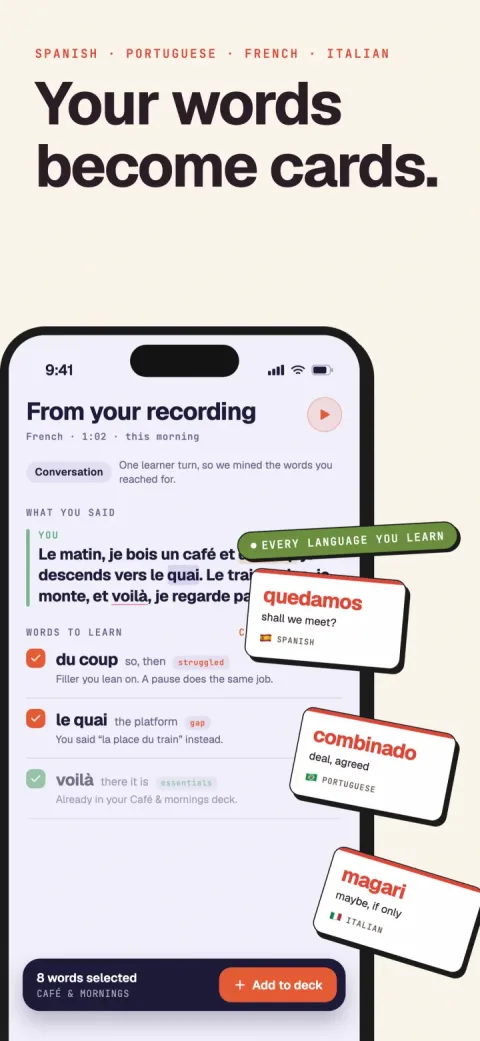
Verbamor turns the words from your own lessons and recordings into flashcards, and brings each one back before you’d forget it.

You've read the sentence. Some version of it opens every flashcard app's science page.
Within an hour you forget half. Within a day, 70%. Within a week, 90%. Ebbinghaus, 1885.
I read Chapter VII. Two of those numbers are close enough to defend. The third is off by a factor I checked twice.
Ebbinghaus published an equation. Solve it for 90% forgotten and you don't get a week.
Ebbinghaus's equation returns 5,309 years.
01 / 06Both pages printing the 90% give no source for it
StudyCards AI, a flashcard company, on 3 September 2026:
His findings revealed a harsh truth: we typically forget approximately 70% of what we learn within 24 hours and up to 90% within a week if there's no active effort to retain it.
studycardsai.com, "The Forgetting Curve"StudyCards AI publishes a second page, "Exact Retention Percentages," which gets the measure right. Ebbinghaus "used a 'savings score': he measured how much less time it took to relearn the same list after a delay," with "33% remains accessible" at 24 hours.
Two pages, one site. The 90 appears only on the page that skips the definition.
TalentCards runs the same 50/70 opener and then swaps the window: "people tend to forget up to 90% of what they've learned within a month." Same 90, different deadline, no source given for either.
DigitalEd, the same day, prints "up to 50%" at an hour and "around 70%" at 24 hours. Then it says learners "often retain only about 25% of what they studied" by the end of the week.
That 25 is right, and it sits three sentences from the same borrowed opener.
And Wikipedia's forgetting curve article has been flagged since December 2018 as needing more citations. It carries the sentence that explains the whole mess: "'Savings' is thus, analogous to retention rate."
That single word, analogous, is where a measure of relearning time became a percentage of words you can say.
02 / 06His own table never reaches 10%, at any interval
Ebbinghaus's full text is free. Chapter VII of the 1913 Ruger and Bussenius translation sits on York University's Classics archive.
The table lives in Section 28 as a scanned image. That's probably why so few people quoting the curve have looked at it.
Here's every row of it. Q is his savings percentage: how much of the original learning time he saved the second time. v is his own column for the rest, which he called the amount forgotten.
| After X hours | Qsavings % | vhis "amount forgotten" % | P.E.mhis probable error |
|---|---|---|---|
| 0.33about 19 minutes | 58.2 | 41.8 | 1 |
| 1 | 44.2 | 55.8 | 1 |
| 8.8 | 35.8 | 64.2 | 1 |
| 241 day | 33.7 | 66.3 | 1.2 |
| 482 days | 27.8 | 72.2 | 1.4 |
| 1446 days | 25.4 | 74.6 | 1.3 |
| 74431 days | 21.1 | 78.9 | 0.8 |
Read the 6-day row. 25.4% saved, 74.6% forgotten. The claim says 90 and 10.
You don't have to trust my reading of a scan, either. He summarises the same table in prose, one paragraph into Section 29:
One hour after the end of the learning, the forgetting had already progressed so far that one half the amount of the original work had to be expended before the series could be reproduced again ... After 24 hours about one third was always remembered; after 6 days about one fourth, and after a whole month fully one fifth of the first work persisted in effect.
Ebbinghaus 1885, Chapter VII, Section 29, paragraph 1One fourth at 6 days, in his own sentence. And look at what he says the half at one hour is: "one half the amount of the original work had to be expended."
Work. He's describing a bill for relearning, and it got copied down as a headcount of lost words.
Then read the last row. After a full month, Ebbinghaus still measured 21.1% savings.
His data never reaches 10% at any interval he tested, including one 5 times longer than the week the claim is about. So the 90 has no row to have come from.
Score the other two folklore numbers while we're here. He measured 55.8% forgotten at an hour against a claimed 50, and 66.3% at a day against a claimed 70.
Both are within about 6 points and in the right direction. The set is two-thirds honest, which is why the third goes unchecked.
03 / 06Savings counts the seconds it takes to relearn a list
Ebbinghaus never tested how many syllables he could produce. He learned a list to two perfect recitations, waited, then learned it again, timing both.
His Section 28 definition is Q = 100D / (L - 85), where L is seconds of original learning and D is the difference.
Seconds. The unit is seconds.
Murre and Dros reran the whole experiment in 2015. They put the consequence about as bluntly as a journal will allow:
In theory it is, therefore, possible in extreme cases that there are subjects who can learn a row of 13 syllables in a single learn-recall trial but who subsequently always forget the learned materials in say 10 min. By conventional (non-savings) retention tests, these subjects would be reported as have 0% retention past 10 min, but these same subjects would show 100% savings for all retention intervals past 10 min.
Murre & Dros 2015, PLOS ONE, discussing the savings methodZero percent recall and 100% savings, in the same person, on the same material.
Murre and Dros's concluding remark names what savings is closer to. Ebbinghaus's method "can also be seen as a precursor to implicit memory tests," picking up traces "which cannot be recalled or recognized but that do show savings." (An implicit memory is one that still speeds you up even when you can't bring it to mind.)
Cannot be recalled. The measure exists to detect the memories a flashcard scores as a failure.
The honest reading: after 6 days, Ebbinghaus needed about three quarters of his original study time to get a list of nonsense syllables back to perfect.
That's the finding. "You can say 25% of the words" isn't in it.
04 / 06How long does Ebbinghaus's equation take to reach 90% forgotten?
About 5,309 years, if you push his own equation that far. Ebbinghaus fitted a curve to his seven points and published it in Section 29, with both constants:
b = 100k/((log t)c+k) k = 1.84 c = 1.25
Ebbinghaus 1885, Chapter VII, Section 29. t is in minutes, from one minute before learning endsI couldn't find anyone who had solved Ebbinghaus's equation for the number everyone quotes, so here's that arithmetic. Check it yourself.
The constants are his. The algebra is a bisection: guess a time, see which side of the target it lands on, halve the gap, and repeat.
First I checked that Ebbinghaus's equation reproduces his own printed column. He publishes calculated values of 57.0, 46.7, 34.5, 30.4, 28.1, 24.9 and 21.2.
Recomputing from the constants gives 57.0, 46.8, 34.5, 30.4, 28.1, 24.9, 21.2. The largest disagreement is 0.07 of a percentage point, which is his rounding.
Then I inverted it. Set b to 10, meaning 90% forgotten, and solve for t.
Two of the three solved figures land almost on top of the folklore. 43 minutes for the half, 1.1 days for the 70. Somebody, somewhere, did read the curve.
The third, 90% forgotten, is out by a factor of about 277,000 against a 7-day week. His function decays in the logarithm of time, so each step down takes far longer than the last.
Losing 90% of savings on a curve that flat takes a geological era. Anyone who plotted it would have watched the tail go horizontal and stopped.
The honest caveat, stated plainly because it cuts against my own headline: 5,309 years says nothing about human memory. It's what happens when you push a 7-point fit 60,000 times past its longest measurement. The man who wrote Section 29 would have refused to do that.
The point is narrower and sharper. On his own published curve, 90% forgotten and one week never meet, even with generous rounding.
05 / 06Four subjects, a century apart, and the lowest is 16.8%
The obvious objection: one man in the 1880s, so who cares what his table says. Fair, and it has an answer.
Murre and Dros ran a full replication in 2015, open access in PLOS ONE: one subject, 70 hours on the same protocol. Their Table 3 puts four savings curves side by side. They're Ebbinghaus, Mack and Seitz from a German replication rarely cited in English, and their own subject, Dros.
| Interval | Ebbinghaus1880s | Mackreplication | Seitzreplication | Dros2015 |
|---|---|---|---|---|
| 1 day | 0.337 | 0.316 | 0.270 | 0.317 |
| 2 days | 0.278 | 0.365 | 0.286 | 0.230 |
| 6 days | 0.254 | 0.309 | 0.205 | 0.168 |
| 31 days | 0.211 | 0.258 | 0.201 | 0.041 |
At 6 days: 0.254, 0.309, 0.205, 0.168. The mean is 0.234.
The lowest of the four is 0.168, still 1.7 times the 0.10 the folklore claims. And that lowest value belongs to the subject Murre and Dros themselves flag as anomalous at the long end.
Four people, a century apart, in two languages. None of them lands anywhere near 10% at a week.
The replication turned up something the myth also flattens. Savings at 1 day and 2 days sit above the fitted curve in all four panels, by at least one standard error.
Murre and Dros conclude the curve "is not completely smooth but does show a jump at the 1 day retention interval." The sleep literature predicts that jump. But they're careful to say this experiment doesn't establish sleep as the cause.
A curve with a bump in it after your first night makes a worse slide and a better fact. It says the review you do tomorrow morning lands on a memory that just got stronger. We have a separate post on the sleep half of that.
06 / 06Ebbinghaus refused to call his own curve a law
The last thing worth quoting is Ebbinghaus on his own results, since the pages citing him as a universal law never do.
Considering the special, individual, and uncertain character of our numerical results no one will desire at once to know what "law" is revealed in them.
Ebbinghaus 1885, Chapter VII, Section 29, opening his discussionAnd immediately after publishing the equation, in the same section:
Of course this statement and the formula upon which it rests have here no other value than that of a shorthand statement of the above results which have been found but once and under the circumstances described. Whether they possess a more general significance so that, under other circumstances or with other individuals, they might find expression in other constants I cannot at the present time say.
Ebbinghaus 1885, Chapter VII, Section 29Ebbinghaus calls his own curve a shorthand, and says he can't tell you whether the constants hold for anybody else.
Then he opens Section 30 with "even though only for my own case" and spends it checking two of his seven numbers against older tests. That's more caution in one chapter than the pages quoting him manage in a decade.
Ebbinghaus was learning nonsense syllables at 0.4 seconds a syllable, then timing how long it took to get back to perfect. You're learning Spanish words that mean things, hooked to sentences and a person who said them to you.
Whatever survives that trip survives as a shape. And a shape doesn't go in a headline as a percentage.
So what should you take? The curve is steep early and flat late, and that much has replicated four times. Reviewing sooner beats reviewing later.
That's the whole transferable finding. It's the same one retrieval practice and every modern scheduler already run on. They fit it to real review logs, where Ebbinghaus had seven points from one man's evenings.
Verbamor is one of the apps that cites this curve, so the correction is aimed at me too. What we do with it is narrow: cards built from your own lessons, scheduled by FSRS.
FSRS is an open-source scheduler. It learns your intervals from your actual answers, so it never assumes Ebbinghaus's constants apply to you.
If you keep your own Anki deck, it runs the same algorithm family for free, and a deck you maintain beats a subscription you abandon. I'd rather you use the numbers on this page to check my marketing than to trust it.
Sources
The primary text
- Ebbinghaus, H. (1885). Memory: A Contribution to Experimental Psychology, trans. Ruger & Bussenius (1913), Chapter VII. Section 28 gives the savings table (58.2, 44.2, 35.8, 33.7, 27.8, 25.4, 21.1 at 0.33, 1, 8.8, 24, 48, 144 and 744 hours) with his own "amount forgotten" column and probable errors, and defines Q = 100D/(L-85) in seconds of learning time. Section 29 gives b = 100k/((log t)^c + k), k = 1.84, c = 1.25, the observed-vs-calculated table, and both disclaimers quoted above. Section 29 also summarises the table in prose: "After 24 hours about one third was always remembered; after 6 days about one fourth, and after a whole month fully one fifth of the first work persisted in effect," and describes the one-hour figure as "one half the amount of the original work had to be expended." Section 30 opens "even though only for my own case." The tables are scanned images in this edition; values read from table23.jpg and table24.jpg. Retrieved 3 September 2026.
The replication
- Murre, J. M. J. & Dros, J. (2015). Replication and Analysis of Ebbinghaus' Forgetting Curve. PLOS ONE 10(7): e0120644. Table 3 carries all four savings columns quoted above. The 0% recall / 100% savings example is from the Discussion; "a precursor to implicit memory tests" and "cannot be recalled or recognized but that do show savings" are from the Concluding Remark; the 1-day jump finding and its sleep caveat are from "The 24-hour point in Ebbinghaus' forgetting curve". Open access, CC-BY. Retrieved 3 September 2026.
The pages printing the claim
- StudyCards AI, The Forgetting Curve: "we typically forget approximately 70% of what we learn within 24 hours and up to 90% within a week." No source cited. Retrieved 3 September 2026.
- StudyCards AI, Ebbinghaus Forgetting Curve: Exact Retention Percentages, the same site contradicting itself: Ebbinghaus "used a 'savings score': he measured how much less time it took to relearn the same list after a delay compared to the original learning session," and "approximately 67% of newly learned material is forgotten within 24 hours ... Only about 33% remains accessible." Retrieved 3 September 2026.
- TalentCards, What is the Ebbinghaus forgetting curve?: "within an hour of learning new information people tend to forget up to 50% of it. Within 24 hours, this can increase to 70%. By the end of the week, people tend to retain only about 25%", and separately "people tend to forget up to 90% of what they've learned within a month." Retrieved 3 September 2026.
- DigitalEd, The Forgetting Curve: "up to 50%", "around 70%", and "learners often retain only about 25% of what they studied." The 25 is right. Retrieved 3 September 2026.
- Wikipedia, Forgetting curve: "'Savings' is thus, analogous to retention rate." The article has carried a "needs more citations" banner since December 2018. Retrieved 3 September 2026.
The arithmetic
- Verification of the fit: recomputing b at t = 20, 64, 526, 1440, 2880, 8640 and 44640 minutes with k = 1.84, c = 1.25 returns 57.0, 46.8, 34.5, 30.4, 28.1, 24.9, 21.2 against his printed 57.0, 46.7, 34.5, 30.4, 28.1, 24.9, 21.2. Maximum disagreement 0.07.
- Inversion: b = 50 at t = 43 minutes, b = 30 (70% forgotten) at t = 1,614 minutes or 1.1 days, b = 10 (90% forgotten) at t = 2,792,589,255 minutes, which is 1,939,298 days or 5,309.5 years. Solved by bisection on his published constants. Against a 7-day week (10,080 minutes) that is a factor of 277,043; against his longest measured interval of 31 days it is 62,558. This is extrapolation far beyond his data and is a fact about the equation rather than about memory.
- Six-day savings across the four subjects in Murre & Dros Table 3: 0.254, 0.309, 0.205, 0.168, mean 0.234. Lowest value is 1.68 times the 0.10 the folklore claims. Ebbinghaus's 31-day savings of 0.211 is 2.11 times the 0.10 claimed at one week.
Intervals fitted to how you actually do.
Verbamor turns the vocabulary from your own lessons into scheduled retrievals, with intervals FSRS learns from how you actually do.
Start 7 days freeThe 7-day free trial is on the yearly plan.