 Verbamor
Duolingo Italian review: what level it gets you to in 2026
Duolingo's Italian course now teaches content through CEFR B2, up from A2 before April 2026. That's how far the course goes. How far you go comes down to hours, and Duolingo publishes none. If a tutor already teaches you Italian, the Italian flashcards guide is the better next read.
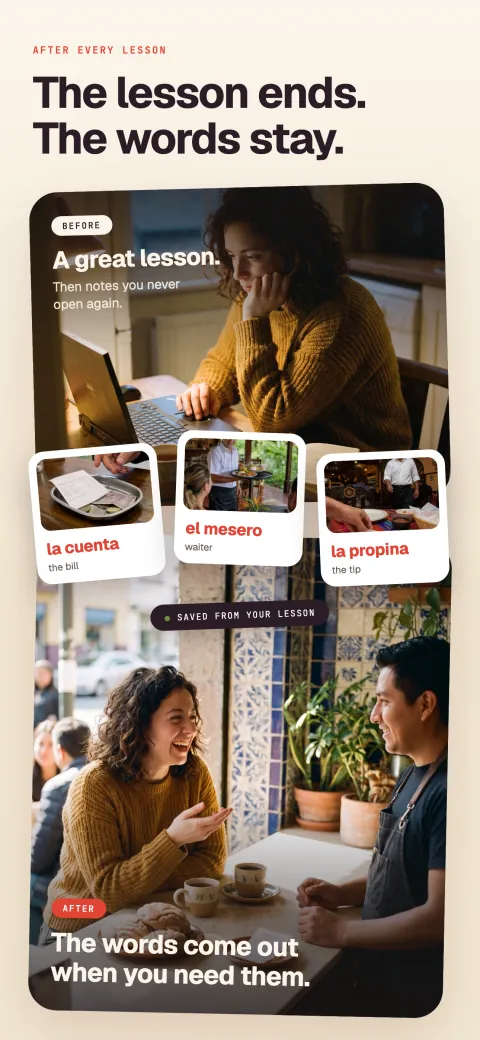
Verbamor records your lesson and turns what your tutor taught into cards that come back on schedule.

Duolingo Italian now gets you through CEFR B2 content, a Duolingo Score of 129. Until 22 April 2026 most learners could only finish A2 content (Score 59). So the course now goes two CEFR levels further, by Duolingo's own scale. What it can't tell you is how many hours of it make you speak Italian.
I build a paid app for people who take lessons, so I have a stake here. For a beginner, my answer is still Duolingo, and I'll show why.
What level does Duolingo Italian get you to?
B2, on paper. Italian is one of nine courses Duolingo expanded on 22 April 2026, alongside Spanish, French, Portuguese and five others. The post says learners "can now learn through B2 on the CEFR scale, or a Duolingo Score of 129."
B2 is the fourth of the six CEFR levels. Duolingo describes someone there as an "independent user" who can "express your viewpoints on a wide range of topics." It also says you "might not understand everything you hear or read 100% of the time." That's a fair description, and more honest than most app marketing.
But be clear about what B2 means here. It's the level the Italian content reaches. Duolingo hasn't published how many Italian learners finish that content, or a test of what they can say afterwards.
A review telling you Duolingo Italian "only gets you to A2" was accurate before April 2026. If you read one, check its date.
The course got longer, and the hours to speak Italian didn't shrink
The US Foreign Service Institute puts Italian in its easiest group for English speakers. Its estimate for that group is 552 to 690 class hours, on a week of 23 hours in class plus 17 hours of homework. That's to professional working level, which means doing your job in Italian.
Duolingo's course page sells "5 minutes a day." So here's some rough arithmetic, mine, using FSI's lower figure.
At 5 minutes a day, 552 hours takes about 18 years. At 30 minutes a day, it's about 3 years. Class hours and app minutes aren't the same thing, so treat those two figures as scale only.
Five minutes a day keeps a streak alive. It won't move you through 552 hours of Italian at any useful speed.
Keep Duolingo. Count minutes instead of streak days, and add the kind of minutes Duolingo can't give you: Italian spoken at you by a person.
Is Duolingo Italian enough for a trip to Italy?
For a trip in six weeks, probably not, and the reason is order. A course teaches Italian in the sequence its designers picked. Your trip needs the train station, the menu and the bill, in roughly that order.
If the trip is the goal, learn the 100 words worth learning before a trip first and keep Duolingo for the habit. If you're learning Italian for the long run, the course order is fine and you can ignore this section.
For a beginner, free Duolingo beats every paid option
Duolingo is the right first Italian app for most people, mine included in the comparison. Here's why, plainly.
- Free. The core course costs nothing. It has ads, and Energy caps how many lessons you do in a row.
- Big. Duolingo listed 10.2 million learners on its Italian course on 13 October 2026.
- Everywhere. It runs on the web, iPhone and Android. Verbamor runs on iPhone and iPad only.
- A path to follow. Verbamor has no course and no grammar lessons, so it can't start you from zero.
Super Duolingo, the paid tier, removes the ads and the Energy limit. The US App Store listing shows a 14-day free trial and six Super prices between $9.99 and $119.99, none labelled with a term. I've put all six prices in one place.
You don't have Italian lessons yet
Start the free course and give it a few months. Paying for anything before you know you'll keep going is the expensive mistake, and Duolingo lets you find out for free.
When it feels easy, add a tutor and keep what they say
A tutor is the next step once the lessons stop being hard. On 21 September 2026, the first 20 one-hour Italian rates on italki had a median of $23.50. The full breakdown is in the best app to learn Italian, with every price I could check.
The tutor solves speaking. Then a new problem shows up: by next week, half of what the tutor taught you is gone. That's normal forgetting, and the fix is to be tested on those words on a schedule.
Verbamor is built for that one job. You record the lesson, or type a phrase into Translate, and it makes Italian cards with an example sentence, generated audio and an image. A scheduler called FSRS picks when each card comes back. There's also a starter deck of about 650 common Italian words.
It costs $19.99 a month, or $129.99 a year, and only the yearly plan has the 7-day trial. Those are US prices. If you don't have lessons or Italian conversations yet, stay on free Duolingo.
Duolingo Italian questions, answered short
Is Duolingo actually good for Italian?
Yes, for a beginner. The Italian course is free to start, it's big (10.2 million learners on Duolingo's own count in October 2026), and its content now runs through CEFR B2. It's weaker on speaking: you see most sentences before you say them. Pair it with a person to talk to once the lessons stop feeling hard.
What level does Duolingo Italian get you to?
The content reaches B2, a Duolingo Score of 129, since Duolingo expanded nine courses on 22 April 2026. Before that, most learners could only complete content up to A2, Score 59. That's the ceiling of the course. Duolingo hasn't published how many Italian learners reach it, or what they can do in conversation when they do.
How long does it take to finish Duolingo Italian?
Duolingo doesn't publish an hour count for finishing the Italian course, so treat any number you read as a guess. For scale, the US Foreign Service Institute puts the group Italian belongs to at 552 to 690 class hours, at 23 hours of class a week, to reach professional working level.
What's the best free app for learning Italian?
Duolingo, for a structured course. Anki, if you want to keep your own words for free on a computer or an Android phone. Anki ships no Italian content, so you build or download the cards. For speaking, nothing free replaces a person, and an italki hour is the cheapest paid step.
Sources
What Duolingo publishes
- Duolingo Blog, 22 April 2026. Our top courses now teach advanced content. Read 13 October 2026. Source for the nine courses, B2 and Score 129, the old A2 and Score 59 ceiling, and the quoted description of B2.
- Duolingo, Courses for English speakers, read 13 October 2026, for the 10.2M Italian learner count. The Italian course page for "5 minutes a day".
- Apple App Store, Duolingo US listing, read 24 September 2026, for the trial and the six Super prices.
Hours
- US Department of State, Foreign Service Institute, Foreign Language Training. Category I at 24 to 30 weeks and 552 to 690 class hours, on 23 class hours and 17 self-study hours a week. The 18-year and 3-year figures are my arithmetic on 552 hours.
Prices
- italki Italian directory, the first 20 listed one-hour rates, read 21 September 2026. Median $23.50.
- Verbamor's prices are read off the app's own plan definitions on 21 September 2026. US prices; other App Store regions differ.
Your Italian lesson ends. The words don't have to.
Record the lesson or type a phrase, and Verbamor builds the Italian cards and schedules them. Paid, on iPhone and iPad.
Start 7 days freeThe 7-day free trial is on the yearly plan.